Serge Lutens — La Myrrhe
Essence
La Myrrhe is the fragrance that took the most penitential, medicinal, soapy-cold resin in the perfumer’s palette - myrrh - and wrapped it in a fizzing, hairspray-bright veil of vintage-style aldehydes, then sweetened the whole thing with honey, bitter almond and candied mandarin. Composed by Christopher Sheldrake for the Les Salons du Palais Royal Shiseido line (the original “bell jar” exclusives that became the Serge Lutens brand proper), it is the closest thing the Lutens canon has to a reworked Chanel No. 5: an aldehydic floral whose familiar opening is detonated and reassembled around a single, exaggerated raw material. What makes it distinctive is the dissonance - most Lutens fragrances are warm, dried-fruit-and-cedar “stews,” but La Myrrhe is cold, statuesque, and architectural, recognized instantly but, as one reviewer put it, “never quite grasped.” It is widely regarded as one of the high-water marks of the Lutens/Sheldrake partnership and was awarded (“masterpiece”) in Luca Turin and Tania Sanchez’s guide.
Scent Profile
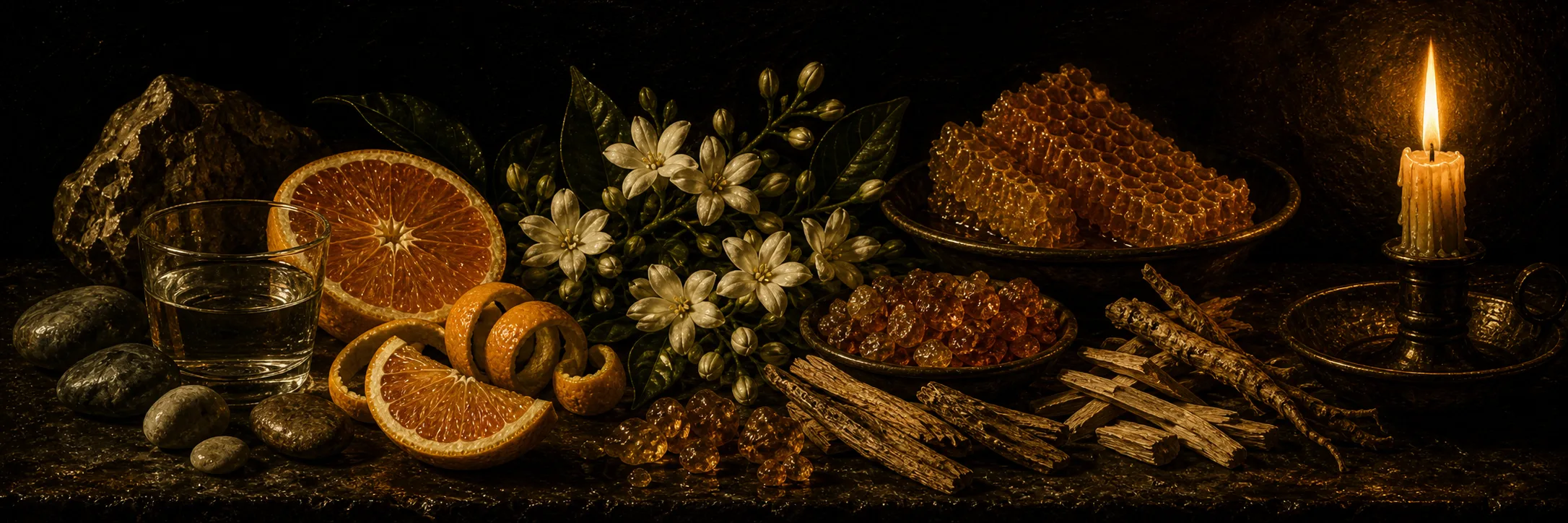
The opening is genuinely confrontational: a blast of fatty, fizzy aldehydes that multiple wearers compare to cheap vintage hairspray, aerosol, or even pesticide for the first few seconds, laid over a sharp, astringent myrrh and a “dark,” slightly bitter mandarin. Sprayed, it is described as so carbonated and aldehydic it “takes up all the air in the room”; this is the central reason the wearers near-universally advises dabbing rather than spraying. Within roughly fifteen to thirty minutes the cold-shower opening recedes and the heart emerges: a sheer, floaty jasmine and a soapy floral labelled “lotus” (read by several noses as heliotrope), an anise/licorice facet that frames myrrh’s medicinal side, and the famous “root beer” tonality - myrrh’s natural sarsaparilla-like sweetness boosted by honey and bitter almond into something that recalls amaretto, ouzo, or sambuca. The drydown is the most conventionally “beautiful” phase: creamy sandalwood, soft amber, a perfumy musk, and the resin finally turned warm, sweet and balsamic, often reading as a skin scent. The signature accord is myrrh-as-aldehydic-floral - cold resin made to “sparkle and fizz like champagne,” in Lutens’s own words. Linearity is low to moderate: it is a transformer, lurching from harsh to soapy to gourmand-resinous, but the arc resolves “from discord to accord.” Perceptible throughout: aldehydes, myrrh, almond/honey sweetness, licorice. Submerged: the named jasmine, lotus and pimento, which most wearers detect only as supporting texture.
Performance
Wearer accounts on longevity are bimodal but skew long: many report 12-plus hours and detect it on skin and clothing the next day, while a minority with reactive skin chemistry get only “a few hours.” Projection is moderate and intentionally so - the aldehydes give an initial loud, “screechy,” room-filling burst that then collapses inward toward a skin scent in the later hours. Sillage is strongest in the first hour and intimate thereafter. The overwhelmingly repeated application strategy is to DAB, not spray: sprayed, the aldehydic top is “abrasive,” “metallic,” and overwhelming; dabbed, the harsh opening is muted and the composition blooms more gracefully. Weather behavior is a known issue - multiple longtime wearers say it performs best in cold, dry conditions (one wears it only under 60F; another finds “any hint of humidity and it’s just ‘off’”), associating it with first snow and winter chill, though Bois de Jasmin and others wear it as an autumn scent. Apply lavishly-but-dabbed in cool weather for the intended effect.
Wearing Context
This is a cold-weather, contemplative fragrance: autumn and winter dominate, with frost or first snow cited repeatedly as ideal. Time of day skews evening and “nocturnal” (Lutens framed myrrh here as “the fragrance of the night”), though its soapy-clean facets make it wearable in daytime cold. Occasions are introspective and personal rather than crowd-pleasing - it is repeatedly described as meditative, “church”-like, even liturgical, evoking incense through stained glass. It is fully unisex in the Lutens “aloof elegance” mode, though its midcentury-aldehyde DNA reads feminine-classic to some men, who report wearing it at home rather than out. Social-perception skew: this is a connoisseur’s fragrance, not a compliment-getter; several reviewers explicitly warn it is “not for someone new to perfumery” and that the Paris Exclusives are “so much more complicated” than the export line.
Comparisons & DNA
The dominant comparison, made by essentially everyone including Turin/Sanchez, is Chanel No. 5 - La Myrrhe is repeatedly called “No. 5’s phantom zone” and a “different take on the famous No. 5,” because Sheldrake (who has worked with Chanel) deploys the same aliphatic-aldehyde brightness. Tania Sanchez specifically compares it to Estee Lauder White Linen - “Lutens and Sheldrake set the smoky balsamic resin known as myrrh against a radiant, rosy, modern aldehydic floral of incomparable crispness, akin to White Linen” - and to Guerlain Shalimar, writing that “by this unexpected route, the fragrance somehow manages to replicate the thrilling balance of incredible brightness and sweetness that Shalimar once had.” Within the house, it is the aldehydic sibling to other “single material exaggerated” Lutens compositions - Tubereuse Criminelle, Bois de Violette, Borneo 1834 - but it stands apart from the cola-thick ambers and chocolate-patchouli the brand became known for post-2000 (Chergui, etc.). Bois de Jasmin draws a delta against Caron Parfum Sacre (also myrrh-containing but “far denser”). Among myrrh specialists, wearers contrast it with Annick Goutal Myrrhe Ardente (which shares the root-beer facet but is warmer), Eau d’Italie Baume du Doge, and Jo Malone Myrrh & Tonka. The key delta versus all of these: La Myrrhe is colder, soapier, fizzier and more dissonant up top, and far less “smoky incense” than its name suggests - as one wearers reviewer warns, “don’t reach for this perfume expecting myrrh smoke; you won’t find it.” It reads more as a jasmine-amber than a myrrh-forward scent to many.
Reception
Critical consensus is reverent: Bois de Jasmin (Victoria Frolova) calls it among her top favorites and “one of the most intriguing compositions” of the Lutens/Sheldrake partnership; a Cafleurebon contributor dubs it a “Modern Masterpiece spotlighting Myrrh with a capital M as the crown jewel”; Turin and Sanchez gave it. reception (wearers) is sharply more polarized, and that polarization is the story: the love-it/hate-it axis runs entirely through the aldehydic-soapy opening. Detractors call it “Robitussin,” “cheap soapy smell,” “boiled celery, soap and licorice,” headache-inducing, or “screechy,” and several admit they “wanted to be in the La Myrrhe ‘club’” but couldn’t wear it. Admirers describe a “gothic masterpiece,” a meditative, mind-warping beauty, and “one of the best Sheldrake has created.” Common praise: originality, the root-beer/honey-almond drydown, complexity, and longevity. Common criticism: the harsh opening, skin-chemistry sensitivity (some pull only metallic aldehydes and musk), and reformulation losses. Blind-buy verdict: NOT blind-buy safe - the near-unanimous advice is to sample first (ideally dabbed), as it is one of the most divisive and skin-dependent fragrances in the entire Lutens line. As one Bois de Jasmin commenter summarized, “I would never encourage anyone to buy blindly from this line.”
Versions & Reformulation
La Myrrhe has been reformulated over its 30-year life, and this is a live wearers topic. Wearers comparing an older Palais Royal bell jar against a circa-2013 bell jar report them as “very different”: the older version is heavier on myrrh, softer, with a more beautiful mandarin note, while the newer is much heavier on aldehydes (more overtly No. 5-like) with the myrrh “drowned out by spices” and overall more potent. A detailed wearers account describes the modern base as “compressed” - the original’s broad, vibrating “harmonic” hum of myrrh and woods reduced to a narrower “din,” part of a general softening/quieting of the Lutens classics over the last decade-plus (paralleling Feminite du Bois). Some attribute the bigger shifts to the Shiseido buyout era (~2015-16), though at least one wearer believes reformulation predates that. Packaging has tracked the brand’s evolution: white Les Salons du Palais Royal Shiseido labels early black labels with Lutens’s name and the salon doors the modern Serge Lutens logo. La Myrrhe has, by most accounts, always lived in the bell jar and was never released in the taller “export” bottles. Note a catalog discrepancy: the catalog lists this as 50ml EDP, but the canonical format is the 75ml bell jar; a 50ml export-style spray existed at points and Lutens’s site has sold the 75ml bell jar, so size/format varies by era and region.
Acquisition Notes
Availability varies by market; sample before buying when possible.
Notable Facts & Lore
- La Myrrhe (1995) was one of the more notable launches in the original Les Salons du Palais Royal Shiseido collection - the line, effectively Serge Lutens by proxy, headquartered at what is now the brand’s Paris flagship in the Jardin du Palais Royal, and the birthplace of the iconic bell jars.
- The name means simply “The Myrrh,” and Lutens leaned into the resin’s biblical and mythological weight.
- His own house copy is famous and is quoted across nearly every review: “Forgive this fragrance, because it knows not what it does!
- You know about myrrh and the Three Kings.
- What you don’t know is that, here, myrrh takes on the fragrance of the night.
- I make it sparkle and fizz like champagne, sustained by a base note of mandarin orange.“ The brand’s later mythology ties the name to the Greek myth of Princess Myrrha, cursed by Aphrodite to desire her father and transformed by the gods into the myrrh tree, her tears the resin.
- The fragrance’s enduring critical lore is Tania Sanchez’s praised review in Perfumes: The A-Z Guide, where she wrote that “La Myrrhe has a pure, clear, unearthly tone with beauty and force, as if the fragrance could sing a clean high C as high as heaven and not show the strain.” It remains a touchstone in any discussion of myrrh in perfumery and of how to reframe a known classic (the No.