Serge Lutens — Sa Majesté la Rose
Essence
Sa Majesté la Rose (“Her Majesty the Rose”), launched in 2000 and composed by Christopher Sheldrake, is the great anomaly in the Serge Lutens catalogue: a relatively straightforward, naturalistic rose soliflore from a house better known for dark, syrupy, spice-laden orientals. It is widely read as Lutens’s “pretty” fragrance — a dewy, green, honeyed garden-rose rendered with hyper-realism rather than the brand’s signature stewed-fruit-and-resin opulence — and is often cited as proof that Sheldrake and Lutens can do restraint when they choose to. Its lore casts it as the queen of roses, built from a blend of Turkish, Bulgarian and Moroccan rose.
Scent Profile
The fragrance is essentially a vivid, photorealistic rose held at center stage from the first spray, variously read as a tea rose or a blowsy, wet garden rose. There is an overpowering initial burst that quickly softens, often with a green, dewy edge and a faintly yeasty, even tropical-fruit or raspberry facet to the petals.
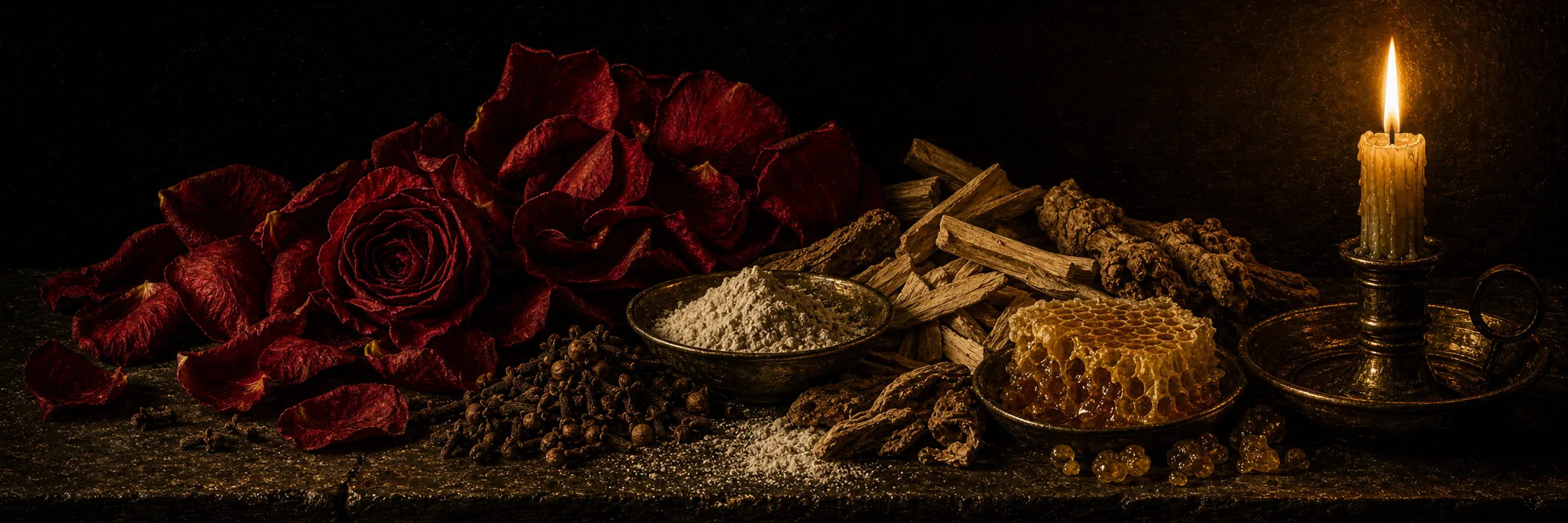
From there it is unusually linear. The rose persists with a touch of clove and a growing honeyed sweetness, the drydown reading as more honeyed than the opening. Guaiac wood becomes a quiet presence after about an hour, and a soft musk emerges late, so the base is woody and gentle rather than dense or resinous.
The one genuinely polarizing element runs through the middle: a sharp, green, soapy facet that some wearers experience as clean, dewy freshness and others as a sour, “cat-pee” acidity that grows over the day. Which way it tips is largely a matter of skin chemistry. The overall arc is a green-acidic naturalistic rose, a near-linear rosy-honeyed heart, and a soft honeyed-woody-musk finish.
Performance
Performance reports are genuinely split, which is itself telling. One camp reports superb sillage and projection with strong lasting power; another finds it wilts within half an hour and becomes a soft skin scent. The most reasonable synthesis is that it skews moderate-to-strong but is markedly skin-chemistry dependent — beautiful and lasting on some wearers, quick to fade or sour on others. It is best worn on warm days, where the rose blooms most flatteringly, and the older export version is generally reported as stronger and longer-lasting than the current one.
Wearing Context
This is a warm-weather, daytime rose. Critics and wearers alike recommend it for a warm spring or summer day, when its green-dewy character is most flattering, and its clean, soft, almost shampoo-like quality makes it read as fresh and approachable rather than dramatic. It is genuinely unisex, with enough green sharpness to avoid reading saccharine or strongly feminine. It excels in daytime, office and casual-elegant settings and would feel underpowered for a dark formal evening — exactly the territory where the rest of the Lutens line shines. The social read is natural, refined and clean, to the point that passers-by may mistake it for a luxury soap or shampoo.
Comparisons & DNA
The most useful contrasts are within the house: La Fille de Berlin is a sharper, peppery red rose, while Rose de Nuit is a dark, leathery, beeswax-and-apricot night rose — one wearer neatly summed it up as Sa Majesté being the daytime rose and Rose de Nuit the nighttime one. Outside the house, it is frequently set against Frédéric Malle’s Une Rose, a darker, earthier, almost mushroom-tinged rose, and its green-sharp pitch has been likened to Guerlain’s Nahema. The honest distinction from most niche roses is that Sa Majesté is lighter, greener and more literal, without the syrup or oud the genre usually leans on — which is also why budget shoppers keep asking whether a simple drugstore tea-rose scent does much the same thing for far less.
Reception
This is one of the most-reviewed roses in niche perfumery, and the consensus is broadly admiring with a vocal dissent. It is repeatedly praised as one of the most natural and user-friendly roses Lutens makes, and an unusually approachable entry into the line. Criticism runs two ways: that it is too ordinary for a Serge Lutens — a simple soliflore that does not justify its price when cheap tea-rose scents smell similar — and that its green-soapy mid-phase turns sour or “cat-pee” on a subset of wearers. Critical reception is warm, with one featured reviewer calling it a tour de force that shows what Sheldrake and Lutens can do when they lay off their shared sugar habit. On value, the verdict is cautious: sample first, because skin chemistry decides whether you get the best rose you have smelled or a spoiled one.
Versions & Reformulation
The fragrance has a meaningful version history. It began in the Lutens export line as a slim rectangular 50ml bottle, widely available and historically affordable. In the 2017 Lutens reshuffle it was among roughly ten export fragrances moved into the Palais Royal bell-jar Exclusives format, so it is now sold primarily as a larger, pricier bell jar. The older flat-bottle export version is consistently described as richer, with a lipstick-like depth and stronger longevity, and the newer version as softer — a perceived reformulation or dilution. Very early bottles also carried a “Fond de Parfum” (alcohol-free) designation rather than “Eau de Parfum,” and a playing-card-themed edition tied to the suit of Hearts was released.
Acquisition Notes
Pricing sits firmly in the niche-luxury tier and has risen with the move to bell-jar exclusivity. The discontinued 50ml export rectangle was historically the affordable route, while the current 75ml bell jar carries an MSRP in the mid-300s, with boutique retail sometimes running lower. Decants and samples are widely available and strongly advised here given how chemistry-dependent the scent is. For vintage export bottles on the secondhand market, storage age is a genuine consideration; otherwise buy from the Lutens boutiques or established niche retailers.
Notable Facts & Lore
- Lutens framed the rose as royalty with the line “The King is dead, long live the Queen!”
- The creation is tied to Proust, with Lutens describing a “royal quest” that conquered the petals of one Turkish, one Bulgarian and one Moroccan rose.
- That tri-origin blend (Turkey, Bulgaria, Morocco) is the documented conceptual backbone of the scent.
- It is said to be one of Serge Lutens’s own favorites, and the one fragrance in the line that most celebrates a single flower.
- It is frequently cited as the most accessible “gateway” Lutens and the house’s definitive daytime rose.