Serge Lutens — La Fille de Berlin
Essence
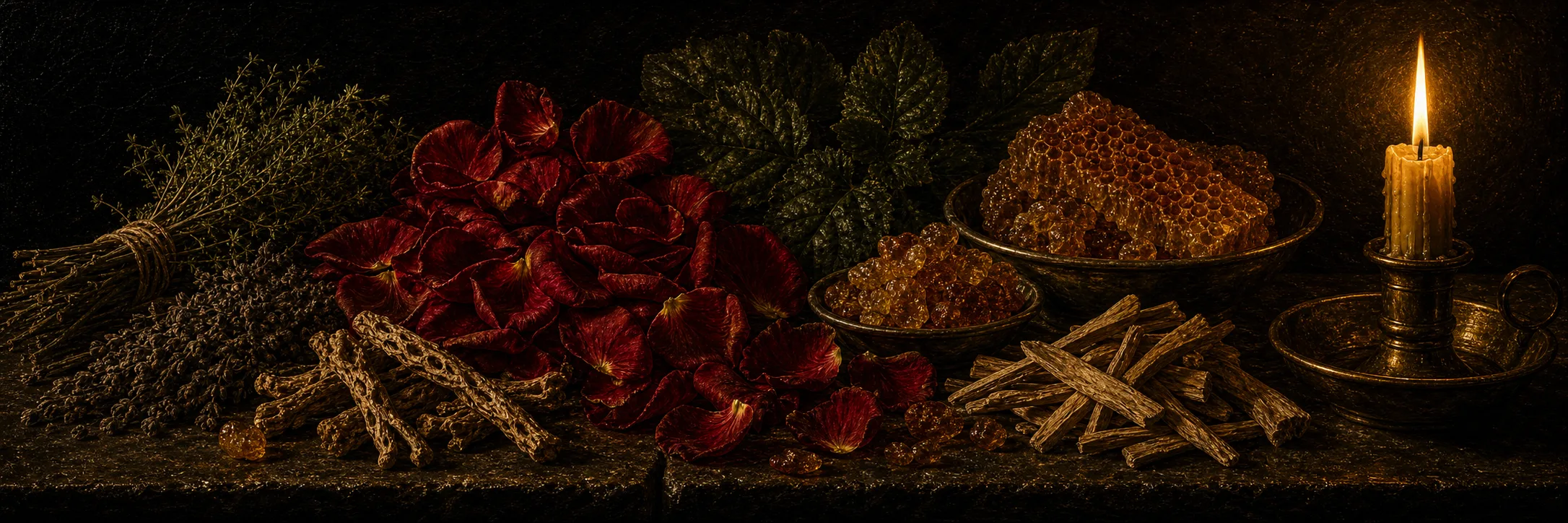
La Fille de Berlin is Serge Lutens and Christopher Sheldrake’s 2013 take on a dark, jammy red rose - a “rose with thorns” wrapped in pepper, honey and a faint metallic-blood edge. It is simultaneously one of the most accessible and crowd-pleasing fragrances in the Lutens catalogue (an easy, beautiful rose) and the carrier of one of the brand’s grimmest, most unsettling backstories. It opens as a near-soliflore crimson rose and either stays gorgeously simple or reveals quiet complexity depending on your skin, making it both a recommended gateway Lutens and, to some critics, an uncharacteristically “safe” one.
Scent Profile
The first seconds are a huge, bright ROSE - Now Smell This called it “nearly a dead ringer for The Perfumer’s Workshop Tea Rose” - quickly turning jammy, sweet and full, like a damask rose dipped in fruit preserves with a liqueur-like, overripe-blackberry richness (Bois de Jasmin’s Victoria Frolova: “an explosion of crimson rose petals, which smell almost sinfully rich with their hint of overripe blackberries… in the less poetic industry parlance, it’s called smelling money”). A peppery, slightly cold metallic facet then enters - the “blood” effect Lutens telegraphed - which Persolaise described as the rose growing “increasingly metallic and blood-like,” and which divides wearers (some get a distinct AquaNet/hairspray note). Geranium and palmarosa add a green, minty, slightly androgynous stemminess. The drydown is the key fork: on some skins (notably Frolova’s) it becomes a “lusty animalic drydown” of amber and musk explicitly referencing Lutens’s own Muscs Koublai Khan; on many others (Kafkaesque, Persolaise) it goes cool, austere, powdery and clean, settling into laundry-musk, light sandalwood and faint violet. Honey and a sheer synthetic moss round the base. Largely linear-to-gently-developing; signature accord: jammy peppered red rose with a metallic-blood edge.
Performance
Generally strong, with the usual skin-dependent variance. Longevity reports cluster around 8-10+ hours: Kafkaesque measured “a little under nine hours,” cited eight on another reviewer and “the whole day” for Frolova; reviewers report 8-12+ hours; some get less. Projection is outstanding early before settling close to the skin after roughly three hours. A handful of wearers find it surprisingly quiet/short, but the dominant view is good-to-excellent performance, especially the opening blast. It lingers notably on clothing.
Wearing Context
Versatile for a Lutens - wearable day or night, office to evening, and across seasons, though its richness leans cool-weather and many find it most magical in cold or damp air (one wearer’s best experience was “outside in a snowstorm,” the moisture cutting the dustiness). It’s refined and well-behaved enough for the office (Frolova noted it’s polished enough to wear there “without raising anyone’s alarm”) yet dramatic enough for statement wear. Fully unisex despite the feminine framing - repeatedly endorsed as wearable by “a bold man.” Social read: mature, elegant, gothic-romantic; the “vampiric/blood rose” imagery recurs constantly in wearers descriptions.
Comparisons & DNA
Within the Lutens line it’s the third rose, positioned between Sa Majeste la Rose (brighter, simpler, photorealistic damask - La Fille is sweeter and more complex) and Rose de Nuit (darker, mossier, more animalic chypre - La Fille is more buoyant and diurnal), with the animalic drydown nodding to Muscs Koublai Khan and the rose/pepper/incense interplay recalling Caron Parfum Sacre. The most frequent external comparison is Frederic Malle Portrait of a Lady - both filed under “goth wedding”/vampiric roses, with La Fille lighter, more transparent and less patchouli-heavy (“translucent red like movie blood rather than opaquely red,” per one wearers reviewer). Other reference points raised by critics and wearers: Malle Une Rose / Rose Tonnerre (Une Rose is earthier, winier, fuller-bodied; La Fille is sparer), Lipstick Rose (Frederic Malle, for the waxy-cosmetic facet), and Rossy de Palma (Etat Libre d’Orange). For a fresher counterpart, Lutens’ own later La Fille Tour de Fer is wearers-framed as the “fresh garden rose” precursor to La Fille de Berlin’s dried/bloody bouquet.
Reception
Among the most warmly received Lutens roses, but with a clear critical divide. Polarization axes: (1) the metallic/hairspray note - beloved by some, a scrubber for others; (2) whether the simplicity reads as “immaculate” or “boring/safe”; (3) the gap between the dark marketing and the well-mannered juice. Blind-buy verdict: split - many call it a safe blind buy for rose lovers, others (discussion) say no given the price and the polarizing metallic edge.
Versions & Reformulation
Single composition, no widely documented reformulation. Released February 2013 as part of the export/Collection Noire, in 50 ml EDP (the standard Lutens export bottle, with both spray and dab-stopper options per the house). Vegan per the manufacturer. The juice is dyed an aggressive crimson/purple - Persolaise noted from the packaging ingredient list that “the purple hue has been achieved artificially,” a deliberate visual that several reviewers found at odds with the scent’s relative restraint.
Acquisition Notes
Availability varies by market; sample before buying when possible.
Notable Facts & Lore
- The lore is unusually heavy.
- Launched for Valentine’s Day 2013 alongside Lutens’s photography book Berlin a Paris and a Galerie Marcilhac exhibition, it was widely misread as a glamorous Weimar/Marlene Dietrich homage (LuckyScent and others ran with that), when Lutens’s own cryptic press text and accompanying video pointed to something far darker - the women of Soviet-occupied postwar Berlin, with strong undertones of shame, blood, violence and what several critics (Kafkaesque, EauMG) independently read as rape and murder.
- Lutens’s verbatim copy: “She’s a rose with thorns, don’t mess with her…
- Her fragrance lifts you higher, she rocks and shocks.“ Denyse Beaulieu (Grain de Musc), in one of the era’s most celebrated pieces of perfume writing, framed it through Villiers de l’Isle-Adam’s Tomorrow’s Eve and Lang’s Metropolis: “Rose.
- Rose and blood…
- A grand, dark, angry rose, potent enough to seep into the bloodstream, with the glowering radiance of a ruby in the rough.
- A warrior queen thumbing her nose at all the wimpy yet migraine-inducing roses drenched in laundry musks…