Serge Lutens — Datura Noir
Essence
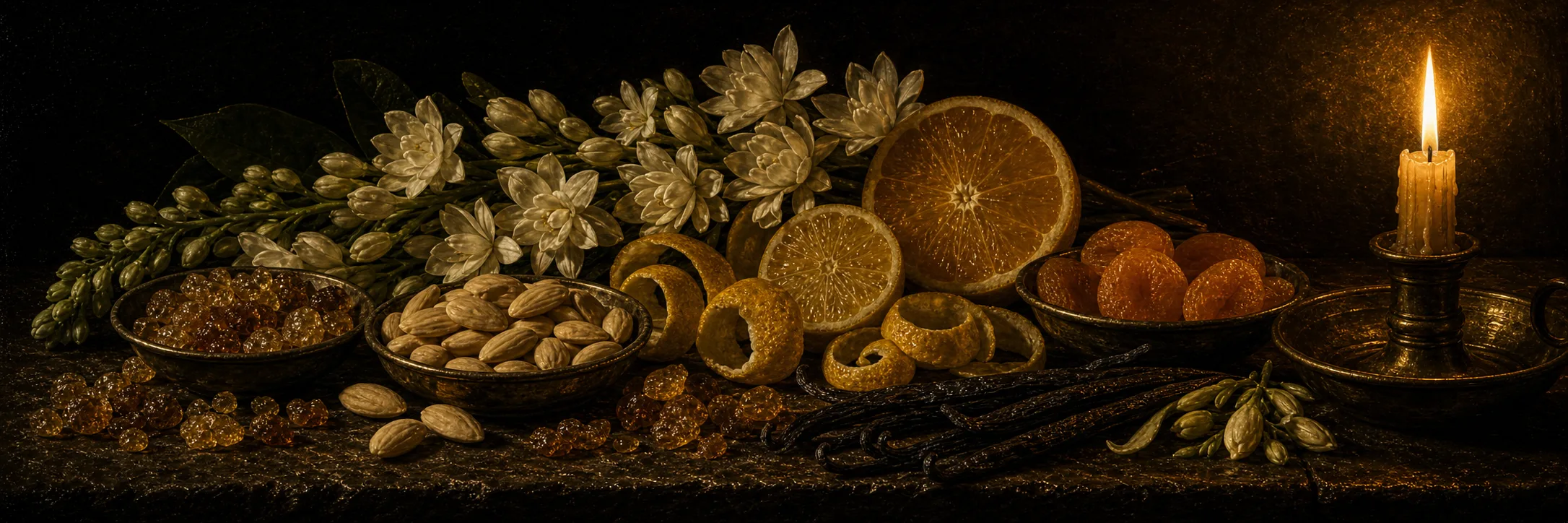
Datura Noir sits in a very Serge Lutens kind of contradiction: the name promises poison, darkness, and danger, but the smell itself often lands as a creamy tuberose-almond confection with a narcotic undertow rather than outright menace. Critics and reviewers agree on the central paradox. It can read like tropical white flowers wrapped in heliotrope, coconut, vanilla, and bitter almond, yet it keeps flashing an off-kilter bitterness or spiritual resinous edge that stops it from collapsing into straightforward gourmand sunscreen. What makes it distinctive is exactly that unstable balance between edible and intoxicating, soft and hallucinatory, beachy and uncanny.
Scent Profile
Now Smell This describes the opening as heady and crowded, with many notes arriving at once before slowly rearranging themselves. That seems consistent with later wearers reviews, which repeatedly report citrus and fruit flickers in the first minutes before the perfume settles around tuberose, heliotrope, almond, coconut, and vanilla. The tuberose here is not Tubereuse Criminelle-style camphorous aggression; it is creamier, sweeter, and more opaque. Elena Vosnaki’s wearers text is especially useful: she stresses the cyanide-like bitter almond nuance, the apricot/osmanthus facet, and the way a loud coconut tone can smother some of the tuberose’s more carnal dimensions. wearers reviews identify the same structure, with tuberose-centered florality moving into almond-vanilla sweetness, cushioned by soft musk and checked by a restrained myrrh in the base. The likely wear arc, then, is briskly fruity-floral for minutes, creamy narcotic white floral for hours, then powdery almond-tonka-musky warmth with a resinous green-spicy thread underneath. What often polarizes people is not the floral heart itself but the interpretive gap around it: one person gets mysterious poisonous blossom; another gets luxury sunscreen, baby shampoo, or expensive body lotion.
Performance
Reliable performance evidence points to good longevity with moderate-to-strong presence rather than monster projection. dissent includes one of the more concrete reports: moderate sillage, excellent projection, and about nine hours on skin, while another reviewer frames it as pleasant but substantial enough to become overwhelming on the wrong skin. wearers reviews converge around reasonable projection and a lovely trail rather than brute force, with several reviewers emphasizing that it is noticeable without turning beastly. At the same time, newer discussions comments describe it as performing well but not projecting in a huge way. The fairest summary is that Datura Noir is materially stronger and longer-lived than its creamy texture might suggest, commonly falling around eight to nine hours with a distinct first half and a softer almond-tonka skin scent later on, but not usually operating as room-filler unless oversprayed or worn in heat.
Wearing Context
Robin at Now Smell This explicitly reads Datura Noir as a secret-rendezvous perfume rather than a daytime one, and that instinct makes sense: this is a sensual floral with sweetness, powder, and narcotic heft, not a clean white-petal spring scent. Even so, later wearers reviews complicate the picture. Some wear it easily by day in cooler weather and describe it as versatile; others save it for hot dry summer evenings, tropical-night moods, or fall and winter when the sweet floral core feels cozier and more faceted. A practical reading is that Datura Noir performs best outside high-humidity daytime heat unless you already know you like sweet tuberose in warm weather. It suits intimate dinners, evening social settings, quiet luxury environments, and solitary wear when you want something creamy and enveloping. It is much less convincing as a universally “safe” office scent than something like Nuit de Cellophane or Clair de Musc.
Comparisons & DNA
The most productive comparison is not “what is this an exact dupe of?” but “what neighboring perfumes explain its weirdness?” collectors repeatedly call it a distant descendant of vintage Dior Hypnotic Poison, which makes sense in the almond-vanilla-tuberose axis, but they are equally clear that it is not a literal copy. Now Smell This called Keiko Mecheri Fleurs d’Osmanthe its “kissing cousin,” pointing toward the osmanthus-fruity-floral side rather than the almond side. wearers itself lists Fleurs d’Osmanthe and Datura Blanche among similar scents; users also compare Datura Noir to Terracotta Le Parfum, and one newer review compares the black-label bottle to Michael Kors Wonderlust. The deltas matter. Datura Noir is softer and stranger than Hypnotic Poison, less overtly sunscreeny and plush than Terracotta, and more almond-heliotrope-laced than a straightforward tropical white floral. Its DNA is best understood as a sweet floral-gourmand hybrid built around tuberose and bitter almond, with osmanthus/apricot and myrrh keeping it from becoming merely creamy.
Reception
Reception is solidly positive but notably polarized in the way only Lutens fragrances tend to be. The praise centers on richness without shrillness, the unusual almond-tuberose pairing, and the fragrance’s ability to feel seductive, creamy, and expensive without becoming syrupy. The criticisms are equally consistent: too sweet, too powdery, too lotion-like, too plastic, too “beach scent,” or simply not dark enough to justify the name. That mismatch between title and reality is a recurring disappointment. As a blind buy, Datura Noir is not especially safe. It is much safer for someone who already knows they enjoy heliotrope, sweet tuberose, coconut, and almond than for someone buying into the fantasy of poisonous noir floral drama.
Versions & Reformulation
This is not a clean one-bottle story. wearers lists the current Eau de Parfum as still in production and notes two documented special presentations: the 2006 “Les Fauves Royaux” Panthere bottle collection and a later card-game bottle design tied to the suit of spades. wearers also links a Datura Noir Fond de Parfum as a related version. More importantly, wearers discussion around the standard fragrance is full of reformulation and packaging talk. reviewers who have owned early cream-label or first-edition bottles describe them as darker, less syrupy, sometimes storax-tinged, and more seductive or “witchy,” while some later black-label owners experience a more heliotrope-almond-forward sweetness. There is no full agreement on whether the vintage is better; one reviewer actually prefers the newer packaging to the remembered original. Availability reports are similarly messy: wearers says the EDP is still in production, while users in 2024-2025 argue over whether some spray formats are discontinued and whether only the bell jar remains easy to find. The safest read is that vintage-versus-current differences are widely discussed, but the exact breakpoints and stock situation are not cleanly documented across sources.
Acquisition Notes
Availability varies by market; sample before buying when possible.
Notable Facts & Lore
- Datura Noir borrows more than a flower name; it borrows a whole mythic register.
- Wearers datura raw-material essay emphasizes the plant’s evening bloom, erotic scent, toxicity, folk-magic associations, and hallucinogenic reputation, and Elena Vosnaki uses that context to frame the perfume as something unstable, poisonous-feeling, and cinematic rather than merely floral.
- Her characterization of Datura Noir as a fragrance that toggles between bitter almond danger, tropical fruit, tuberose, and coconut-laced suntan-lotion fantasy is one of the more memorable pieces of writing attached to the scent, because it explains both the fascination and the frustration the perfume still provokes.