Serge Lutens — El Attarine
Essence
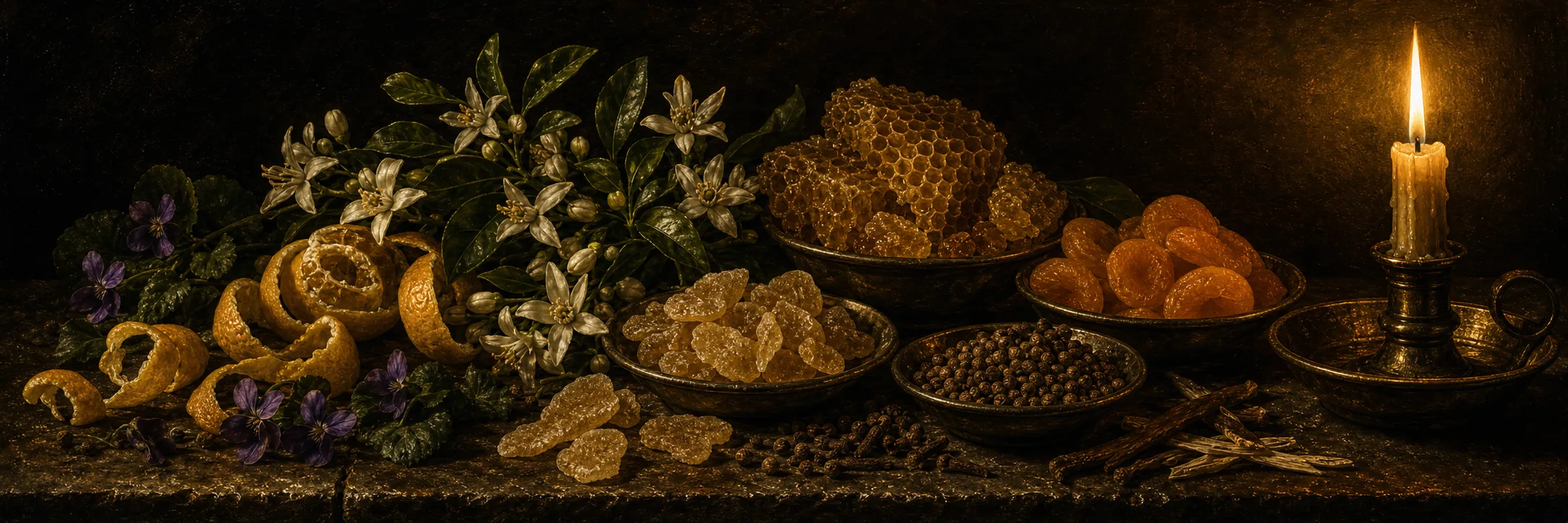
El Attarine (2008) is a Serge Lutens / Christopher Sheldrake exclusive - originally a Palais Royal bell-jar release - that takes the house’s familiar stewed-fruit-and-spice orientalism and renders it luminous and golden rather than dark and heavy. The name refers both to the Arabic “attar” (perfume/essence) and to the 14th-century Medersa el-Attarine, a celebrated Koranic school in Fez sited at the edge of the spice-and-perfume souk. Lutens’ press copy promised “gold, sun-drenched topaz, everlasting flowers and saps.” Denyse Beaulieu (Grain de Musc) read it as Lutens “revisiting his entire oeuvre,” summing up his style - and offered the best single-line description: “Bois de Violette wedged into Santal de Mysore, with a lashing of Fleurs d’Oranger.” Its signature is the unexpected pairing of cumin with honeyed immortelle, apricot and orange blossom - a “savoury meets golden-sweet” tension that divides wearers sharply.
Scent Profile
The opening is the dealbreaker: a strong burst of cumin that reviewers call “arguably the best showcase of the spice I have encountered… almost like pure essential oil,” over a dry, peel-like mandarin/citrus. To cumin-haters it reads sweaty and curry-like; to admirers it’s an oily, savory spice masterclass. Now Smell This (Robin) describes the structure that follows: “strong, dense citrus” quickly devolving “into that blend of stewed dried fruits and curry spices that Serge Lutens fans know,” over a base of “woody, pencil-ish notes and middling-skanky musk… finished off here with just a pinch of powder.” A shy violet bridges into what wearers most-cited reviewer calls the “Golden Phase,” where immortelle, crisp apricot and a watery honey converge into a sunlit, golden accord - herbaceous and dusty-dry rather than the syrupy maple-curry immortelle of Annick Goutal Sables or Dior Eau Noire. Beaulieu emphasized restraint: the immortelle is “only a subtle, licorice-like, burnt flavouring,” not a clobbering one. Sandalwood and a somewhat generic cedar ground the drydown, which several reviewers describe as continuing “forever at a low volume,” velvety and softly skanky. Many note it is best experienced warmed on skin, not sniffed nose-to-wrist.
Performance
Reports conflict, and reformulation may explain it. Bois de Jasmin and several owners report “very good” sillage and longevity on the original bell jar. But a recurring, more recent complaint on wearers from bell-jar owners is weak performance - “sillage is truly abominable… longevity is not great, about 2 hours before I need to refresh” - with one such reviewer explicitly wondering “perhaps a reformulation has taken place,” noting their bottle skewed fruity-floral with barely any cumin. Practical reading: vintage/older bell jars appear to perform better and skew more cumin-savory; later stock may be softer, sweeter and shorter-lived. Apply by splash generously if using a bell jar; let it bloom on skin rather than judging it in the first minutes.
Wearing Context
A cool-weather, autumn-winter scent - golden, honeyed and spicy, it suits crisp days and evenings. Unisex, though its honey-immortelle-apricot heart and subdued execution make it broadly wearable by anyone comfortable with gourmand-spicy orientals. It reads as contemplative and “quieter than some of the others in the line” (Now Smell This), making it more of a personal, cozy comfort scent than a projection statement - wearers editorial calls it “discreet and seductive, as though it’s melded with its vessel.” Best for intimate settings, cold-weather daywear, and spice/immortelle enthusiasts. Practical reading: the cumin makes it a risky choice for close-quarters professional settings if your skin amplifies the savory facet.
Comparisons & DNA
The dominant comparison is to Lutens’ own Arabie (2000) - repeatedly cited as the main inspiration and described by Now Smell This as “the main source of inspiration for El Attarine’s motifs.” Consensus: El Attarine is the more restrained, fruitier, more floral and “more wearable” Arabie; the standalone wearers verdict from the genre skeptic was blunt - “if you like this sort of thing buy Arabie instead. It’s bigger and gutsier.” Beaulieu’s structural read ties it to the Bois series (Bois de Violette / Feminite du Bois) plus Santal de Mysore and Fleurs d’Oranger. Other names invoked by critics and wearers: Muscs Koublai Khan, La Myrrhe and Chene within the house; Annick Goutal Sables and Dior Eau Noire as immortelle reference points (El Attarine being far less syrupy). Perfume Shrine’s Elena Vosnaki, who owns bell jars of both, stressed El Attarine and La Myrrhe are “nothing alike except for the sweet aspect.” Parfums d’Empire Fougere Bengale was raised and dismissed as a comparison - its immortelle is salty-curry, not honeyed.
Reception
Polarizing but quietly revered. Critic reception was strong: Now Smell This called it “my favorite from the Serge Lutens line since 2004’s Chene.” Luca Turin’s Guide blurb (quoted by NST) quipped “You certainly don’t go shopping for fabric softener wearing this.” The dissent came from a prominent wearers reviewer who found it a “dilution of the idea behind Arabie: fruitcake… more approachable, but also less distinctive.” sentiment on reception is that it’s a “grower” - many report disliking it at first (the cumin) then coming to love it years later (“10 years on, it seems my tastes have changed… now, I love it”). It is widely flagged as a poor blind buy: as one owner put it, “the majority of people will find El Attarine either over-the-top and borderline unwearable or larger-than-life in a wonderful, remarkable way.” Blind-buy verdict: no - sample first, ideally an older batch.
Versions & Reformulation
Originally a 2008 limited Palais Royal exclusive, including a numbered 30-bottle special edition (850) alongside the standard bell jar (110 at launch). El Attarine has cycled in and out of availability and is among the Lutens titles repeatedly reported as “discontinued” or hard to find: a Palais Royal staffer (per wearers boutique thread) listed it among the currently-discontinued exclusives, “although they still have some bottles left at the Parisian boutiques.” Strong wearers suspicion of reformulation exists - Kafkaesque’s reporting documents that Lutens reformulates frequently, and multiple recent bell-jar buyers report a markedly softer, less cumin-driven, weaker-projecting juice than older bottles. Sold as 75 ml EDP in the bell jar. Practical reading: batch/era matters more than usual here.
Acquisition Notes
Availability varies by market; sample before buying when possible.
Notable Facts & Lore
- The fragrance is a double homage - to the Arabic concept of “attar” (where smell and taste blur, as Lutens’ cryptic press release insisted “there is no distinction between the olfactory and the gustatory”) and to the Medersa el-Attarine in Fez, built between 1323 and 1325 on the orders of Marinid sultan Abu Sa’id Uthman II (construction supervised by Sheikh Abdallah ibn Qasim al-Mizwar), and named after the adjacent Souk al-Attarine spice-and-perfume market.
- Beaulieu reported that with the 2008 releases (El Attarine and Serge Noire), Lutens declared all his fragrances henceforth belong to “the Oriental family” and should no longer be sub-classified - a personal decision reflected in the wax-sample mailings of that period.
- The launch generated insider lore about the difficulty of obtaining early samples - Perfume Shrine’s review opens with the saga of securing “a treasured few drops” through “a somewhat tortuous path,” part of the Lutens mystique of olfactory “opium” smuggled back from Paris.