Serge Lutens — Fleurs de Citronnier
Essence
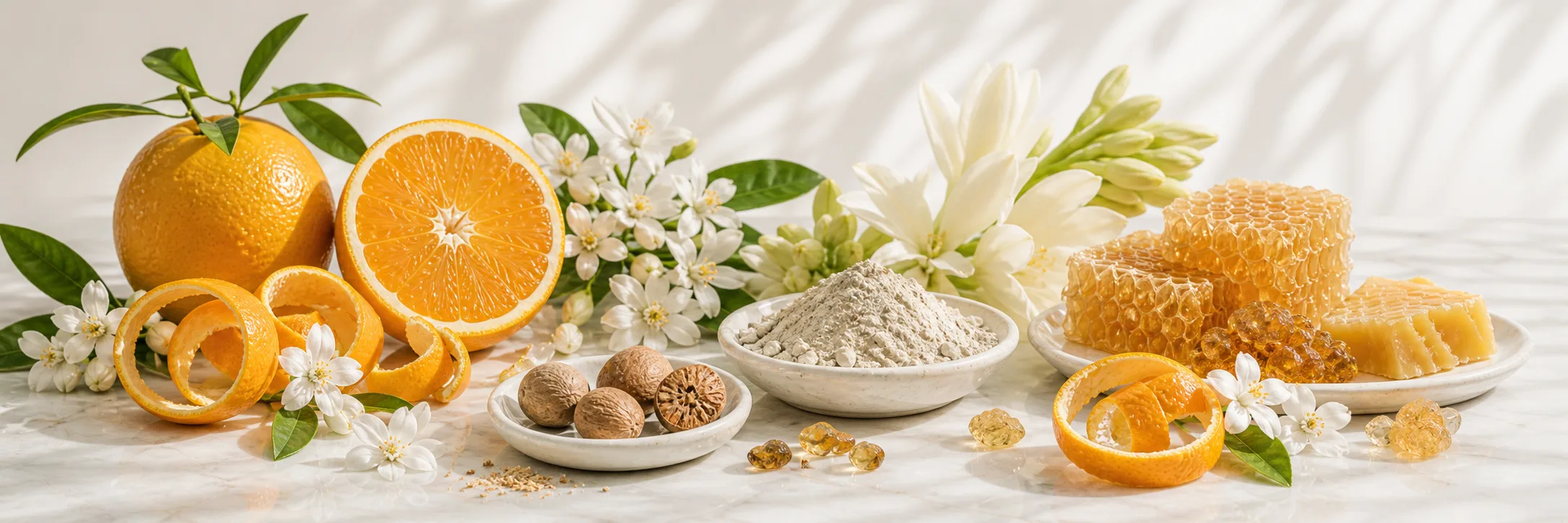
A waxy, honeyed lemon-blossom-and-neroli soliflore - Lutens’ sleeper export release, frequently overshadowed by Fleurs d’Oranger but quietly beloved by a small cult of enthusiasts. It uses petitgrain and neroli as the citrus-and-blossom backbone, then layers in white honey, a recessed tuberose and a soft styrax-musk-iris base. Less dramatic than the typical Sheldrake-Lutens output and one of the few releases in the line that can plausibly be called an office-safe daytime fragrance.
Scent Profile
The opening is a snappy neroli-petitgrain duet, lightly bitter and green from the petitgrain’s twig-and-leaf facet, with a recognisable lemon-blossom freshness - bright but not zesty in the Italian-cologne sense. Nutmeg whispers in the background, dusty rather than warm. Within 15 minutes the citrus retreats and the honey enters: this is the trademark Lutens “white honey,” waxy and slightly animalic rather than syrupy, and it transforms what could have been a clean cologne into something more carnal. There is a faint waxiness here that reviewers consistently compare to lipstick or to high-end orange-blossom hand cream.
Performance
A divisive performer. On warm skin and in cool weather, Fleurs de Citronnier projects modestly for the first 1-2 hours then sits close to skin for 6-9 hours total. On dry skin or in heat, it can fade dramatically within 2-3 hours - multiple reviewers report 1-hour longevity. The honey and styrax do most of the longevity heavy lifting; the citrus top is short-lived. It loves humidity, surprisingly - the warm muggy air seems to amplify the honey-musk drydown rather than burn off the citrus too quickly. Best application: three to four sprays on the chest, neck, and inside elbows, with a light extra spray to the shirt collar for trail. Skin chemistry interacts heavily - those who amplify musk get longer wear, those who do not may need to layer with an unscented body oil first.
Wearing Context
The most versatile fragrance in the Lutens export line. It works at the office, on a warm spring afternoon, at a daytime wedding, in summer evenings, even on cold winter mornings (where its honeyed warmth surprises). It is the answer when a Lutens enthusiast needs a scent that can pass professional muster without feeling like a sellout to mainstream “clean” releases. The lemon-blossom-and-honey angle has occasional crossover with classical wedding fragrances and conservative women’s perfumery, so younger users sometimes flag it as “matronly” or “vintage hotel”; older users tend to read those same cues as elegant. Social-perception skew is faintly feminine in the US, fully unisex in continental European retail. It falls flat at a nightclub or any context where presence matters more than refinement.
Comparisons & DNA
Within the Lutens house: Clair de Musc is the cleanest stylistic neighbour - soft white musk with floral facets - and Fleurs de Citronnier reads roughly as “Clair de Musc with a citrus-blossom front end and a tuberose ghost.” Datura Noir shares the lemon-blossom and waxy facet. A la Nuit is the jasmine-soliflore parallel. Cross-house: Tom Ford Neroli Portofino (2011) is the closest-in-genre comparison, also lemon-blossom-and-neroli forward, but Neroli Portofino is bright, citrussy and aquatic where Fleurs de Citronnier is honeyed and waxy; many users argue Lutens did the genre first and better. Annick Goutal Neroli, plus the broader neroli class from Le Labo and Chanel Les Exclusifs Boy/Neroli - Fleurs de Citronnier sits warmer and more skin-like than any of these. Frederic Malle Cologne Indelebile addresses orange blossom with a different bias. Caron Narcisse Noir has been cited by reviewers as having a kindred waxy-floral quality. There is no widely-discussed Armaf/Lattafa/Maison Alhambra clone of this exact composition.
Reception
Among the most underrated releases in the Lutens catalogue, and Victoria Frolova at Bois de Jasmin says so explicitly: “probably the biggest sleeper in Serge Lutens export line. It’s often getting passed over in favor of its sultry sibling, Fleurs d’Oranger.” Frolova praises its “delicate aspect of citrus flowers” and the way the tuberose “cooperates with all the other facets of the perfume.” Birgit at Olfactoria’s Travels considers it best in cool weather despite its summer reputation, writing in 2012 that “I don’t think Fleurs de Citronnier works best in the heat. I think it is more of a cold weather scent.” reception is positive but quiet, with average ratings stronger than total review count suggests. Common praise: realism of the lemon-blossom, versatility, the rare clean-but-not-boring Lutens. Common criticism: longevity issues, perceived simplicity, and complaints from Lutens-philes that it lacks the house’s signature drama. Polarisation is mild. Blind-buy verdict: safe for anyone who likes neroli, hates aquatic-fresh fragrances, and accepts that “clean” can mean “honeyed waxy” rather than “laundry detergent.”
Versions & Reformulation
Originally released in 2004 in the rectangular Collection Noire bottle. Reformulated in 2019 as part of the “Les Eaux de Politesse” reorganisation, and put into a new clear, square (“ice cube”) 100ml bottle. The reformulation is contentious among long-time wearers: a senior wearers reviewer with multiple Lutens bottles writes that the new version has “the powdery musk of the original (which gave it its former unusual flair)… dialed back almost to nonexistence, and the longevity is now abysmal… all of the edginess and interest of the original is pretty much gone.” Lutens has not officially acknowledged the change; the company’s own copy describes the new collection as “light, fresh, transparent,” which the wearers reads as a tacit confirmation of dilution. wearers maintains two separate entries - one for the 2004 original and one for the 2019 version - which is unusual. EDP only.
Acquisition Notes
Availability varies by market; sample before buying when possible.
Notable Facts & Lore
- Lutens’ own copy frames it lyrically: “Of all the citrus family - orange, mandarin, grapefruit - the lemon tree, and specifically its blossom, exudes a magical freshness.” The fragrance is part of his broader Mediterranean palette and has been described in fragrance-wearers shorthand as “the daytime sibling of Fleurs d’Oranger.” In 2005 a limited domino-motif bottle collection of this scent was released - a minor collector curiosity.
- No major celebrity association is documented.
- The fragrance has a quiet but devoted following among perfumers and perfume writers who praise its restraint: it is one of the few Sheldrake-Lutens releases that demonstrates the duo’s capacity for minimalism rather than maximalism.
- The 2019 reformulation/repackaging is one of the most-discussed minor controversies in the Lutens fandom: many of the longest-serving members consider it the test case for what is being lost in the post-Shiseido-buyout streamlining of the house.