Serge Lutens — Rahät Loukoum
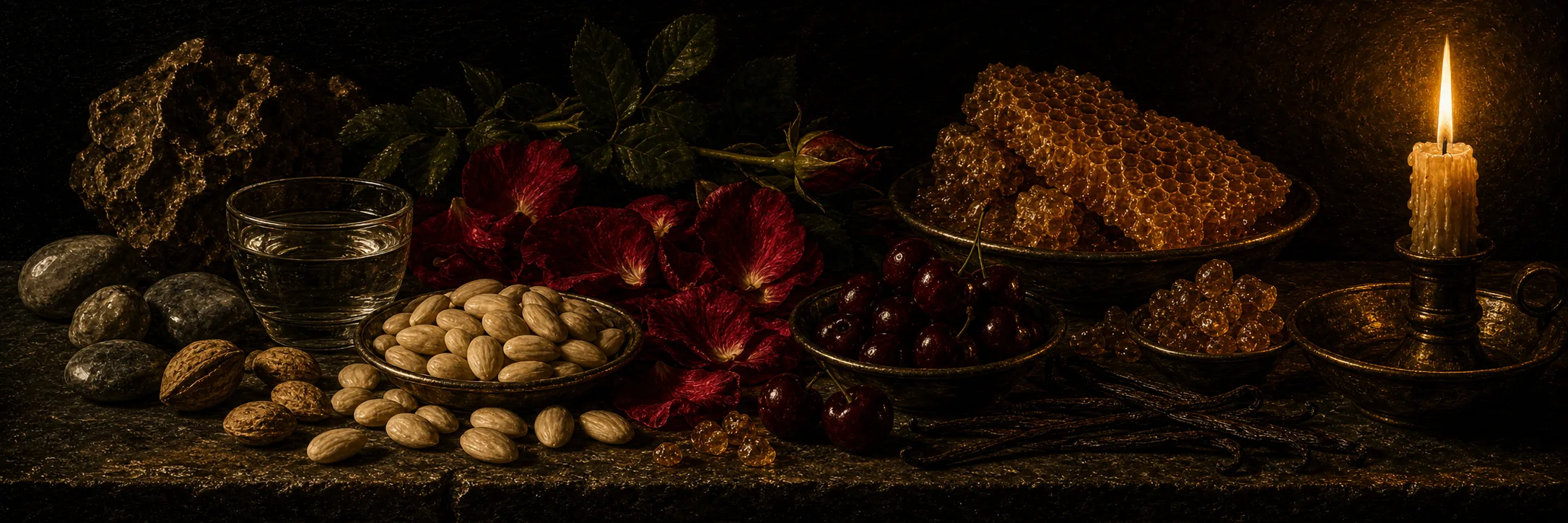
Essence
Rahat Loukoum (1998, Christopher Sheldrake) is the iconic Serge Lutens almond-cherry-honey gourmand, named for the Turkish confection (lokum). It’s famous as one of the house’s most overtly edible compositions - a cherry-cough-syrup-and-marzipan opening melting into milky almond, white honey, muted rose, and a soft powdery musk-vanilla base. Polarizing by reputation: to admirers it’s “the gourmand,” a comfort scent of candied cherries and almond pastry dusted in powdered sugar; to detractors it’s cloying cherry medicine over sticky musk. Either way it’s a benchmark almond gourmand and a Lutens cult object.
Scent Profile
The opening is a bright, boozy blast: tart cherry and a big dose of alcohol that, as nearly everyone notes, reads “pretty much like cherry cough syrup” or maraschino cherry - Bois de Jasmin’s Victoria Frolova describes “biting into a maraschino cherry and finding that it has an almond inside.” Within minutes the almond intensifies; the listed “fresh white almond” comes across to many as the smoky scent of just-toasted almond slivers or marzipan, with crushed cherry-pit (benzaldehyde) bitterness underneath. The 1-3 hour heart is the beloved phase: milky-to-doughy almond accented with dried-rose-petal wisps, the hawthorn adding a faint bitter-green edge, heliotrope contributing its Play-Doh/powdered-sugar softness, and white honey lending a waxy floral sweetness. The 3+ hour drydown is soft, fuzzy, lightly powdery - honeyed musk, a touch of vanilla and tonka resin, “less and less like food the longer it is on the skin.” Of the listed notes, almond, cherry, heliotrope, honey, vanilla and musk are clearly perceptible; the Turkish rose is muted/in-the-background and the aldehydes function mainly to aerate the powder rather than reading as classic aldehydic sparkle. Perception of sweetness is famously divisive - reviewers split so hard (“never gets past screaming CHERRIES” vs. “cold, powdery, only slightly sweet and bitter-metallic”) that one wonders if they mean the same thing by “sweet.” It’s broadly linear after the opening - the almond/honey/powder accord holds court for hours - though a notable minority report a striking late transformation into a smoky leather-and-tobacco “rich men’s club / tack room” facet. The signature accord is that marzipan-cherry-honey “Turkish delight dusted in powdered sugar.”
Performance
Performance reports vary widely by skin, but the central tendency is moderate. Projection is soft-to-moderate - it is “not a powerhouse,” wearable “with abandon even in warm weather” per Now Smell This - creating a cozy, enveloping bubble rather than a big trail. Sillage is gentle; this is more an intimate comfort scent than a projector, though a determined minority find it strong and tenacious. Longevity on skin ranges from disappointing (some report it fades within a few hours and won’t last) to excellent (others get all-day wear and a persistent musky base) - skin chemistry clearly drives a lot of the variance, with the heavy white-musk base clinging longest. On clothing and hair it is markedly more tenacious - wearers specifically note it “holds really well, especially on fabrics and hair.” Heat amplifies the sweetness; it’s generally a cooler-weather scent but its softness keeps it wearable in warmth. Application strategy: a little goes a long way (“a tiny bit goes a very long way,” per a wearers-quoted line attributed to Tania Sanchez), so apply sparingly to avoid the sweetness tipping into cloying, and use fabric for longevity.
Wearing Context
Best in fall and winter and cool weather, and as an evening/cozy/comfort scent rather than a professional daytime signature - though its softness means some wear it anytime. It shines as a “comfort fragrance”: soothing, nostalgic, almost addictive, a “happy little cloud of Turkish delight” for relaxing, cold nights, or when you want to feel cocooned. It falls flat in formal/professional settings for those who find gourmands juvenile, and in hot, sweat-prone contexts where the sweetness can cloy. It reads unisex but leans slightly feminine/youthful to many noses, though plenty of men wear it (one wearers reviewer specifically pictures the smoky-leather drydown as masculine, “a rich men’s club”). Social-perception skew: sweet, comforting, distinctive, “grandma’s candy dish” nostalgic to some, sophisticated-gourmand to others - not a conventional crowd-pleaser but a memorable one.
Comparisons & DNA
Its closest sibling is Lutens’ own Louve (2007), the export-line almond-cherry near-relative - Now Smell This’ Robin frames Louve as “blander, drier, considerably less foody” Rahat, staying closer to the skin (some call Louve “Rahat Loukoum’s twin”). Keiko Mecheri Loukhoum is the most-cited comparator - similar almond/powder but, per repeated wearers verdict, “smells cheap” and lacks Rahat’s cherry and refinement. Montale Sweet Oriental Dream is the popular cheaper alternative - cloyingly sweeter, better projection, “smells like candy” where Rahat reads more nuanced. Tom Ford Lost Cherry is the modern, woodier, pricier cherry-tobacco descendant (Frolova: Rahat is “similar but… less sweet and more transparent than Lost Cherry”). Other touchpoints: The People of the Labyrinths Luctor et Emergo and Givenchy Oblique Rewind (cherry/almond/pipe-tobacco “distant cousins”), Etro Heliotrope (shared heliotrope, poor projection), and Frolova’s discontinued favorite Castelbajac (red bottle) marzipan-acacia, which she rates above all of them. Because Rahat is a polished commercial Lutens (not an artisanal attar), affordable approximations genuinely exist - Keiko Mecheri Loukhoum and Montale Sweet Oriental Dream are the standard recommendations, though devotees insist none truly equals it. Lineage: it sits in the lineage of almond/heliotrope “marzipan” gourmands and helped cement the almond-cherry comfort-gourmand as a serious perfumery category, influencing later cherry-gourmand hits.
Reception
Reception is intensely polarized - exactly the sign, as “that there’s something really interesting going on.” Admirers (the larger camp on wearers) call it a masterpiece comfort gourmand: delicious marzipan-cherry-honey, addictive, beautifully made, “the gourmand fragrance.” Detractors find it cloying cherry cough syrup, soapy-functional, or sickly in the musky drydown. The axes of polarization are sweetness perception, the cherry-medicine accord, and longevity. /2 coverage is genuinely strong for this scent: Now Smell This (Robin Krug) wrote a foundational appreciation calling it her introduction to the “comfort scent” idea, “soothing, and evocative… almost addictive.” Bois de Jasmin (Victoria Frolova) is the notable dissent - she ranks it #1 in her “10 Perfumes I Should Love… But Do Not,” writing that “it contains everything I should enjoy, but the end result smells like a cross between a cheap almond candle and a cleaning product.” No Turin/Sanchez review of Rahat Loukoum itself was found - it was a Palais Royal exclusive largely outside the Guide’s scope (Turin did review the related export Louve), so claims of a Turin verdict on Rahat should be treated cautiously. “Blind buy?” - risky precisely because of the cherry-syrup/sweetness polarization and skin-dependent performance; Frolova explicitly warns the almond-cherry functional-product association is “something to keep in mind” before a blind purchase. Sample first.
Versions & Reformulation
Single core composition, but with important format and sourcing history. Historically Rahat Loukoum was a Paris/Palais Royal Shiseido exclusive - hard to obtain in the US and a frequent “find a substitute” topic on discussions - but it has long been available in the export “Le Vapo”/travel format (2 x 30 ml refillable spray) and the iconic 75 ml bell jar (cloche). Pricing and bottle design shifted with Shiseido’s mid-2010s revamp of the brand. Vintage devotees worry, as with many old bell-jar Lutens, that the formula may have been “tweaked” over the years and lost some of its original magic, though no specific dramatic reformulation is documented; current bottles are still widely regarded as excellent. The bell jar vs. travel-spray choice is about format/quantity, not a different juice.
Acquisition Notes
Availability varies by market; sample before buying when possible.
Notable Facts & Lore
- The defining piece of perfumer lore is documented and charming: in an interview, asked which perfume was the most fun to develop, Lutens’ longtime perfumer Christopher Sheldrake answered not with a prestige icon like Muscs Koublai Khan or De Profundis but with Rahat Loukoum - described by Now Smell This as “a happy little cloud of light, innocence, and play.” The fragrance is named for and inspired by the Turkish confection rahat lokum (Turkish Delight) - though, as Turkish wearers and critics note, it smells little like the real rose-and-pistachio candy, prompting one wearers reviewer’s quip that Lutens “pranked us” by making cherry-almond cough syrup instead (the Arabic rahat al-hulkum means “contentment of the throat”).
- Its enduring “this is the one that did X” status: it’s repeatedly cited as the archetypal Lutens comfort gourmand and the scent that introduced many enthusiasts to the entire category of gourmand “comfort scents.” Its US scarcity as a Palais Royal exclusive also made it a long-running grail/“find-a-substitute” obsession on MakeupAlley and wearers, fueling the cottage industry of comparisons to Keiko Mecheri Loukhoum, Montale Sweet Oriental Dream, and Louve.