Serge Lutens — Douce Amère
Essence
Douce Amere is a Christopher Sheldrake composition for Serge Lutens (dated 2002 on wearers, though some sources cite a 2000 launch) whose name - “bittersweet” - is its entire thesis. It pairs the bitter green medicinal bite of artemisia/wormwood (the herb behind absinthe) and anise against a soft, creamy, vanilla-and-cinnamon gourmand heart. It’s widely considered one of the most underrated, “wallflower” entries in the Lutens canon: unusually easy to wear, lacking the house’s polarizing cumin/burnt notes, yet still distinctive. Critics treat it as an off-beat light oriental gourmand with a quirky herbal twist rather than a true sugar bomb.
Scent Profile
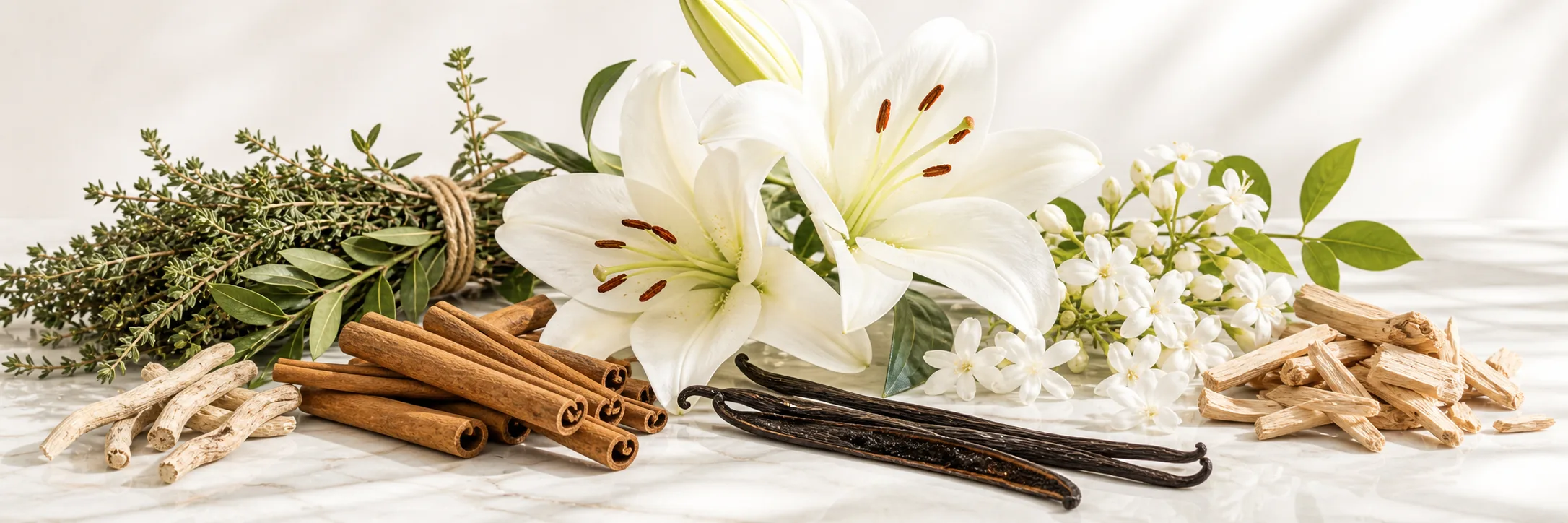
The arc is the bittersweet tug-of-war Lutens describes (“First bitter, then sweet, it’s absinthe of course”). It opens with a brief flash of lemony citrus heavily dusted with cinnamon, candy-sweet, immediately cut by the bitter, green, mildly medicinal wormwood - some note a fleeting mentholated or mint-like coolness. Robin at Now Smell This describes the drydown as “something more like a milky pudding laced with black licorice, mildly spicy, with abstract floral notes and vague hints of something that smells very much like chocolate… a velvety finish, and a pale wood base.” The white florals (tiare, lily, jasmine) are soft and largely blended-in, keeping it from tipping into full gourmand. The defining signature accord is the persistent bitter-green wormwood thread running over a creamy vanilla-cake base - multiple reviewers note the “ghost of wormwood lingers longer than any other fragrance” with this note. Critics liken the anise-plus-gourmand effect to a more transparent cousin of Guerlain’s L’Heure Bleue, minus the furry oriental warmth. Often compared to sugared almonds, marzipan, anise pastilles, and “cake batter without the sugar.”
Performance
Selected reports cluster around excellent longevity but gentle, close-to-skin sillage - a hallmark of the composition. Bois de Jasmin and others note “wonderful lasting power, but its sillage is much gentler, wearing more politely close to the skin.” Specific skin reports range widely: one wearers reviewer cites eight hours, another a “good 12 hours,” while a wearers reviewer gets only 4-5 hours with very light projection. The consistent theme is that it “sits very close to the skin” and won’t create a big scent bubble - several reviewers explicitly wish it projected more. Apply generously if you want others to catch it; it rewards the wearer more than the room.
Wearing Context
Critics frame it as a cool-weather scent - a “winter warmer” that “comforts like a warm camel coat,” evoking French winter landscapes and absinthe in a dimly lit bar (per the Cafleurebon review). Note, however, that perception of the wormwood/anise is highly temperature-sensitive: a Perfume-Smellin’-Things writer observed it (and other Lutens) becomes “uncivilized” and pungent above ~39C, while a wearers reviewer found it perfect on a warm spring day - so cool-to-mild conditions are the safe zone. Genuinely unisex with a slight feminine lean in some readings, though several note it “would be glorious on a man.” Best for contemplative, intimate, or cozy occasions; its bookish elegance and comfort-scent character suit everyday or quiet evening wear rather than projection-driven settings.
Comparisons & DNA
The clearest in-house DNA link is to the broader Lutens gourmand-oriental family: reviewers contrast it with Un Bois Vanille (syrupier, treacly vanilla - Douce Amere stays drier), Bois Oriental/Bois et Fruits, Arabie (dried fruits), and note it shares Sheldrake’s signature gingerbread/Guerlinade-style base. Outside the house, the standout comparison is the discontinued IUNX No. 3, which a Now Smell This reviewer found “very similar to Douce Amere, but much more transparent.” Perfume Shrine compares its bittersweet liquorice-anise effect to a grown-up, tipsy Lolita Lempicka (after “absinthe cocktails”) and to the airier side of Keiko Mecheri Paname, while noting its sweetness is reminiscent of - but lighter than - Chopard Casmir. Other anise-note neighbors cited by NST include Caron Aimez Moi, Guerlain Anisia Bella, and Lolita Lempicka. No designer “clones” exist; this is a singular composition.
Reception
Among -2 critics and the wearers, Douce Amere is a beloved underdog. Now Smell This calls it “one of the glories of the Serge Lutens line”; Olfactoria’s Travels confessed it was the rare Lutens she “fell for immediately” and loves “unconditionally”; Cafleurebon ran it as an “Unsung Perfume Hero.” Common praise: its seamless blending (no single note dominates), its unusual bitter-green-meets-creamy-vanilla balance, and its easy wearability for a Lutens. Polarization runs along two axes: (1) the anise/wormwood note, which anise-haters simply can’t wear (“your evil scent twin”), and (2) a contrarian critic read - one wearers reviewer argued that stripping out Lutens’s challenging notes leaves it “a bit boring… a better-than-average fruity floral,” knocked further by the house’s “signature metallic lavender.” Sheldrake himself reportedly called it the most challenging perfume he worked on at Lutens (per a commenter citing a Sheldrake interview). Blind-buy verdict: risky only because of anise sensitivity and its now-limited availability - sample first, but widely loved by those it suits.
Versions & Reformulation
Douce Amere launched in the export line and was moved into the Paris-exclusive (bell jar) range in 2010 - confirmed by Now Smell This’s editorial note (“in 2010, Douce Amere was moved into the exclusive range”) - when Lutens discontinued it for export alongside Chypre Rouge and (briefly) Miel de Bois and Clair de Musc, a move that disappointed fans and pushed export bottles to discounters. Today it is sold primarily as a 75ml bell jar (and a 50ml export EDP exists from the earlier era). Notably, Douce Amere was one of roughly seven early Lutens scents once offered as an alcohol-free “Fond de Parfum” (FDP) rather than EDP - now rare. Collectors use the bell-jar logo eras (Shiseido pre-1999; “Palais Royal” 2000-2010; “SL” logo post-2010) and allergen ingredient lists to date bottles. No major scent reformulation is documented, but vintage-vs-current differences track these production eras.
Acquisition Notes
Availability varies by market; sample before buying when possible.
Notable Facts & Lore
- The inspiration is documented: per Lutens, Douce Amere riffs on the ritual of the absinthe drinker - water dripped through a perforated spoon over a sugar cube into wormwood’s “emerald blood” - and the artemisia/absinthe (“chiba”) traditionally mixed into Moroccan tea “once savoured by artists.” Lutens’s own copy: “First bitter, then sweet, it’s absinthe of course.
- As green as wormwood is grey, these two ideas tussle inside me…
- Only to kiss and make up on the skin.“ The name also echoes a 1970 Jean Poiret comedy “Douce Amere,” though Lutens’s stated muse is the absinthe ceremony and the wormwood plant itself.
- The fragrance has acquired cult status partly because of its export discontinuation, cementing its “underrated lost gem” reputation among Lutens devotees.