serge-lutens — Ambre Sultan
Essence
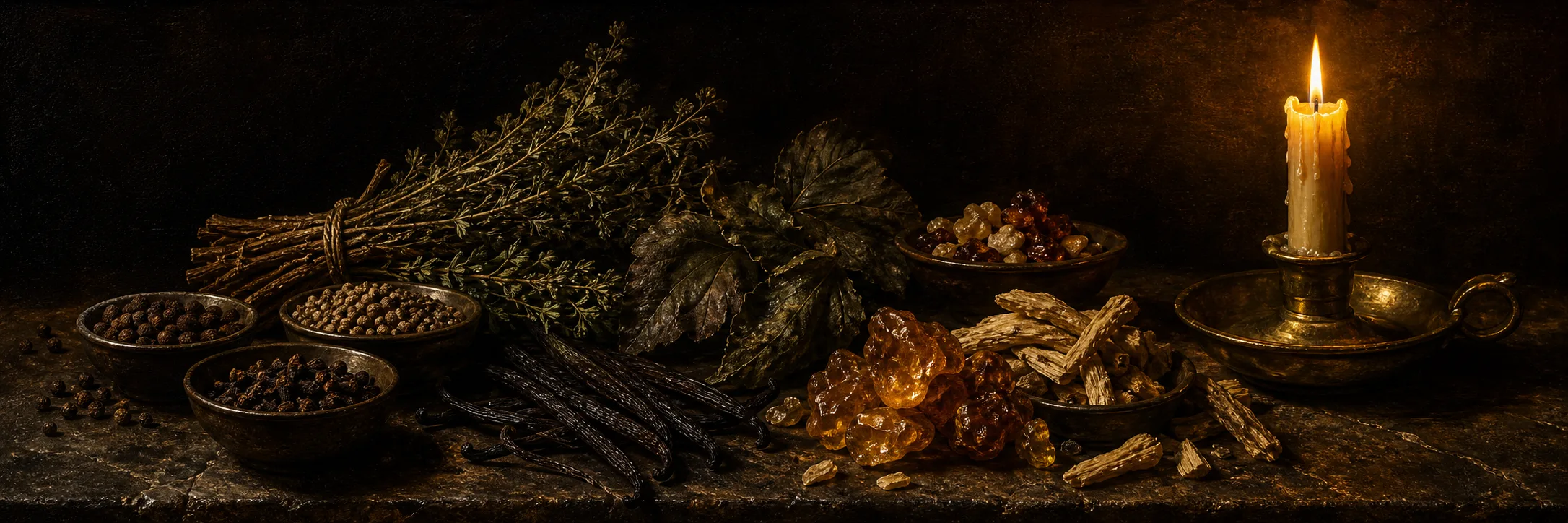
Ambre Sultan (1993) is the herbal-amber benchmark - the perfume that redefined what “amber” could mean in modern niche perfumery by layering a sweet labdanum-benzoin-vanilla core with bay leaf, oregano, myrtle and coriander. Sheldrake and Lutens, drawing on Lutens’s Moroccan years, produced what reads as resin from a souk apothecary jar rubbed against a handful of crushed Mediterranean herbs. Victoria Frolova at Bois de Jasmin called it the modern “amber gold standard.” It is widely imitated and remains, three decades on, the reference herbal amber.
Scent Profile
The first ten to twenty minutes open with a strikingly green, aromatic, almost savory accord. Bay leaf and oregano dominate - Bois de Jasmin describes the effect as “tomates a la provencale (tomatoes grilled with parsley and oregano)” - sitting over a coriander-myrtle top that adds a peppery, almost lemony brightness. Beneath this, the labdanum-benzoin amber is already present but veiled. This opening is what separates Ambre Sultan from every other amber on the market: most ambers begin sweet, this one begins green.
Performance
Projection is strong but not aggressive - a powerful presence within arm’s length rather than a room-filler. Sillage is moderate-to-strong for the first three hours, then close-to-skin. Longevity on skin is typically 8-10 hours; on clothing and wool scarves, 24+ hours is normal (this is one of the great fabric-cling fragrances). Bois de Jasmin’s review notes its “great tenacity with a powerful sillage” and adds the consistent warning: “be forewarned that proper dosage makes the difference between a caress and asphyxiation.” One spray too many, she writes, “and the beauty of Ambre Sultan becomes smothering.”
Wearing Context
Fall and winter are the primary seasons; early spring works in cooler climates. It is largely unwearable in high summer heat. Time of day: evening and night are natural, but the herbal opening makes it surprisingly viable for daytime in cold weather - Persolaise’s account of his first encounter with Ambre Sultan was on a perfumery counter, not in an evening context.
Comparisons & DNA
The amber reference grid: L’Artisan L’Eau d’Ambre Extreme (sweeter, more vanillic, less herbal - the cozier choice); Maitre Parfumeur et Gantier Ambre Precieux (smoother, more lavender-myrtle, almost amber-on-training-wheels by comparison); Tom Ford Amber Absolute (heavier on the incense and labdanum, no herbs); MFK Grand Soir (modernist take - caramel-amber with no herbs, much smoother and arguably more crowd-pleasing); Profumum Roma Ambre Aurea (denser, sweeter, more honey); Annick Goutal Ambre Fetiche (more leather-laced, lighter herbal); Guerlain Shalimar (the great-grandparent - Ambre Sultan’s vanillic base is in direct Shalimar lineage but stripped of the bergamot-civet opening); Etro Messe de Minuit (incense-heavier cousin).
Reception
Critical reception is unusually unified. Persolaise placed it in his “Favourites” series in July 2024, recalling his first encounter where “words failed me” after spraying. Now Smell This and Cafleurebon have written about it as a benchmark across multiple posts. response is similar. Positive reception is unusually strong. wearers treat it as one of the four or five “you must smell this” niche ambers. Praise centers on the herbal opening, the smoothness of the drydown, the fabric longevity. Criticisms cluster on: (1) the cumin-adjacent angelica facet that some wearers find sweaty or off-putting in heat; (2) the reformulation thinning; (3) the price relative to performance after 2017. Polarization is mild - most people who don’t love it still respect it. Blind buy verdict: low risk if you have already loved any labdanum amber and enjoy herbal accords (oregano, bay leaf). High risk if your reference is something like Mugler Angel - Ambre Sultan is closer in spirit to a Mediterranean kitchen than to a chocolate shop.
Versions & Reformulation
Single composition launched 1993 in the export 50ml format. A perfume confit (a high-concentration oil) was released in late 2021, reviewed by Persolaise on Love at First Scent that December - he wrote that “the passage of a few hours was very kind to this relatively dense format, lending the vanillic, balsamic base a woozy, intoxicating quality.” The confit is the only true concentration variant. Per wearers databases, a “Noel 2000” limited edition of 500 bottles was released, and in 2006 the bottle was reissued under the “Les Fauves Royaux” collection with a Tigre motif assigned specifically to Ambre Sultan. The Collection Noire repackaging in 2017-2018 coincided with a quiet reformulation that critics including Kevin at Now Smell This and several users flagged as noticeably thinner and shorter-lived than pre-2015 bottles. Vintage bottles with the older silver/black label are sought after on the secondary market. The bell-jar 75ml version exists but Ambre Sultan has always been primarily an export-line scent.
Acquisition Notes
Availability varies by market; sample before buying when possible.
Notable Facts & Lore
- Sheldrake’s stated intent for Ambre Sultan, communicated through Lutens’s accompanying copy at launch, was to capture the smell of the dark resinous amber paste sold in Moroccan souks - the “amber” of folk perfumery, not the labdanum-vanilla amber of European perfumery.
- Lutens, who had lived and worked in Marrakech for years, treated the brief as a personal olfactory portrait.
- The herbal contrast was Sheldrake’s solution to a creative problem: a straight souk-amber would have read as generic; the bay leaf and oregano were added late in development to give the composition specificity.