Serge Lutens — Fille en Aiguilles
Essence
Fille en Aiguilles (2009) is Christopher Sheldrake’s refined pine-and-incense fragrance for Serge Lutens - a cool, bracing conifer-resin opening that descends through frankincense smoke into the candied, dried-fruit warmth that defines the Lutens base. Its name puns on “girl in (pine) needles,” “girl in stilettos,” and the idiom “de fil en aiguille” (a seamless transition). Widely regarded as one of the best pine fragrances ever made and a beloved cold-weather/holiday scent, it carries one persistent, near-universal criticism: it wears close and doesn’t last. A connoisseur’s pine, made with material quality cheaper coniferous scents can’t match.
Scent Profile
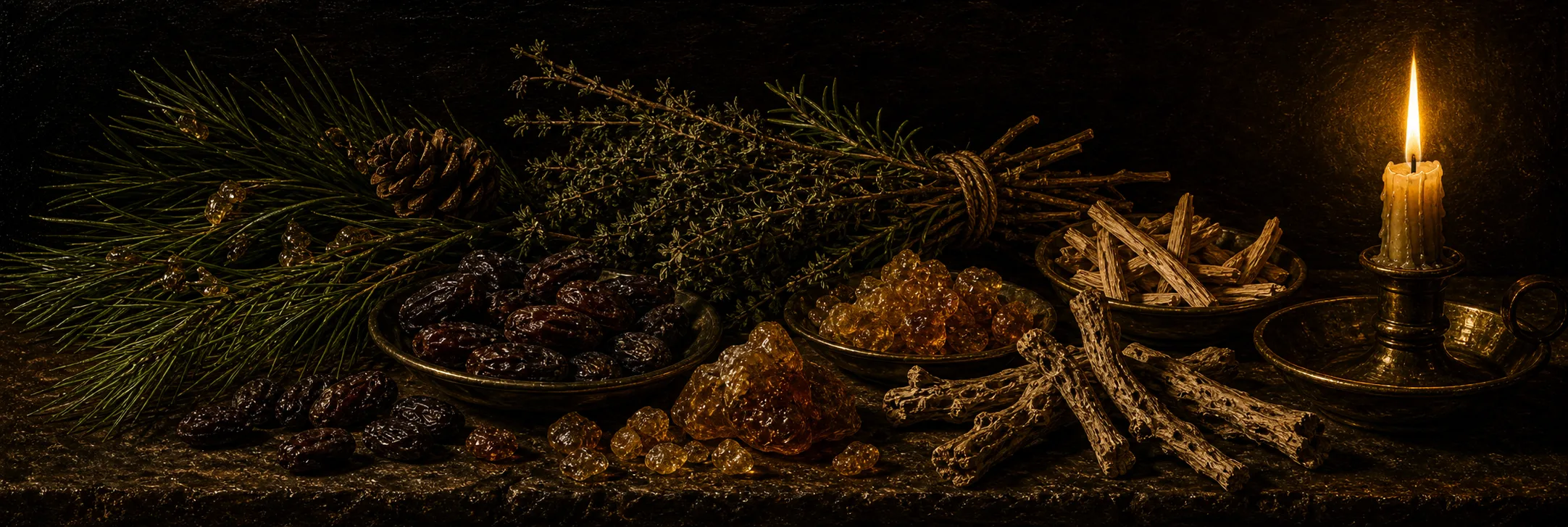
Built on pine needles, balsam fir, dried fruits, spices, bay leaf, frankincense, vetiver and a “solar” herbal facet, the composition opens cool and bracing - a fresh conifer-resin blast that Now Smell This and wearers describe as a Mediterranean umbrella-pine forest. Frankincense descends quickly, draping smoke over the pine blanket. Kafkaesque captured the opening as “like a pencil eraser on paper,” with a tangy-sweet plum fruitiness, a green resinous note threaded with smoke, plus cardamom and red pepper. From there it develops into a sugared, smoked, spiced woodiness with frankincense running throughout, softening to a honeyed woodiness by around hour six. The candied-fruit/cedar foundation is explicitly reminiscent of Lutens’ own Feminite du Bois and Arabie - the toasted-plum compote that recurs across the line. After the first hour it is largely linear: the central pine-resin-incense-fruit accord holds without dramatic further development. Perceptible throughout: pine/fir, frankincense, dried fruit; vetiver and the herbal “solar” notes lift the late drydown.
Performance
Performance is the fragrance’s defining weakness and the single most consistent criticism across every documentation tier. Now Smell This (Kevin, December 23, 2009) put it plainly: the scent “has good staying power but close-to-the-body sillage.” In practice many wearers report less - The Fandomentals warned “don’t expect for this to go strong much longer than four hours,” and multiple reviewers cite three to four hours. One wearers reviewer named “weak longevity and low sillage” as “the fly in the pine amber.” The flip side of its restraint is wearability: it is less sweet and cloying than many Lutens, and several reviewers happily wear it even in heat. Apply generously and expect an intimate, close-wearing scent rather than a projector.
Wearing Context
This is an autumn and winter fragrance first - a holiday/Christmas scent and a meditative comfort wear, suited to cold air where the pine and incense read cozy. A minority wear it year-round, including in hot and tropical climates, taking advantage of its relatively low sweetness. It reads contemplative and refined rather than loud or seductive; its close sillage makes it inoffensive in shared spaces but a poor choice when you want presence. It shines as a personal, cocooning cold-weather scent for someone who loves coniferous and resinous compositions.
Comparisons & DNA
The classic pairing - and rivalry - is Parfum d’Empire Wazamba (2009), the other great pine/incense release of that year; Now Smell This’ Kevin framed it memorably: “Fille en Aiguilles is the Marquise de Pompadour (cool, cerebral, urbane) to Wazamba’s Madame du Barry (emotional, buxom, provincial). Which do I prefer? The floozy.” Profumum Roma Arso shares the piney profile but is bolder and more campfire, where Fille is prettier and more nuanced with winter spices. Slumberhouse Norne is syrupier and gothic (“woods and spice”), Fille more refined (“fragrant woods and sweet woods”). Comme des Garcons Zagorsk shares the conifer/frankincense/spice heart but reads cooler; the Lutens is warmer and sweeter. Tom Ford Plum Japonais is widely considered a near-copy - Kafkaesque called it “Fille en Aiguilles done very, very badly” (roughly 90% the same), with Fille the original and the better of the two. Within the house, Arabie and Feminite du Bois share its dried-fruit-compote base. On clones: there is essentially nothing cheaper that matches - Sheldrake’s material quality is repeatedly cited as the reason to choose it; Abbott Sequoia is mentioned by one reviewer as a similar-and-cheaper option.
Reception
This is one of the best-documented fragrances in its research cohort, with named critical attention behind it, and the consensus is strongly positive - “holy grail” status, “massively beloved amongst almost everyone who has tried it.” Luca Turin reviewed it in the 2009 paperback expansion of Perfumes: The A-Z Guide; his verdict is famously ambivalent (“Tricky to give a verdict on: imagine the thumb wiggling”). Denyse Beaulieu (Grain de Musc) reviewed it positively in 2009 and bought a bottle; Now Smell This (Kevin) covered it the same year. Polarization centers on two things: the weak performance, and the high price. A minority find it one-dimensional (a “one-trick pony”), too sweet, or even household-cleaner-like. It is not a safe blind buy for anyone who dislikes pine, but close to one for pine lovers.
Versions & Reformulation
An Eau de Parfum Haute Concentration. It began as an export-line scent in the oblong rectangular bottles (50 ml, roughly 95/$140 at launch), and later moved to the more expensive Gratte-Ciel (“skyscraper,” 100 ml, ~305-375) and bell jar / Flacons de table (Paris Exclusive) formats. Reformulation chatter is moderate: older rectangular-bottle versions are said to have had a deeper base, while recent Gratte-Ciel and bell-jar versions still “very much smell like Fille en Aiguilles” per owners, though one reports a sharper fir note. Kafkaesque (2017) reported it had not been “badly gutted.” The juice is naturally dark (dyed); a clear or watery juice is a red flag for a fake.
Acquisition Notes
Availability varies by market; sample before buying when possible.
Notable Facts & Lore
- The name layers three meanings: “Fille en Aiguilles” reads as “girl in (pine) needles” and “girl in stilettos / high heels,” and it also evokes the idiom “de fil en aiguille” (a seamless transition) - which Turin noted in his review.
- Lutens’ own stated inspiration was a pine forest in summer sun: “Pine needles.
- Resin, sunshine, cicadas and the shade of tall pine trees.
- The needles prick your feet, but a stand of pines by the beach is a wonderful thing!“ - a beach/Mediterranean framing that confused some reviewers expecting a wintry scent.
- Turin’s verbatim 2009 review is vivid: “…the top of this has heady outreach, like umbrella pines…
- A fine kerosene/caramel ambiguity…
- The delicious teetering between piny and sweet can’t last, and the scent soon descends into a luscious maple syrup candy, into that ole Serge Lutens soup o’fruits, the toasted plums of Arabie…