Acqua di Parma — Acqua di Parma Blu Mediterraneo - Mandorlo di Sicilia
Essence
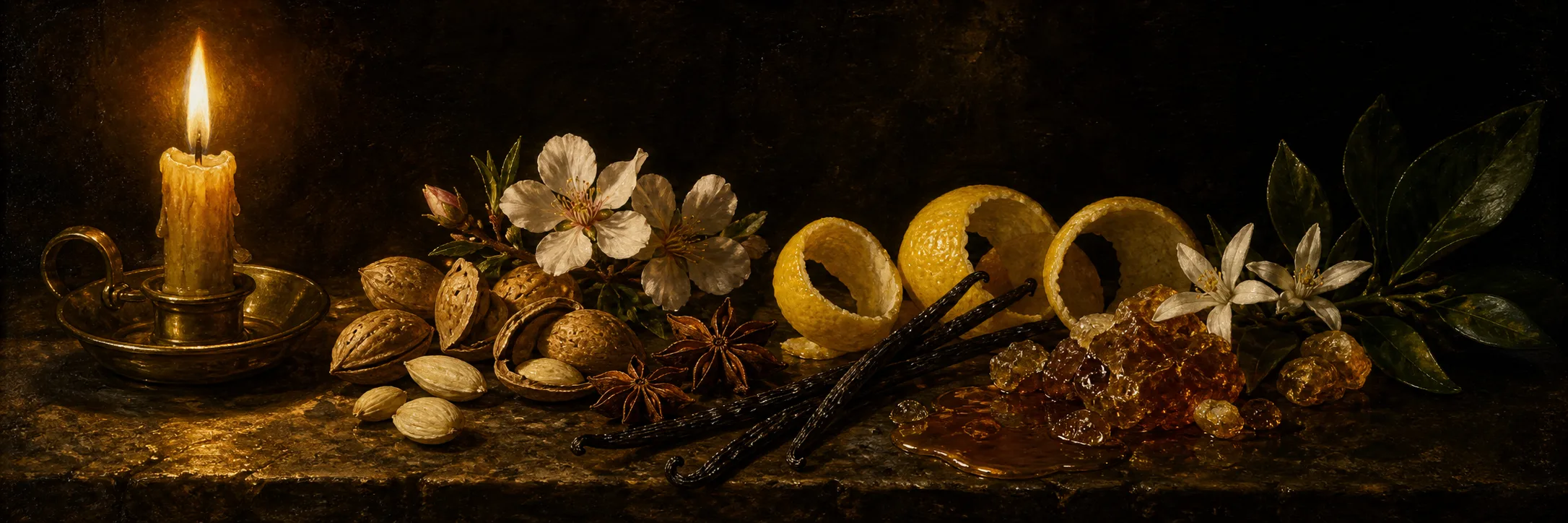
Mandorlo di Sicilia (“Sicilian Almond”) is the gourmand outlier of Acqua di Parma’s Blu Mediterraneo collection — an Eau de Toilette built around a creamy, marzipan-like almond and bourbon vanilla, in deliberate contrast to the line’s signature bright citrus-aromatics. Where Arancia di Capri, Fico di Amalfi and Mirto di Panarea evoke a Mediterranean coast, this one evokes a Sicilian patisserie. It is widely regarded as one of the most realistic and wearable almond fragrances in the designer/niche space, and it was a relatively early gourmand at a time before the 2000s gourmand boom.
Scent Profile
The fragrance opens on a divisive accord that wearers describe through food and drink: sweet almond, orange and creamy vanilla that reads to many as a “root beer float” or root-beer-candy fizz, with star anise supplying a licorice-and-almost-menthol cooling lift and bergamot a brief bright edge. Frangipani and orange blossom round the top. As it settles, the almond comes forward in a marzipan/amaretto register over white peach, ylang-ylang and a touch of jasmine, before resolving into a warm, powdery base of bourbon vanilla, tolu balsam, white musk and cedar. Two camps emerge over the opening: admirers find it a “photorealistic” almond and “the closest expression to amaretto” in a fragrance; detractors find the orange-vanilla-anise blast medicinal — one reviewer memorably dubbed it “Eau de Tussagesic” after a childhood cough syrup. The drydown is the area of broadest agreement: a cozy, non-sugary vanilla-and-balsam skin scent that even the opening’s critics concede is the best phase.
Performance
Performance is the consistent knock. As a light EDT it is moderate-to-poor in longevity and intimate in projection — commonly cited at four to six hours, becoming a skin scent after the first few hours. A vocal minority disputes this, reporting strong tenacity on skin and clothes (“I have clothes that smell days after being sprayed”), but the dominant view, including from longtime devotees, is that “longevity and projection are not great. “ The practical upside repeated across reviews: it is so light and inoffensive that you can over-spray freely without it becoming overbearing.
Wearing Context
Unusually for the Blu Mediterraneo line, Mandorlo di Sicilia is often recommended for mild-to-cool weather and even autumn/Advent wear rather than peak summer heat — its warmth, sweetness and powder read as cozy. That said, plenty of wearers treat it as a warm-weather gourmand and a vacation/holiday scent. It is genuinely unisex, though it leans slightly feminine on some skins; it is consistently described as a personal, comfort-wear “guilty pleasure” rather than a projecting statement scent. Casual daytime, relaxed weekends and intimate settings are the natural fit.
Comparisons & DNA
The most cited comparison is amaretto/marzipan itself — this is a benchmark “realistic almond. “ Wearers also reference Parfums de Marly Layton (“without the awkward mintyness/spicyness… fresher, smoother”) for the sweet-almond-anise effect, Lolita Lempicka and other anise-forward gourmands, and root-beer/cream-soda candy. Within its own line it is the gourmand odd-one-out; comparison-shoppers weigh it against Arancia di Capri (simpler, brighter, slightly better projection) and Fico di Amalfi (greener, more polarizing fig). Niche almond alternatives raised by the wearers include higher-performance options for those who love the profile but want more sillage.
Reception
Among almond and gourmand lovers, Mandorlo di Sicilia enjoys near-cult status — “a masterpiece,” “the most beautiful and elegant almond perfume,” a nostalgic summer-and-Italy memory scent for long-term wearers. Outside that audience it is genuinely polarizing: the star-anise/root-beer opening draws strong reactions, and at least one reviewer rated it the worst of the Blu Mediterraneo scents he sampled, citing the medicinal cough-syrup association. The fairest summary is that it is a love-it-or-leave-it profile executed at high quality, with performance as the main caveat even for fans. No documented review by Luca Turin or Tania Sanchez (in Perfumes: The Guide or elsewhere) could be located for this fragrance, so its critical reputation rests on consensus rather than coverage.
Versions & Reformulation
Mandorlo di Sicilia is offered as an Eau de Toilette, with a matching bath-and-body line (shower gel, body cream) that wearers use to extend its modest longevity. No reformulation history is documented in available sources. The broader Blu Mediterraneo line received a 2025 “La Riserva” reinterpretation that intensified three other scents (Arancia di Capri, Fico di Amalfi, Mirto di Panarea); per Wallpaper*, quoting Acqua di Parma head of product development Paola Paganini, the reinterpretation used an eight-week (two-month) maceration process to dial up “intensity and sillage” — but Mandorlo di Sicilia was not among them, so its formula appears unchanged.
Acquisition Notes
Because performance is modest and the bottle is expensive at full retail, the wearers repeated advice is to buy discounted: tester bottles and discounter stock are often available at steep markdowns, which lets you spray liberally without anxiety. A decant or sample first is strongly advised given how polarizing the opening is — if the root-beer/anise accord doesn’t work for you, no amount of quality will redeem it. Conversely, if you love realistic almond, this is treated as close to mandatory.
Notable Facts & Lore
- There is a genuine dating discrepancy worth flagging: the catalog and wearers both list 1999, and Acqua di Parma’s corporate history states the Blu Mediterraneo line launched “the following year” after the 1998 Via Gesù boutique (i. e., 1999) — yet other Acqua di Parma-aligned histories, including Escentual’s, state the line was “kickstarted with… Arancia di Capri in 2000.
- “ Sources thus conflict between 1999 and 2000 for the line’s debut; the catalog’s 1999 is defensible but not unanimous.
- Separately, no individual perfumer is credited — like much of Acqua di Parma’s output from this era it is attributed to the in-house team, and a third-party retailer’s attribution to Bertrand Duchaufour could not be verified and should be treated as unconfirmed.
- The almond itself is marketed as the prized Avola almond of Sicily, and “Mandorlo di Sicilia” translates literally to “almond tree of Sicily.
- “