Acqua di Parma — Blu Mediterraneo Arancia di Capri
Essence
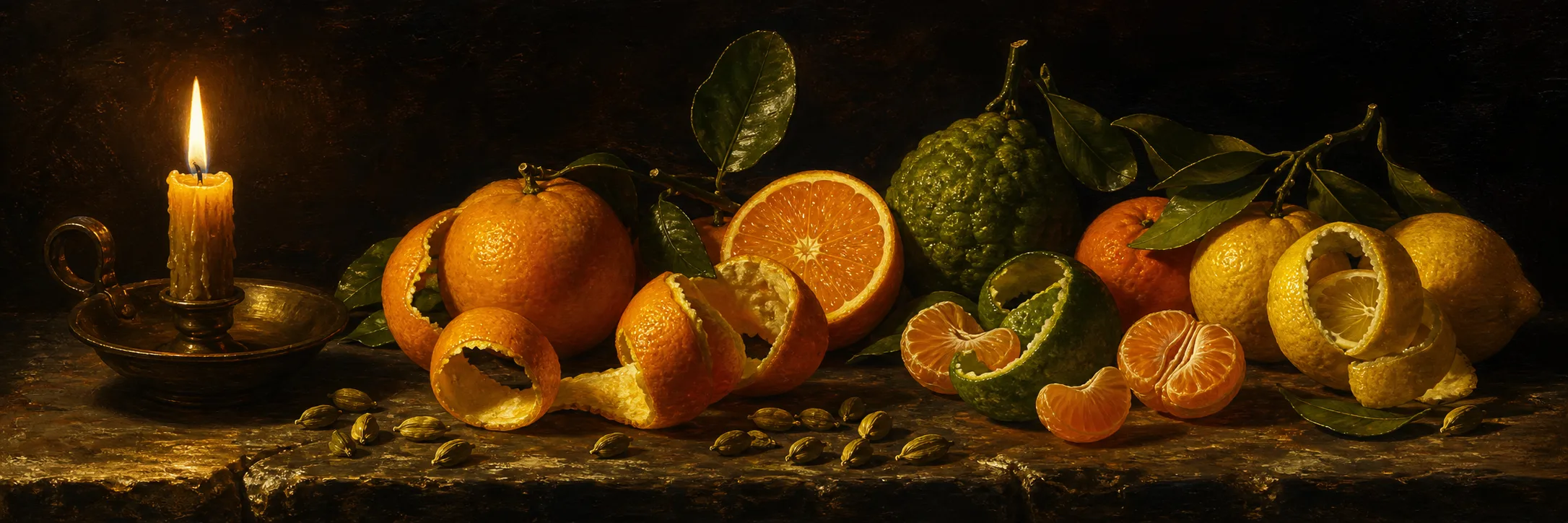
Arancia di Capri is the orange-zest benchmark of modern Italian cologne — a 1999 EDT that helped launch the Blu Mediterraneo line and codified what a “luxury freshie” was supposed to smell like in the early 2000s. It is essentially a high-resolution photograph of a freshly peeled Sicilian orange, lit by a faint cardamom flicker and softened by a sweet musk wash. There is no story, no journey, no surprise. The whole point is the postcard: a single bright moment, expensively rendered, deliberately fleeting.
Scent Profile
The opening is the thesis statement, and it lands within seconds: a vivid, juice-and-peel orange accord that reads as sweet orange flesh and bitter rind simultaneously, ringed by Sicilian mandarin (the candied/clementine facet) and pricked by bergamot’s bittersweet sparkle. There is a brief flash of grapefruit-like sharpness on cold-skin application that fades fast. The lemon is structural rather than featured; it brightens the orange but doesn’t take a solo. For the first ten to fifteen minutes this is essentially orange-juice-with-zest, and reviewers frequently reach for the same shorthand: orange soda, Capri Sun, fresh-squeezed. The heart is where the composition narrows rather than develops. Petitgrain pulls in a green, woody-bitter twig facet — the orange-tree side of the citrus — and a sawdusty, pithy quality emerges that prevents the whole thing from collapsing into Fanta. Cardamom is listed but rarely perceived clearly; it functions as a faint pod-spice warmth under the petitgrain rather than a recognizable note. Most experienced wearers report the cardamom as submerged or absent, and many ding the pyramid for promising it on paper without delivering it on skin.
Performance
Performance is the chronic complaint and the structural limitation of the entire Blu Mediterraneo EDT line, and Arancia di Capri is a textbook case. Projection is light-to-moderate for the first thirty to forty-five minutes (roughly an arm’s length in still air), drops to intimate within ninety minutes, and is essentially skin-scent territory by hour two to three. Sillage is short — you will smell yourself; others will need to be close.
Wearing Context
This is a daytime, warm-weather fragrance with a narrow but excellent core use case. Peak season is late spring through early autumn; it falls flat in genuine cold and reads as out-of-context when worn with heavy clothing. Best time of day is morning to mid-afternoon — it is essentially an olfactory espresso. Office, brunch, errands, casual lunches, beach club, hotel pool, Italian summer wedding before the ceremony — all native settings. It is at its most useful in hot, humid environments where heavier fragrances would suffocate.
Comparisons & DNA
Arancia di Capri sits in a small group of “Italian sweet orange” benchmarks. The closest sibling is Bond No. 9 Little Italy (2003), which several reviewers note smells “remarkably similar” in its woody-sweet-orange register, just with slightly more amber depth and better persistence. Hermès Eau de Cologne Orange Verte and its Concentrée flanker share the orange-and-greenery skeleton but go drier and greener, with no caramel sweetness; they are the more austere cousin. Atelier Cologne Orange Sanguine pushes harder on the blood-orange juicy facet and lasts noticeably longer, while Annick Goutal Eau de Sud and Eau d’Hadrien stay tarter and more bitter. D&G Light Blue lives in the same hot-day genre but is lemon-apple, not orange. Within the house, Arancia di Capri is the citrus-forward counterpoint to Acqua di Parma Colonia: where Colonia is bergamot-lavender-rose-cologne classicism, Arancia is single-note orange photography.
Reception
Consensus across wearers is bifurcated along one axis: the juice is widely praised as one of the most natural and beautiful orange accords in commercial perfumery, and the performance is almost universally criticized relative to price. a wearer reviewer editorial coverage of the line repeatedly calls it “true to its name” and one of the line’s icons; the user score sits in the strong-positive band, but the longevity and value sub-scores routinely drag the overall down. Common praise: realism of the orange, lift and mood-elevation, photogenic simplicity, high quality of materials, the cardamom-petitgrain green underlay that keeps it from going saccharine, and broad unisex wearability.
Versions & Reformulation
The original 1999 Arancia di Capri EDT has stayed remarkably consistent in character across batches, though longtime wearers occasionally note subtle production-to-production variation in opening intensity (likely natural citrus oil supply). No major reformulation event has been publicly documented. Concentration variants and flankers do exist. Arancia di Capri La Riserva (2025) is an EDP-strength reinterpretation produced via a two-month maceration process, with a reworked composition (blood orange, mandarin, petitgrain bigarade; basil, rosemary, mineral-salt; cedarwood, ambrettolide, suede). The nose for La Riserva is credited as Jérôme Di Marino.
Acquisition Notes
Pricing position: upper designer / entry niche. Retail at Acqua di Parma boutiques and full-price retailers (Nordstrom, Saks) is roughly USD $145 for 75 ml and ~$225 for 150 ml as of recent listings; discounters (FragranceNet, FragranceX, Notino, Jomashop) routinely cut 30–40%, with 150 ml testers commonly seen at around USD $90–110. The 30 ml is the gift size, the 75 ml is the standard, and the 150 ml is the value-per-ml option for fans.
Notable Facts & Lore
- Arancia di Capri is one of the four original 1999 Blu Mediterraneo launches and the entry that became, by consensus, the line’s signature citrus — the one Acqua di Parma is still trading on twenty-five years later.
- The perfumer for this specific composition is not publicly documented; Bertrand Duchaufour authored Cipresso di Toscana (2005) and François Demachy is credited on Mirto di Panarea (2008), but Arancia’s nose remains uncredited in standard databases.
- The fragrance’s commercial significance is partly external: it was Acqua di Parma’s evidence to LVMH (which acquired the house in 2003) that the brand could build a modern line outside the original 1916 Colonia, and the Blu Mediterraneo formula — “single ingredient from a single Italian region, in a blue cylindrical bottle” — became the template for everything that followed (Bergamotto di Calabria, Fico di Amalfi, Mirto di Panarea, Chinotto di Liguria, Ginepro di Sardegna, Mandarino di Sicilia, etc. ).
- The fragrance has been a steady catalog presence rather than a viral one; TikTok-era influencer hype has largely landed on its sibling Fico di Amalfi instead.
- It does appear regularly in “best summer fragrance” YouTube lists from Jeremy Fragrance, Curly Fragrance, Mike Pretto and others, almost always with the same caveat: “smells incredible, doesn’t last.
- “ Acqua di Parma’s 2025 launch of the La Riserva collection — and specifically the inclusion of Arancia di Capri as one of the three originals chosen for the maceration treatment — is the clearest acknowledgement by the house that the longevity criticism finally needed an answer.