Acqua di Parma — Zafferano
Essence
Zafferano is Acqua di Parma’s saffron-led entry in its premium “Signatures of the Sun” line, originally a Harrods exclusive. Despite a spice-forward name and a floral-oriental classification, it wears as a bright, citrus-and-white-floral scent built on a curiously soft, almost violet-like saffron rather than the dense leathery-medicinal saffron of many oud-saffron compositions. The vanilla-tonka base gives it warmth without heaviness. It is the rare “saffron” fragrance that reads as luminous and clean rather than smoky, making it a transitional spring/summer scent dressed in expensive Italian restraint.
Scent Profile
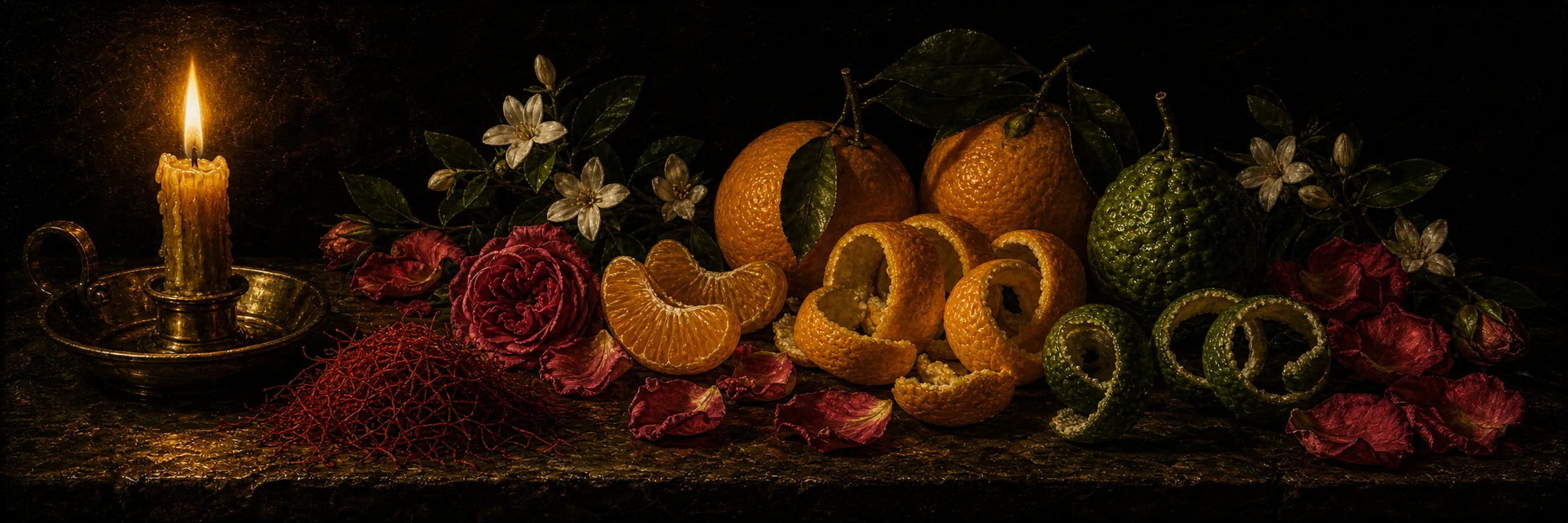
The listed top notes — bitter orange, mandarin, coriander, bergamot — dominate the first 10–20 minutes, and this is the loudest the fragrance ever gets. The opening is unmistakably an Acqua di Parma citrus: bright, slightly bitter, effervescent, with the coriander adding a faint green-spicy lift that keeps it from being a simple cologne. Saffron is barely perceptible at first; reviewers consistently note the citrus “enhanced by saffron which is barely perceptible. “ Through the first hour, the citrus recedes and the heart emerges: saffron, geranium, orange blossom, rose, jasmine sambac. The signature accord here is the unusual one — the saffron does NOT manifest as the dry, suede-leather, iodine-tinged saffron of Middle-Eastern-style compositions. Instead, multiple wearers describe it as “soft, almost violet-like,” merging with the florals into an aromatic-citrusy-white-floral character. The orange blossom and jasmine sambac are perceptible and lend a “girly,” sweet floral cast that some find feminine-leaning; rose and geranium sit underneath, more structural than prominent. This is a fragrance that evolves moderately rather than dramatically — citrus-forward to floral-saffron, then to a soft sweet base.
Performance
Consensus pegs Zafferano as a light-to-moderate projector with a notable caveat: it has a genuinely strong first hour. One detailed wearers review notes it “makes itself known and sparks curiosity” in the opening hour, then “becomes more intimate, lingering on the skin for 5-6 hours and on clothes for even longer. “ Skin longevity clusters around 4–6 hours per multiple wearer accounts, which several reviewers flag as the fragrance’s main weakness — “like almost all of its brothers and sisters, [it] could benefit from more longevity.
Wearing Context
Zafferano is fundamentally a warm-weather, daytime fragrance. Best seasons are late spring and summer; reviewers repeatedly file it as a “summer fragrance” and a “freshy” with signature potential for citrus-and-saffron lovers. Time of day skews daytime and early evening, owing to the bright opening, though the sweet vanilla-tonka drydown makes it serviceable into a warm evening. It shines in casual-to-smart daytime settings, office wear (it is inoffensive and clean), and warm-climate travel.
Comparisons & DNA
The most striking wearers comparison is to Dior Midnight Poison. A reviewer writes that “after several years of discontinuing midnight poison by Christian Dior and our hearts are still sad about it, we have the one that is closest to the fragrance of that time… it does not have the trail as powerful as the mythical midnight poison but it does have the duration. “ That points to a shared dark-rose-amber lineage, though Zafferano is brighter and more citrus-forward. Within saffron fragrances, Zafferano sits at the opposite pole from the dense saffron-leather of Maison Francis Kurkdjian’s saffron work or the medicinal saffron of oud-saffron compositions; it is far softer and more floral.
Reception
Established critics (–2) coverage of Zafferano is thin to nonexistent; this is a premium-distribution release that the major niche blogs did not substantially review. Reception must therefore be read from wearers sources, and that signal is moderately positive. Common praise: an unusual, “unexpected and vibrant” take on saffron; high-quality, natural-smelling materials; an addictive, elegant character; and strong performance on fabric. One enthusiastic reviewer calls it “one of the most interesting summer fragrances I have ever smelled. “ A South Asian reviewer for whom saffron is a familiar culinary note praised it as a “final boss of saffron fragrances” that “completely repurposed these spices to make a truly unique floral.
Versions & Reformulation
Zafferano launched in 2022 as an Eau de Parfum and was originally created as a Harrods exclusive before wider Acqua di Parma distribution. There is a later, more concentrated sibling — Zafferano Ambrosia Extrait de Parfum (50ml) — which is a distinct, richer interpretation rather than simply a stronger version of the same juice; documented in-wear comparison between the EDP and the Extrait is sparse, so treat them as related but separate compositions. No significant reformulation of the EDP is documented in available sources.
Acquisition Notes
Zafferano sits in the luxury designer/premium positioning. It is available in 100ml and 180ml Eau de Parfum; per Harrods listings the 180ml retails around £415–€415 / $430, placing it well above mainstream designer pricing. The Zafferano Ambrosia Extrait (50ml) runs roughly $295. reliable purchase channels: Acqua di Parma boutiques and acquadiparma. com, Harrods (its origin retailer), and major luxury department stores (Bloomingdale’s, Selfridges, Space NK). Grey-market discounters list it well below retail — a wearer reviewer price widget on the Zafferano page lists “Jomashop. com 3 items for 19.
Notable Facts & Lore
- The perfumer is not publicly documented.
- The fragrance’s stated concept, per Acqua di Parma, is “an olfactory translation of the Venetian terrazzo’s compositional technique” — the Venetian craft of binding precious materials (gold, marble, Murano glass) into an ornamental whole — using Venice as a “metaphorical intersection between East and West” along the historic spice route.
- Saffron is foregrounded as “red gold,” a nod to Iranian/Middle-Eastern saffron, “known as ‘red gold’ because of the process by which it is harvested” — saffron is famously among the most labor-intensive spices on earth, requiring roughly 150,000 hand-picked crocus flowers to yield a single kilogram.
- The most concrete piece of release lore is its origin as a Harrods exclusive before broader rollout — the fragrance “was originally created for Harrods,” per a wearer reviewer database note.
- No major celebrity associations, viral TikTok moments, or controversies are documented in available sources; this is a quiet, under-the-radar luxury release rather than a hype object.
- Coverage is genuinely thin beyond wearers databases, and that gap is worth flagging plainly to anyone researching it.