Acqua di Parma — Blu Mediterraneo Mirto di Panarea
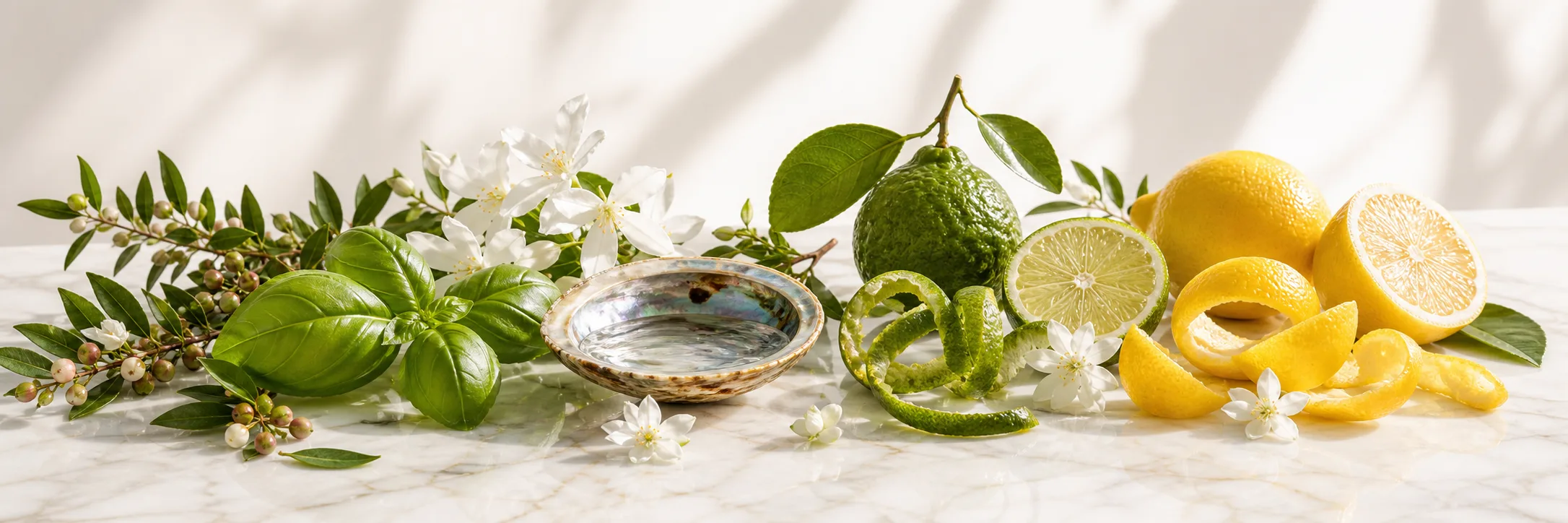
Essence
Mirto di Panarea is Acqua di Parma’s herbal-aquatic detour inside the citrus-heavy Blu Mediterraneo line: a François Demachy composition built around myrtle berry and basil over a thin saline accord, with a soft amber-cedar landing that keeps it from evaporating in a single hour. It is the line’s most “green” entry — less Capri-orange-grove, more Aeolian-island scrubland after rain — and the one most often defended as having genuine character rather than designer-aquatic interchangeability. Unisex, EDT, summer-coded, polarising on performance.
Scent Profile
The opening is not the bright-fruit citrus shock of Arancia di Capri or Bergamotto di Calabria; it is cooler and more astringent. Italian lemon and bergamot register for the first three or four minutes as a thin halo around a pronounced green-aromatic accord — basil leaf and myrtle reading together as bruised herb stems rather than kitchen herbs. The myrtle here is the berry-and-leaf rendition, slightly resinous, faintly juniper-adjacent, with a recurring “soapy clean” facet that many wearers describe. By the 30–60 minute mark the citrus has burned off and the heart resolves into a sea-breeze-musk accord (the listed “sea notes”) layered against a quiet jasmine-and-damask-rose pair. The florals are barely perceptible as florals; they function as a creamy connective tissue that softens the herbs and the salt. Damask rose adds almost no rose-petal smell — it shows up only as a damp weight under the myrtle. Jasmine is even more submerged; do not expect indole.
Performance
Light projection at one foot for the first 30 minutes, then a close-to-skin signature thereafter. Sillage is intimate. Longevity on skin runs 3–5 hours for most wearers, with about 90 minutes of that being clearly audible and the remainder a soft second-skin. On cotton or linen the dry, woody-amber base hangs on for 8–12 hours. In hot, dry weather the herbs bloom and the salt accord opens up — this is its native environment. In humidity the saline thins into a vague clean impression.
Wearing Context
Spring and summer are its only true seasons; late spring through early autumn in temperate climates, year-round in genuinely Mediterranean ones. Daytime over evening; brunch, beach club, sailing, outdoor lunch, hot-weather office, post-shower commute. The herbs make it slightly more “going somewhere” than the line’s pure-citrus entries, so it works for warm-weather business casual where Arancia di Capri would feel like a beach holiday smell. Where it shines: in heat, against bare arms and white linen, when the air is moving. Within ten metres of saltwater it stops being a fragrance and starts being site-specific.
Comparisons & DNA
Within Acqua di Parma, Mirto sits opposite the citrus-forward Arancia di Capri and Bergamotto di Calabria (sweeter, simpler, more “juice”), and shares more architectural DNA with the now-discontinued Cipresso di Toscana (drier, more coniferous) and with Ginepro di Sardegna (sharper juniper). Within the Colonia family it is distinct: cooler and greener than Colonia Essenza, less floral than the original Colonia, less aromatic-fougère than Colonia Club. Against other houses, Eddie Bulliqi at wearers reads it as “a bit like an elevated Bleu De Chanel on the skin, if Bleu’s sugar-cube grapefruit was transformed with pine needles, gin, and berry jam” — the comparison is generous to Mirto but architecturally accurate (aromatic-woody-amber spine, greener and less synthetic than Bleu de Chanel). Hermès Un Jardin sur la Méditerranée and Eau de Narcisse Bleu live in adjacent territory (myrtle and Mediterranean herbs) but are flatter and more abstract.
Reception
Wearers aggregate ratings sit in the high-3 to low-4 range out of 5 — solid but not adored. The consensus splits along a single fault line: scent vs performance. On scent, the praise is consistent — “natural,” “realistic,” “transporting,” “Mediterranean garden by the sea,” “the most realistic scents I’ve ever come across. “ On performance, the criticism is just as consistent and louder: “two hours and gone,” “below average,” “weak,” “overpriced for what you get. “ wearer discussions threads routinely surface it as a sample-only recommendation; blind-buying a full bottle at retail is widely discouraged.
Versions & Reformulation
The 2008 EDT in the standard Blu Mediterraneo cylinder bottle is the reference. A 2021 Limited Edition repackaging carried the same juice in a decorated bottle. A 2025 “Summer Edition” was released with effectively the same composition and the same Demachy attribution but a designer-signed Ben Arpea bottle.
Acquisition Notes
Pricing position: niche-adjacent designer (LVMH-owned). Standard sizes are 75ml and 150ml EDT in the Blu Mediterraneo cylinder. Boutique retail in the US sits around $130 for 75ml and around $200 for 150ml (approximate; pricing varies by retailer and over time); EU pricing similar in euros. Discounters (FragranceNet, Jomashop, Notino) regularly carry it at 30–50% below boutique pricing, and grey-market 75ml bottles can often be had under $90. Decant ecosystem: well-supplied.
Notable Facts & Lore
- Panarea is the smallest inhabited island of the Aeolian archipelago off the north coast of Sicily — a roughly three-square-kilometre volcanic outcrop whose maquis (myrtle, juniper, mastic, lentisk) is the explicit visual inspiration for the composition.
- Demachy was Dior’s in-house perfumer at the time of creation and remained so until 2018; Mirto di Panarea is a frequent inclusion on enthusiast lists of his best work outside Dior, and Eddie Bulliqi argues at wearers that the combination of “myrtle, basil, and juniper, for garden-fresh pesto, along with mastic and rose,” may make it his best formula.
- The fragrance launched March 2008 alongside the rest of the early Blu Mediterraneo expansion and predates Tom Ford’s Neroli Portofino (also 2008) by months; together the two effectively defined the luxury-Italian-coast cologne category for the decade.
- There is no significant celebrity-association lore for Mirto specifically (those stories all attach to the original 1916 Colonia); no viral social-media moment; no controversy.
- Its place in the brand mythology is as a workhorse of the line — the herbal alternative that the brand and the wearers both reach for when the citrus entries feel one-note.
- Persolaise (Dariush Alavi) has interviewed Acqua di Parma’s master perfumer Giorgio Paganini in the Blu Mediterraneo Bergamotto Di Calabria Spugnatura context, locating the line’s intent in transparent, place-specific Italian olfactory portraiture; Paganini took over creative direction after Demachy’s departure and oversaw the 2025 La Riserva extension.