Acqua di Parma — Iris Nobile Eau de Toilette
Essence
The Iris Nobile Eau de Toilette is the 2004 original of Acqua di Parma’s first dedicated women’s fragrance and the founding scent of its Le Nobili collection. Composed by Francoise Caron and Francis Kurkdjian, it is unusual among iris perfumes precisely because it is not a cold, rooty orris: it captures the iris flower rather than the iris root, a warm, sunny, citrus-and-orange-blossom floral with a sparkling character. Now discontinued, it is prized by those who prefer its luminosity to the darker 2006 Eau de Parfum that followed.
Scent Profile
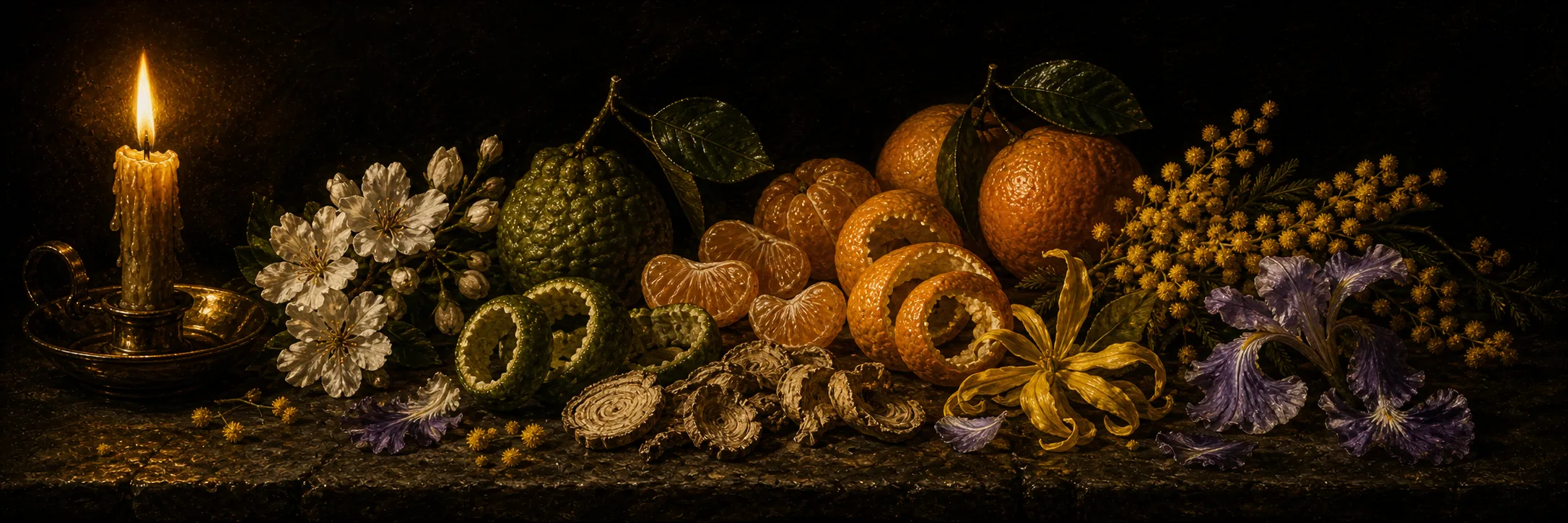
The EDT opens luminous and sparkling, with bright orange, mandarin, and bergamot lifted by a distinctive star-anise note that adds a slightly spicy, licorice-like twist before the florals arrive. The critic Victoria of Bois de Jasmin made the defining point: this is an iris that does not smell of frozen roots but is soft and floral, and the layering of iris with orange blossom brings the composition closest to the scent of real iris flowers. She imagined it as “the scent of an orange iris,” with amber lending a crispness that tempers the creamy warmth.
The heart is a full floral chorus, orange blossom as the most persistent companion to the iris, plus ylang-ylang, tuberose, mimosa, and a cedar nuance. As Now Smell This observed, it reads as a beautiful blend of iris and orange blossom with just a hint of anise, and is as much about orange blossom as it is about iris.
The base is light: soft, slightly powdery vanilla and amber. The recurring critical knock concerns the drydown, where, as Bois de Jasmin noted, the distinctive floral character can blur into a soapy, indistinct arrangement, losing the edge that drew her to the EDT in the first place. The signature accord is sparkling citrus and star anise over a sunny, non-rooty iris-and-orange-blossom floral.
Performance
The EDT’s defining trait is its lightness and short duration, the very thing that pushed some buyers toward the EDP. As Now Smell This noted, the EDT drew complaints about lasting power, and Bois de Jasmin contrasted the two: the EDT touches the skin lightly while the EDP clings; where the EDT fades into a somewhat flat base, the EDP stays vivid. Expect moderate sillage and modest longevity, with some reports of roughly three hours of projection plus skin-scent time. Treat it as a refreshing, close-wearing summer floral rather than a projection or all-day performer, and apply generously.
Wearing Context
By near-universal agreement this is a spring and summer daytime fragrance. Now Smell This called the original EDT one of its favorite summer perfumes, and the house itself launched it as a summer scent, reserving the richer EDP for cooler weather. Bois de Jasmin’s image of a marble cafe table and Earl Grey on a rainy spring day captures its chic, elegant daytime register. It fits daywear, the office, and warm-weather social occasions, reading elegant, feminine, and chic rather than sexy or heavy, polished and tasteful.
Comparisons & DNA
The most important comparison is internal, EDT versus EDP, a well-documented split. The 2006 EDP adds oakmoss, patchouli, and amber for a denser, richer, chypre-twisted fall scent, while the 2004 EDT stays brighter and citrus-led; several writers, including the author at Now Smell This, prefer the EDT’s luminosity even as many readers champion the EDP. Against other irises, it is the warm, floral, orange-iris counterpoint to the cold, rooty school it deliberately departs from, the Serge Lutens Iris Silver Mist, Chanel No 19, and Frederic Malle Iris Poudre lineage. For the EDP’s chypre side, the relevant ancestors are old-school chypres such as Miss Dior, Guerlain Mitsouko, and Gres Cabochard.
Reception
Reception is strongly positive and tinged with mourning over its discontinuation. The EDT in particular enjoys affection as a rare floral iris, of flower rather than root, elegant and summery, praised for its luminous citrus-anise opening, its orange-iris effect, its chic restraint, and its expensive impression. The most consistent criticisms are the soapy, indistinct drydown and weak longevity, and there is a genuine axis of polarization between EDT and EDP loyalists. Notably, Luca Turin and Tania Sanchez rated Iris Nobile relatively modestly in “Perfumes: The Guide,” a four-star “iris gardenia” entry, a cooler critical note against the warmer reception elsewhere. For lovers of warm, non-rooty floral iris the EDT is a worthy hunt; iris purists who want grey, powdery orris should look to the Lutens or Malle school.
Versions & Reformulation
The Iris Nobile story is layered. The 2004 EDT is the original; the 2006 EDP, created with Francoise Caron’s involvement, reworked it into a darker, chypre-leaning composition with oakmoss and patchouli, effectively a different fragrance in feel rather than a simple concentration bump. The line later spawned limited editions in 2008 and 2010 and the distinct 2012 Iris Nobile Sublime, built on a different brief with Tuscan iris, jasmine sambac, birch, and black locust. The EDT here is discontinued, and secondhand EDP bottles can read darker or spicier, suggesting batch variation or aging. Buyers should be clear which version they are pursuing, as the three smell materially different.
Acquisition Notes
Discontinued, so this is a secondary-market item. When current it sold around the EUR 85 / 50 ml tier, in 50 ml and 100 ml bottles with the signature round yellow boxes. Today it must be sourced second-hand, where condition and turning are real risks, since aged citrus-forward EDTs are especially vulnerable to top-note degradation. Buy from sellers who can confirm storage and fill level, prefer boxed examples, and use decants or samples as the lowest-risk way to try it. Watch for listings that confuse the EDT, the EDP, and Iris Nobile Sublime.
Notable Facts & Lore
- Launched in 2004, it was Acqua di Parma’s first women’s fragrance and the founding scent of the Le Nobili collection.
- The collection later grew to include Magnolia Nobile (2009) and Gelsomino Nobile (2011, by Michel Almairac).
- It arrived just after Acqua di Parma joined the LVMH Group in 2001, following the house’s 1990s revival by Della Valle, di Montezemolo, and Borgomanero.
- Its perfumer pairing is notable: Francoise Caron, known for Ombre Rose and Eau d’Orange Verte, with Francis Kurkdjian early in his independent career.
- The brief deliberately pursued the iris flower rather than the iris root, the concept that gives the fragrance its identity.