Acqua di Parma — Colonia
Essence
Colonia is the 1916 Italian cologne that defined the modern citrus-aromatic-floral cologne genre — a Sicilian-lemon top, a quietly rosy lavender-rosemary heart, and a soft woody-musky base anchored by sandalwood, vetiver and patchouli. It is the founding fragrance of Acqua di Parma, the reference point for every “barbershop” and “Italian gentleman” cologne that has been compared to it for a century, and the calibrated expression of understated formality. Unisex by use if not by 1916 intention. The single most-imitated, most-quoted, most-romanticised eau de cologne of the twentieth century outside of 4711.
Scent Profile
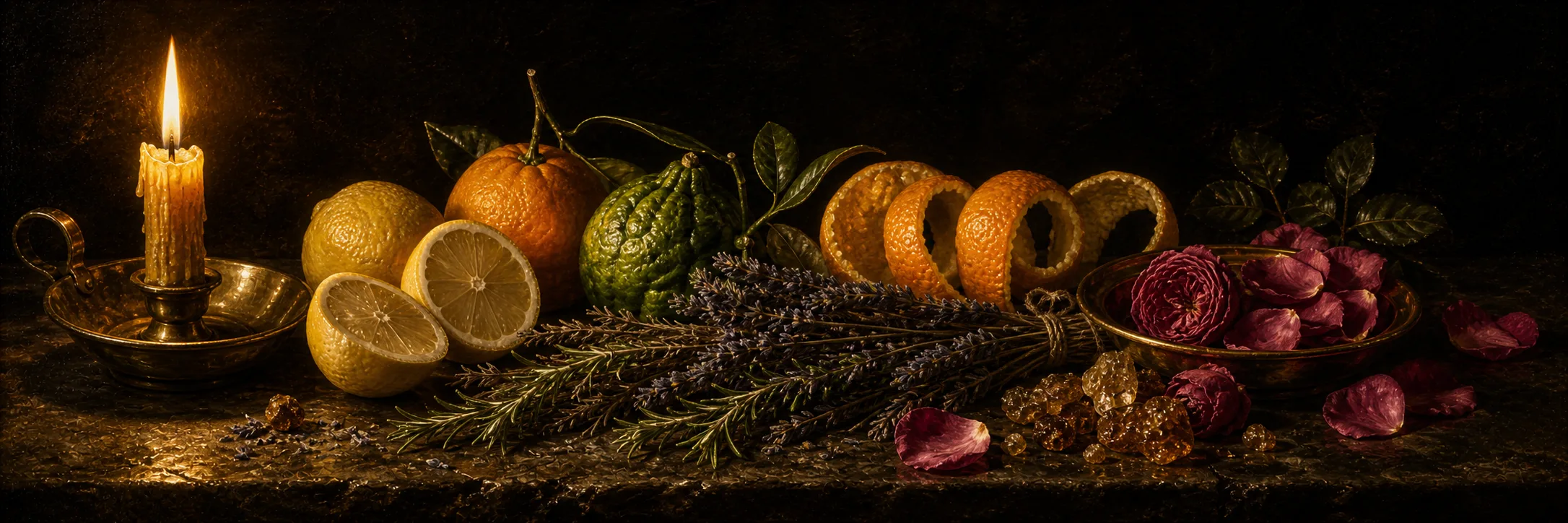
The opening is a coherent yellow blast: lemon and orange in roughly equal proportions, with bergamot smoothing the edges, no single citrus dominating. Compared with northern French and German colognes (4711, Roger & Gallet), the lemon here reads sweeter and rounder, less aldehydic and less “head-shop hippie citrus” — there’s a faint waxy quality from the underlying lavender already coming up. Patricia at Bois de Jasmin (2014) put it well: “Colonia opens with a blast of realistic lemon, like the best-quality, tart, lip-puckering lemon drop imaginable. Almost immediately, the lavender and rosemary are faintly discernable, grounding the citrus with a touch of earthiness. “ The first ten minutes are pure summer-morning brightness; a small minority of wearers find this opening sharp, “lemon Pledge” or headache-inducing on the first inhale (a recurring complaint on some wearer discussions), but for most it is the textbook of how citrus should kick off a fragrance. By 15–30 minutes the heart asserts itself. Lavender is the spine — herbaceous and slightly sweet rather than the dry, bitter Provençal lavender of a fougère. Rosemary is a distinct second presence, more aromatic than medicinal, and verbena threads through both, extending the lemon impression.
Performance
Light to moderate projection in the first hour, then close-to-skin. Sillage is gentle. Longevity is the single most-criticised aspect: on skin, 2–4 hours for most wearers, with some reporting as little as 90 minutes for the citrus before the dry skin-scent stage. On cotton or wool it persists 8–12 hours and is genuinely beautiful as it fades. It performs best when overapplied — six to eight sprays, multiple zones — and benefits from layering with the matching shower gel and the Colonia After Shave Balm, both of which significantly extend the heart on skin.
Wearing Context
Spring through early autumn is the core wearing window; in temperate Mediterranean climates it works year-round. Daytime is its native time, though it is unexpectedly effective at warm-evening events — opera, summer dinner, garden parties — where its understated quality reads as elegant rather than fading. Occasions: business formal, business casual, weddings, weekend brunch, travel, the morning after a long shower. Where it shines: in tailored clothing, in warm weather, on someone over 30. Where it falls flat: in dance clubs, in cold winter, in any context expecting a compliment-magnet scent trail.
Comparisons & DNA
The two unavoidable lineage points are 4711 Original Eau de Cologne (1792) — the Köln ancestor that every Italian and French cologne descends from — and the Guerlain Eaux (Eau de Cologne Impériale 1853, Eau de Cologne du Coq 1894). Colonia is positioned closest to those Guerlain eaux in feel and quality but is rounder and more floral than 4711, more masculine than Eau Impériale, less spicy than the Coq. Floris No. 89 (1951) is a frequent neighbour — barbershop citrus-floral with sandalwood — and is the most direct comparison from the British tradition. Penhaligon’s Blenheim Bouquet is much sharper and more bracing; Trumper’s Eucris drier and more leathery; Geo. F. Trumper’s Extract of Limes is the same idea, simpler and cheaper.
Reception
Wearer consensus: a classic, beautifully made, slightly old-fashioned, frustratingly short-lived cologne that is overpriced at full retail but worth owning at discount. Common praise: quality of materials, naturalness of citrus, elegance, versatility, “smells like a gentleman,” timelessness. Common criticism: poor longevity, high price for the performance, “smells like old people / lemon Pledge / barbershop” in a pejorative sense for younger wearers, reformulations have thinned it over time. Polarisation axes: heritage and quality (deeply admired by older and traditionalist wearers) vs longevity-per-dollar (deeply resented by performance-oriented wearers); soapy clean (appealing to most) vs powdery-floral (off-putting to some who don’t expect rose in a men’s cologne).
Versions & Reformulation
Colonia has been reformulated multiple times across more than a century — the modern juice retains the architecture but has visibly lost the prominent indolic jasmine that backboned the heart in older bottles, and current production uses cleaner synthetic musks in place of older animalic notes. Long-term collectors on wearers distinguish at minimum: (a) pre-LVMH bottles, often marked “(Italy)” at the base, considered the richest; (b) early LVMH-era bottles through roughly 2010, still with audible jasmine; (c) current production, lighter, more transparent, more musk-forward.
Acquisition Notes
Pricing position: positioned as niche by the house but priced at upper-designer / lower-niche by current standards — current US boutique retail is $120 for 50ml, around $170 for 100ml, and $222 for 180ml (per Scent Grail’s pricing breakdown); EU pricing is similar in euros. The 180ml is the per-millilitre value buy.
Notable Facts & Lore
- The house was founded in 1916 in Parma; the brand’s narrative attributes the original Colonia to founder Carlo Magnani, an Italian aristocrat working with chemists in a small Parma laboratory, though formal industry attribution lists the perfumer as unknown.
- Colonia was conceived not as a cologne to wear but to scent gentlemen’s handkerchiefs and the linings of bespoke Italian tailoring — a detail the brand still emphasises in its marketing.
- The mid-twentieth-century celebrity association is genuinely well-documented in Acqua di Parma’s own archive and is central to the brand’s mythology: Cary Grant, David Niven, Ava Gardner, Audrey Hepburn, Humphrey Bogart and the soprano Eva Turner are all named among devotees of Colonia from the 1930s through the 1950s.
- Leonardo DiCaprio has been cited as a contemporary admirer.
- The brand fell into commercial decline through the 1970s and 1980s and was revived in the early 1990s by a consortium of Italian businessmen — Diego Della Valle (Tod’s), Luca Cordero di Montezemolo (then Ferrari) and Paolo Borgomanero (La Perla).
- LVMH took a 50% stake on 15 September 2001 (per the DFNI announcement at the time), with the full acquisition completing in two stages culminating in 2003 (per FashionNetwork’s later reporting on the deal).