Acqua di Parma — Colonia Assoluta
Essence
Colonia Assoluta is the 2003 flagship flanker that opened Acqua di Parma’s modern Colonia expansion: a citrus-aromatic eau de cologne extended into floral-woody territory by Jean-Claude Ellena and Bertrand Duchaufour working together — an unusual pairing of perfumery’s leading minimalist and one of its leading complex compositionists. The result is brighter and more floral than the 1916 original, with unusual longevity for an EDC thanks to an amber-musk base, and a heart of jasmine, ylang-ylang, pink pepper and the (controversial) paprika/pimento accord. Discontinued, increasingly collectible, and the most critically respected of the Colonia flankers.
Scent Profile
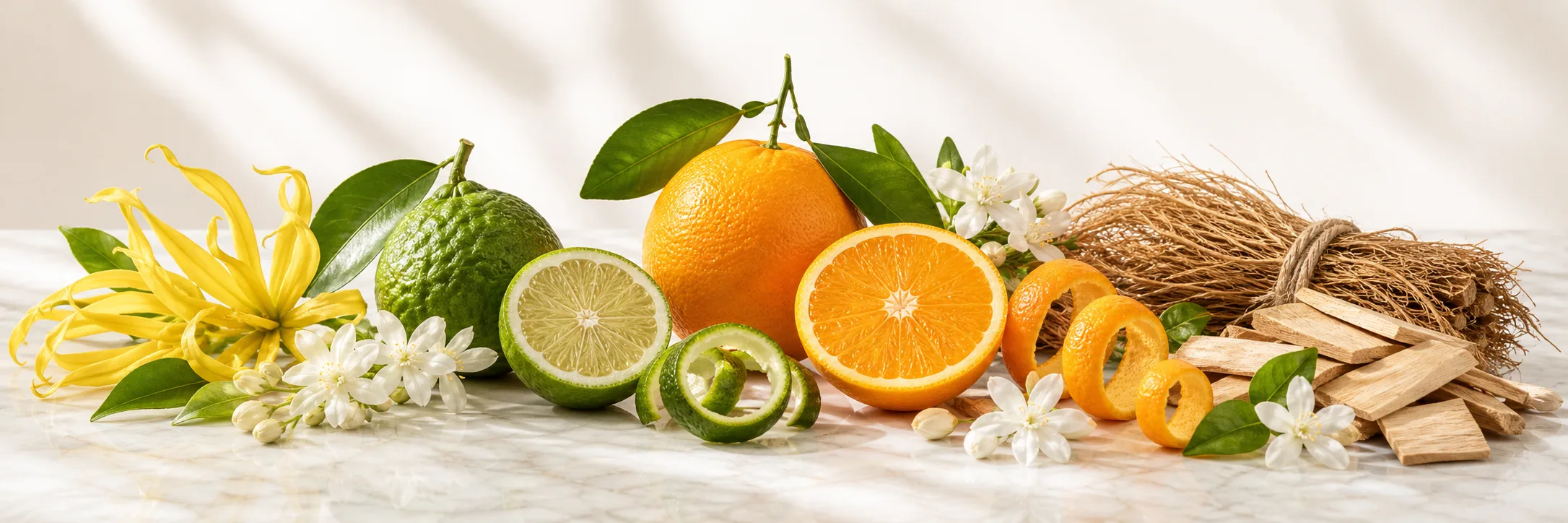
The opening reads as a slightly different yellow than the original Colonia: bitter and sweet orange share the lead with bergamot and lemon verbena rather than lemon proper, so the first impression is more peel-and-zest than juice. The bitter orange gives a green-pithy bite that is absent from the 1916 original. Within five to ten minutes a sparkling pink-pepper-and-cardamom dust enters from underneath — present but not aggressively spicy — and announces that this is going to be more perfume-shaped than its parent. By 20–40 minutes the heart blooms. Jasmine is the central note here in a way it never quite is in current Colonia: creamy, slightly indolic, juicy. Ylang-ylang adds a banana-soft floralcy and partners with the jasmine to push the composition toward an almost aldehyde-floral-classic register — multiple critics have compared this stretch to Patou Joy in skeleton if not in execution. Cedar is present as a dry support, vetiver as a soft green ground, and the much-discussed paprika/pimento note as a faint warm-spice glow rather than a chilli kick. A subset of wearers — including a notable wearers long-form review on the chilli-pepper note in modern perfumery — find the paprika overpowering, “shrill,” teeth-aching; most do not perceive it as a discrete chilli at all.
Performance
Light to moderate projection at one to two feet for the first hour, then close. Sillage is gentle. Longevity is, by Acqua di Parma standards, very good: 5–8 hours on skin for most wearers, with the amber-musk base persisting into the next morning on clothing. This is the only Colonia flanker that wears noticeably more like an EDT than an EDC. Heat amplifies the florals and is its native condition; in cool weather it remains coherent but reads more wood-spice than citrus. Humidity tilts it toward soap; dry heat brings out the jasmine.
Wearing Context
Late spring through early autumn is the core window, with warm-evening wear being one of its strongest contexts — the floral heart blooms in a way that is wasted in cool air. Daytime business and dressy evening are both comfortable. Occasions: weddings, art-opening drinks, the kind of summer dinner where the original Colonia feels too austere. Where it shines: in indoor warmth, formal-casual contexts, on women as well as men. Where it falls flat: cold weather (the spice dominates and the citrus disappears), sport, casual outdoor activity.
Comparisons & DNA
The closest neighbours are: the original Acqua di Parma Colonia (sharper, lemonier, less floral, much shorter); Mugler Cologne (transparent and musk-driven, less floral, less sweet); Hermès Eau d’Orange Verte and Eau de Mandarine Ambrée (more linear citrus); Penhaligon’s Castile (cooler, more orange-blossom). Outside the cologne genre, the bitter-orange-and-jasmine combination is closest to Jean Patou Joy (heavier, denser, more aldehydic) and to Chanel Pour Monsieur Concentrée (drier, more austere). The fruitchouli-floral drydown is in the same family as Paco Rabanne Pour Homme (1973), which reviewers explicitly invoke as the modern aromatic-fougère cousin. Within Acqua di Parma: Assoluta is the floral-modern flanker; Essenza is the neroli-soapy version; Intensa the warm-spicy-leathery version; Pura the transparent modern remix. The 2013 Colonia Assoluta Edizione Speciale repackaged the same juice with bike-themed engraving for the 10th anniversary; the 2007 Colonia Assoluta In Villa was a markedly different green-cypress-spicy flanker by AdP (not the same juice).
Reception
Consensus on wearers is unusually positive — Colonia Assoluta is the Colonia flanker most often described by long-time collectors as “the best of the line” and the one whose discontinuation is most mourned. Common praise: quality of materials, longevity (relative to the line), elegance, the perfumer pedigree, the perceived “two fragrances in one” structure of citrus opening into amber-floral drydown. Common criticisms: leans feminine for some male wearers, the paprika note is divisive, current bottles are reformulated and less interesting than originals, “discreet to the point of invisibility” for Christopher Stocks at The Sniff Box.
Versions & Reformulation
Two clearly distinct production eras exist. The original formulation (2003–roughly 2013) is denser, spicier and more floral, with a more audible jasmine indole and a more piquant paprika/pink-pepper character; the later/reformulated juice (roughly 2014 onward) strips back the jasmine and amplifies clean musks, producing what wearers regulars describe as effectively a different fragrance — “Acqua di Parma goes Jekyll and Hyde with Colonia Assoluta,” in one widely-quoted review. The 2013 Colonia Assoluta Edizione Speciale (bike-engraved 100ml) marked the 10th anniversary with the same juice in a special bottle.
Acquisition Notes
Pricing position at original retail was niche-adjacent designer (US around $120 for 100ml at launch). Now discontinued, prices have climbed: vintage 100ml or 180ml bottles in good condition typically sell for $150–250 on secondary markets (eBay, wearers private sales); some buyers report finding mid-formulation testers at substantial discount. Decant ecosystem is reasonable but thinner than for current production — Surrender to Chance, The Perfumed Court and DecantX still list it intermittently.
Notable Facts & Lore
- The Ellena/Duchaufour collaboration is the headline fact and is itself unusual — the two perfumers’ aesthetic philosophies are essentially opposed, and the pairing has generated decades of speculation in the perfume blogosphere about who did what.
- Christopher Stocks at The Sniff Box likened it to “getting Debussy and Ravel to compose a duet”; a recurring fan hypothesis (voiced in a wearers thread) is that one perfumer began the work and the other was brought in to finish or commercialise it, though no public confirmation exists.
- The composition is, in the absence of perfumer commentary specifically about this fragrance, generally read as Ellena setting the citrus and minimalist top, Duchaufour layering the amber-spice base — but this is enthusiast inference rather than industry record.
- Colonia Assoluta launched in 2003, the same year LVMH’s two-stage acquisition of Acqua di Parma culminated (LVMH had taken a 50% stake on 15 September 2001 and completed the acquisition by 2003).
- The launch represented the first major creative gesture of the LVMH era — effectively the announcement that Acqua di Parma would no longer be a one-fragrance house.
- It opened a flanker line that, by 2025, runs to more than a dozen entries.