Acqua di Parma — Acqua di Parma Profumo
Essence
Profumo is Acqua di Parma’s classical floral chypre — a perfume whose marketing claims a 1930 origin and over 300 ingredients, and which exists today chiefly through a 2000s relaunch and a 2008 reformulation. In its better-loved older incarnation it is a dense, dry, mossy-and-civet floral chypre repeatedly described as a near-relative of Guerlain Mitsouko: the same oakmoss-and-stone-fruit grandeur, but smoother, easier to wear, and Italian. It is the rare chypre that lets a modern wearer glimpse what the great pre-war chypres actually smelled like.
Scent Profile
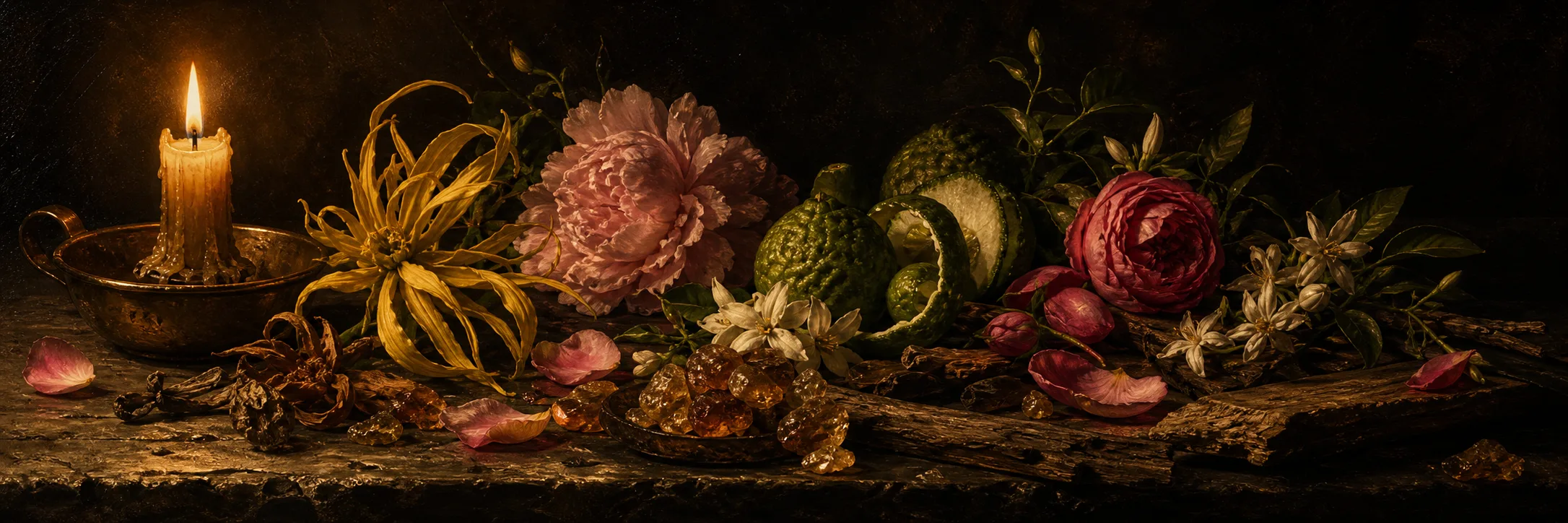
Profumo’s character depends heavily on which version is in the bottle (see Versions), but the through-line is classical chypre architecture: bright top, lush floral heart, mossy-woody-animalic base. The vintage/older “burgundy box” version opens, in the truest chypre tradition, with a powerful, sometimes disarming blast of alcohol and civet over a refined citrus-herb accord — bergamot threaded with sage, cinnamon, clove and cardamom giving a cool-hot, spicy-medicinal tinge. The listed ylang-ylang and peony register as a slightly creamy, exotic lift rather than discrete notes. Within the first 10–20 minutes that skanky civet and the citrus settle and the structure declares itself. The heart (one to three hours) is a lush, well-blended floral — Bulgarian rose and jasmine foremost, with a creamy iris/orris facet and the ylang persisting — woven so tightly that, as one reviewer put it, the ingredients “can’t be told apart. “ Labdanum adds an ambery, raisiny warmth. This is the dominant mid-stage character: a poised, slightly powdery floral suspended over the gathering moss. The drydown (3+ hours) is the chypre payoff and the part wearers swoon over: oakmoss, patchouli, sandalwood, vetiver and musk forming an earthy, dry, smoky-woody base, sometimes with a leathery edge and that “rosy/mossy drydown to die for.
Performance
Reports skew toward dense and tenacious but civilized rather than monstrous. The older formulation is described as full-bodied and long-lasting — wearers note it survives repeated hand-washing and stays “complex as soon as it hits the skin. “ Projection is moderate: an “average, just-right amount of sillage and longevity” for many, with the relaunch versions sometimes reading lighter and brighter. Longevity commonly runs most of a day on skin for the richer versions; a wearer reviewer wearers pool for the EDP relaunch scores longevity around and sillage around 2.
Wearing Context
Profumo is a cool-season, evening or sophisticated-daytime fragrance — autumn and winter suit its mossy, spicy, woody density best. It is occasion-flexible in the way classics are: equally at home as an elegant work scent, a dinner perfume, or a “decompression”/comfort fragrance (one devotee uses it as a stress antidote after exhausting days). It shines in settings that reward refinement and won’t be drowned out — and where vintage chypre character reads as cultured rather than dated.
Comparisons & DNA
The defining comparison, made almost universally, is Guerlain Mitsouko — Profumo is “the best version of Mitsouko… that isn’t even Mitsouko,” sharing the oakmoss-stone-fruit chypre soul but smoother, more balanced and easier to wear (minus, in some versions, Mitsouko’s divisive oily peach). Denyse Beaulieu (Grain de Musc), reviewing a pre-reformulation bottle, placed it as “an archetypal chypre… blending the smooth glamour of a very early, Mitsouko-era fragrance with just a hint of the gender-bending characteristics of aromatic 1950s types like Miss Dior. “ Other recurring reference points: Chanel 31 Rue Cambon (Profumo is drier, lighter and more floral than the Chanel’s creamy iris), Givenchy III (Profumo slightly sweeter and softer), Rochas Femme and Carven Ma Griffe (genre siblings), Castle Forbes Lonach (a masculine resemblance), and Grossmith Golden Chypre as a fellow modern “Mitsouk-alike.
Reception
Among classic-chypre enthusiasts on wearers, Profumo is a quietly revered “overlooked gem” — “holy grail material for the chypre lover,” “smooth, sensuous, sumptuous,” an “Italian masterpiece. “ exists and is positive: Beaulieu wrote it up affectionately as a “chypre obit” when the original was being discontinued, and on the relaunch a side-by-side made even purists hesitate (good news that the new version was “faithful to its chypre origins”). The principal axis of polarization is version confusion — reviewers stress you must specify vintage vs. 2008+ reformulation, because they smell materially different, and some find the older one “dusty/old” while others find the reformulation too bright or “fruity-floral. “ A minority feel it doesn’t justify its price, or that it reads generically chypre.
Versions & Reformulation
This is the crux of Profumo. The brand claims a 1930 original (allegedly 300+ ingredients), though perfume historians could find no period documentation — historian Octavian Coifan found no trace of the fragrance in his collection of period Italian magazines (per Denyse Beaulieu, Grain de Musc) — so the date may be PR rather than fact. The version most vintage-lovers prize is the older formulation sold into the 2000s in a burgundy/maroon box (bulb atomizer, then pump) — a dense, oakmoss-and-civet old-school chypre.
Acquisition Notes
Luxury positioning, and increasingly a collector’s hunt. The relaunch retailed at premium parfum/EDP prices (wearers cite $250+); vintage burgundy-box bottles are scarcer and command more, though lucky secondhand finds surface (one collector famously bought a bottle listed only as “Italian perfume” for $10). Sizes historically included 50 ml and 100 ml, plus 5 ml minis that are a good low-cost way to sample the older juice on eBay.
Notable Facts & Lore
- The headline lore is the contested 1930 origin: Acqua di Parma markets Profumo as a 1930 chypre of 300+ ingredients, but when writer Denyse Beaulieu consulted historian Octavian Coifan, he could find no mention of an Acqua di Parma perfume in his period Italian magazines — so the date may be a PR fabrication, even if a 1930s chypre from the house is not implausible (nearly every brand made one then).
- Either way, the perfume is genuinely beloved as a faithful classical chypre.
- It was a notably under-the-radar release: Beaulieu noted that as of the late 2000s it had been reviewed by essentially one perfume blogger and a handful of discussions users despite existing for decades.
- Its identity in enthusiast culture is bound up with the broader story of the great chypres’ decline under oakmoss restrictions — Profumo is repeatedly mourned in the same breath as Mitsouko, Rochas Femme, Miss Dior and Guerlain’s lost Parure.