Acqua di Parma — Acqua di Parma Iris Nobile
Essence
Iris Nobile, the 2006 eau de parfum, is the richer, darker sibling of Acqua di Parma’s 2004 Iris Nobile eau de toilette, and despite its name it is not really a cold, rooty orris fragrance at all. It is a luminous Italian white-floral bouquet built around orange blossom, ylang-ylang and tuberose, dressed in a chypre-leaning woody-mossy base, with iris contributing powder and texture rather than dominating. Critics including Denyse Beaulieu and Victoria Frolova placed it in the small, unusual lineage of Italian chypres. The eau de parfum is the version that earned a cult following and the version mourned after its discontinuation.
Scent Profile
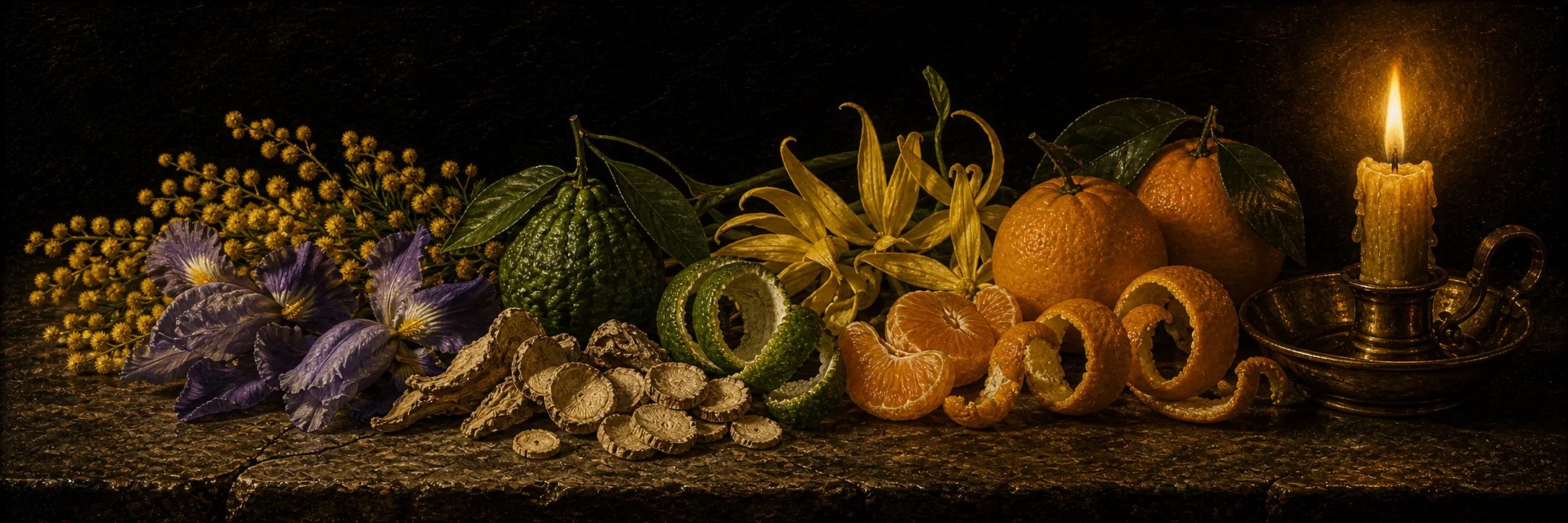
The opening is unmistakably Acqua di Parma: a bright, slightly bitter citrus burst of bergamot, mandarin and orange that nods to the house’s signature Colonia, lifted by a distinct licorice-like star anise that is the most polarizing top accent here.
The heart is a creamy, almost tropical white-floral medley. Ylang-ylang is prominent enough that some find it heavy, tuberose and orange blossom add a waxy richness, and mimosa and hibiscus soften the edges. The iris reads as powder and a cool, velvety lift rather than as a carrot-seed orris, which is why the name can mislead.
The drydown is where the chypre character emerges: a woody, mossy, lightly sweet base of cedar, amber and vanilla, with oakmoss and patchouli giving a modern chypre feel without old-fashioned mustiness. Victoria Frolova of Bois de Jasmin described the eau de parfum as woven out of darker and richer notes, remaining vivid where the eau de toilette faded flat, and clinging to the skin like angora wool. Robin of Now Smell This reassured anyone wary of dusty vintage chypres that this one does not have that musty feel.
Performance
Performance is widely reported as good and notably better than the eau de toilette, which fans repeatedly criticized as fleeting. Wearers describe several hours of moderate projection followed by a long skin-scent phase, with one detailed account logging roughly four hours of moderate projection plus two more close to the skin, and the scent surviving on silk scarves for up to two weeks. Several report still detecting it on the wrist twelve hours later. It is not a sillage monster, but it is tenacious and full-bodied for a floral.
Wearing Context
Despite the citrus opening this is a cool-weather, autumn-to-spring fragrance, with the eau de toilette serving as the summer version and this eau de parfum as the fall and evening one. The consensus places it as elegant, chic, office-appropriate and dressy, skewing feminine and somewhat formal and mature. One wearer captured it as a cup of fragrant Earl Grey on a rainy spring day, an apt image of its refined, slightly haughty character. It reads as quiet luxury, expensive rather than loud.
Comparisons & DNA
The most important comparison is internal. Against the lighter, citrus-forward 2004 eau de toilette, this eau de parfum is darker and longer-lived, and the later Sublime and Acqua Nobile flankers each pull in their own direction. Within the broader iris world it is the cautionary reference: fans of cold, rooty orris like Serge Lutens Iris Silver Mist, Frederic Malle Iris Poudre or Chanel No. 19 are generally warned off, because Iris Nobile is not an orris soliflore and belongs instead with lush Italian white florals. In Perfumes: The A-Z Guide, Luca Turin gave it four stars with the terse descriptor “iris gardenia,” which neatly captures where it actually sits.
Reception
Critical reception was warm. Both Bois de Jasmin and Olfactoria’s Travels preferred the eau de parfum to the eau de toilette for its darker, richer, more substantial presence, even as one admitted she had bought the wrong sister and been surprised by the strong ylang-ylang. Its four-star critic rating and inclusion among perfumes that got lost in the shuffle reflect genuine respect. Wider sentiment is more divided: many call it a masterpiece, timeless and elegant, while detractors find the ylang-ylang plasticky, the jasmine cheap, or the whole thing too mature. The most recurring complaint is simply that it does not deliver the iris the name promises.
Versions & Reformulation
The naming is genuinely confusing. The 2004 release was an eau de toilette; the 2006 eau de parfum, this entry, added the chypre base. Limited editions followed in 2008 and 2010, both leaning more overtly chypre with oakmoss, patchouli and ambrette. A 2014 tenth-anniversary edition reissued the composition in a gold-decorated refillable flacon, with an enclosed note claiming the formula was unchanged. Some wearers of later bottles report a darker, spicier juice, raising the possibility of batch drift, though no critic has documented this. The 2012 Iris Nobile Sublime is a distinct flanker, not a like-for-like replacement.
Acquisition Notes
The eau de parfum is discontinued and now a secondary-market hunt, with full bottles appearing online at inflated prices and travel or handbag minis the most commonly available format. Buyers who caught it before it dried up often describe blind-buying out of fear of discontinuation. Because the bottles and names across the eau de toilette, Sublime and Acqua Nobile versions are so similar, the key precaution is to confirm you are buying the 2006 eau de parfum, the chypre version, and not one of the lighter relatives.
Notable Facts & Lore
- Iris Nobile inaugurated Acqua di Parma’s feminine Le Nobili sub-collection, marking the LVMH-era push into women’s florals beyond the house’s cologne heritage.
- LVMH took a 50 percent stake in Acqua di Parma in 2001 before the brand later came fully under its umbrella.
- The fragrance aims at the scent of iris flowers rather than the violet-woody orris butter from the roots, an angle rarely explored in perfumery.
- Its chypre structure makes it a quiet outlier, an Italian chypre, a category critics have half-jokingly questioned the existence of.
- Luca Turin awarded it four stars in Perfumes: The A-Z Guide, summarizing it as “iris gardenia.”
- Its discontinuation is treated by fans as one of the more lamented fragrance losses of the 2010s.