Acqua di Parma — Quercia Eau de Parfum
Essence
Acqua di Parma’s oakmoss showcase — a woody-aromatic fougère built around oakmoss absolute, dressed in the house’s signature bright Italian citrus. “Quercia” means oak in Italian, and the brief was a walk through an oak forest. In wear it’s a classic citrus-aromatic opening that turns into a sweetened, mossy-woody fougère with cardamom warmth and tonka in the base. The 2019 EDP is the higher-concentration sibling of the 2016 “Colonia Quercia” Eau de Cologne Concentrée. It’s a polarizing, “mature,” dressed-up scent that fans call a sleeper hit and detractors find generic for the price.
Scent Profile
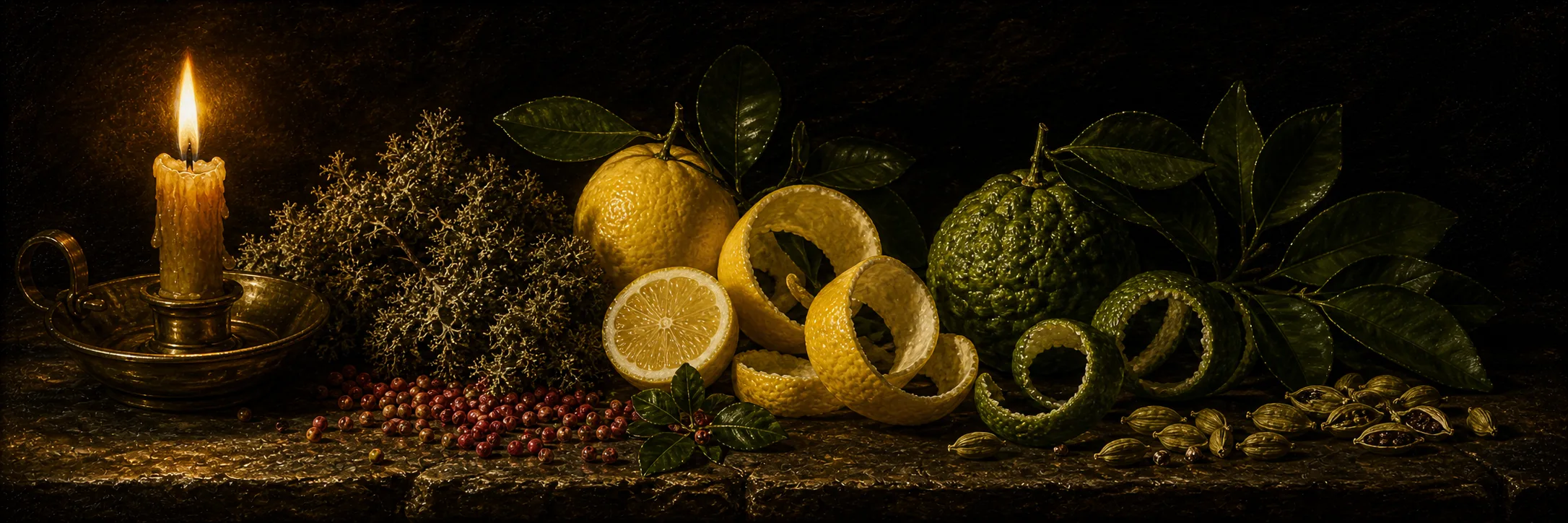
The opening is quintessential Acqua di Parma: a bright, clean citrus burst of lemon, Calabrian bergamot and petitgrain, lifted and spiced by pink pepper. It reads “classic cologne” for the first few minutes — fresh, slightly soapy, recognizably the Colonia DNA. Cardamom arrives quickly, adding a cool-then-warm spicy facet that several wearers find prominent (a few even read it as cola-like or, early on, faintly Dior Homme Intense-ish). This is the most conventionally “Acqua di Parma” phase. Through the heart, the fragrance pivots toward fougère territory. Geranium adds a rosy, slightly minty greenness that, with the oakmoss, gives a retro barbershop-fougère feel; cedar contributes a dry, starchy woodiness. The defining move is the oakmoss coming forward — thick, lichen-ish and “retro” by modern standards, this is the note the whole composition is named for and built around. Wearers split here: fans call it “the best oakmoss scent on the market” with a tamed, wearable moss; skeptics find the moss more “fuzzy”/synthetic than a true vintage chypre-grade oakmoss.
Performance
For Acqua di Parma — a house often criticized for weak longevity — Quercia EDP is a standout performer. One detailed review reported strong projection and a scent trail for the first few hours, settling to a skin scent around the nine-hour mark; many wearers report 7–8 hours and up, and several explicitly report “12hrs+ on me. “ Projection is moderate-to-strong early — one wearer logged “moderately strong projection for 3-4hr, lingers as a modest scent bubble for 5-6hr, longevity 12hr+” — then it sits close to skin. Sillage is moderate.
Wearing Context
A daytime, dressed-up, cooler-season fragrance for most — “office or daytime weekend outings,” semi-formal to formal, and frequently pegged as a “mature” scent for a man roughly 30-plus (one wearer’s image: a private-equity professional in a crisp white shirt). It works as an everyday refined-citrus-woody for those who want something classic but with more depth and warmth than a plain cologne.
Comparisons & DNA
Within Acqua di Parma, it sits beside the Colonia (Acqua di Parma) line as a deeper, mossier, more autumnal take on the house citrus, and reviewers explicitly note it doesn’t smell like the brand’s Colonia Leather or Colonia Oud — it’s its own oak/moss direction. The most evocative external comparison comes from wearers, where a reviewer linked it to Tabac Original (Mäurer & Wirtz) via shared bergamot/petitgrain, geranium and a pronounced oakmoss — a barbershop-classic aura, not a scent twin. A wearer placed it between Dior Homme Intense (Christian Dior) in the opening and “a grown-up Eros (Versace)” in the cedar-geranium-tonka drydown “but without the sweet vanilla. “ wearers reviews drew less flattering lines to La Nuit de l’Homme (Yves Saint Laurent) (a “less vibrant” version), and, for the spice-tonka direction, to Minotaure (Paloma Picasso) and L’Eau Bleue d’Issey pour Homme (Issey Miyake).
Reception
Wearers reception is genuinely polarized — this is the recurring theme on wearers. The positive camp calls it a “hidden gem,” a “little masterpiece,” and praises the natural-feeling, high-quality citrus-moss blend and (unusually for ADP) the strong performance; one reviewer went so far as to declare “this is the best oakmoss scent on the market! … The oak moss is tame, that’s what makes it so special! “ The negative camp finds it “boring,” “generic,” “stale, rotten wood with a horrible tonka sweetness,” or an overpriced “shower-gel”/“bath foam” scent — and some oakmoss purists are scathing, calling the moss fake/“fuzz” and unworthy of the price (one self-described “oakmoss freak” dismissed it as practically “a Sauvage flanker”).
Versions & Reformulation
Two related products cause confusion. The original Colonia Quercia launched in 2016 as an Eau de Cologne Concentrée (in the brown/dark Art Deco “Ingredient” flacon, 100 ml and 180 ml), part of the older Colonia/Ingredient framing. The Quercia Eau de Parfum (this dossier) launched in 2019 and is the higher-concentration version, later folded into Acqua di Parma’s “Signatures of the Sun” collection (black-label presentation). wearers classifies the 2019 EDP explicitly as “a variant of Colonia Quercia… which differs in concentration.
Acquisition Notes
Niche-designer / near-luxury Pricing position: around £197 for 100 ml and £242 for 180 ml (roughly $250+), with the Signatures-of-the-Sun EDP positioned at the pricier end of the ADP range. Bottle sizes: 100 ml and 180 ml EDP. Decant ecosystem: sample/decant sellers carry it (5 ml and 10 ml decants are available from splitters), and ADP’s own Discovery sample set has included Quercia — sampling is strongly advised given the polarization and price. Reliable sources: Acqua di Parma’s official site, and authorized retailers (John Lewis, Escentual, Harvey Nichols, department stores).
Notable Facts & Lore
- The documented intent is the house’s own oak/oakmoss “ingredient” concept: Acqua di Parma frames Quercia as a walk through an oak forest, celebrating the oak (quercia) as a symbol of strength and rootedness and built on oakmoss absolute “reimagined through the luminous lens of Italian citrus.
- “ The original 2016 Colonia Quercia was tied to a narrative of the aristocratic families of Piedmont and the oak as a “sacred tree.
- “ No perfumer is publicly credited in available sources for this release.
- The recurring frag-specific debate is whether it actually smells of oak at all — wearers repeatedly note it’s “mostly moss and cedar, not oak,” and that the name oversells the literal oak-tree concept.
- Its other talking point is performance: it’s one of the ADP releases enthusiasts cite as bucking the brand’s reputation for short longevity, which partly explains its sleeper-hit status among fans even as oakmoss purists dismiss it.