Acqua di Parma — Mandarino di Sicilia
Essence
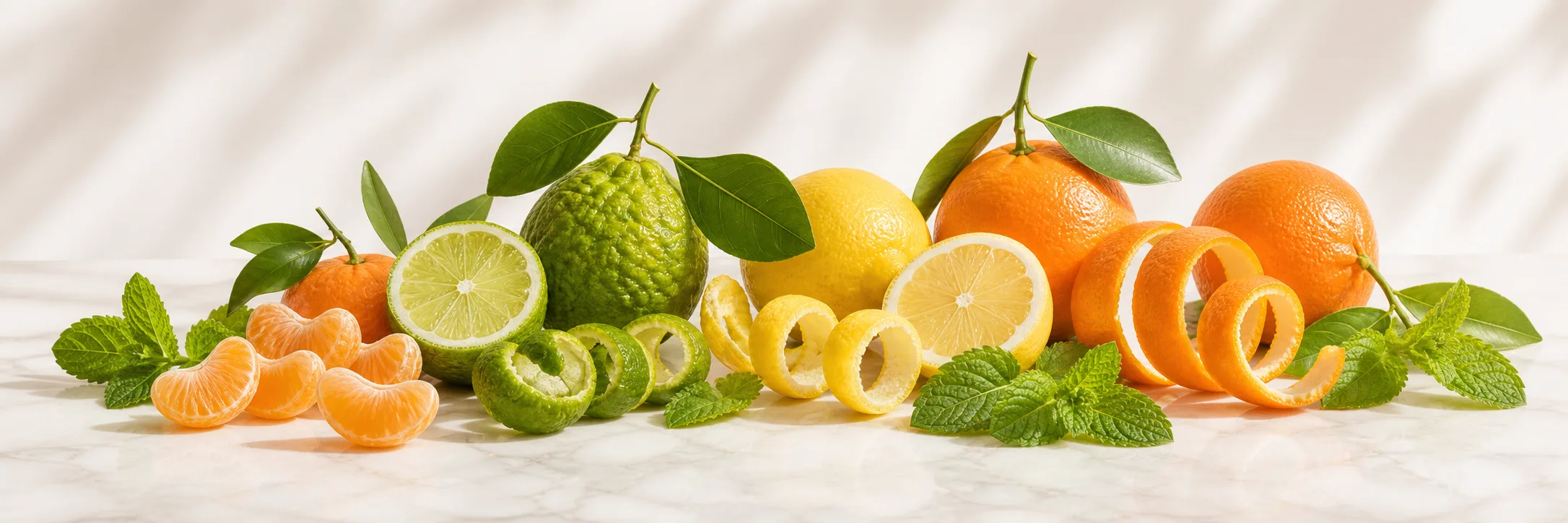
A 2024 in-line addition to Acqua di Parma’s Blu Mediterraneo collection, Mandarino di Sicilia is a high-fidelity green-mandarin citrus built around early-harvested Sicilian mandarins picked while still green. What distinguishes it from the older Arancia di Capri is its emphasis on the bitter, leafy, peel-forward facet of the fruit rather than juicy sweetness, lifted by a noticeable spearmint coolness and grounded by a soft, powdery patchouli-cedar-musk base. It reads as a fridge-fresh, photorealistic mandarin — naturalistic rather than synthetic — and is the rare designer citrus whose drydown is actually considered rather than throwaway.
Scent Profile
The opening is the headline act: a startlingly crisp burst of green mandarin that reads as freshly peeled peel-oil mist rather than mandarin juice. Bergamot, lemon and blood orange add sparkle and a faint tart-sour fizz — several wearers liken the effervescence to cracking open an Orangina. All four listed top notes are perceptible, though green mandarin dominates and lemon sits furthest back. Within minutes the heart’s spearmint and petitgrain arrive and are unusually prominent; spearmint in particular is near-dominant for many wearers, giving a cool, breezy lift without tipping into toothpaste territory. This minty-green facet is the signature accord — a “fridge-fresh,” icy-herbaceous mandarin. By the one-to-three-hour mark the citrus thickens and turns slightly “pulpier” and creamier, with blood orange resurfacing, all over earthy patchouli that runs in the background from early on. The patchouli is the swing note: it gives the drydown a faintly masculine, earthy weight that some find pushes the scent out of strictly unisex territory. Cedar and musk round out the base into a soft, powdery, clean finish — Persolaise specifically praised the powdery drydown as “more considered and convincing than most in this genre.
Performance
Performance is the central caveat. Projection is light-to-moderate: a genuinely bright, radiant push for the first hour, after which sillage softens to a close, intimate halo. Longevity is the recurring complaint — most wearers report roughly four to six hours on skin, with several noting the mandarin has clearly pulled back by hour two and requires conscious sniffing by hour three. One enthusiast review claimed a solid six-to-eight hours, but the consensus sits lower, and cooler days yield around four to four-and-a-half hours.
Wearing Context
This is a spring and summer daytime fragrance — built for heat, sun and casual leisure. It shines as an uplifting warm-weather citrus for daily wear, errands, the office, brunch, or anywhere a clean, elegant freshness is wanted; it reads as effortlessly upscale without shouting. It falls flat as an evening or cold-weather scent, where its lightness and short life leave little to work with, and the density some perceive can feel slightly heavy for the very hottest, most humid days. Socially it is broadly inoffensive and crowd-pleasing.
Comparisons & DNA
The inevitable comparison is Tom Ford’s Mandarino di Amalfi (Calice Becker, 2014): many blind-buy Mandarino di Sicilia explicitly to scratch that itch at lower cost. The verdict is that it gets close on the gorgeous mandarin but is more linear and more purely citrus-focused — Amalfi has the floral orange-blossom/jasmine heart and Neroli Portofino-style musky drydown that Sicilia lacks. It is not a 1:1 dupe. Within the house, it is more energetic than the older Arancia di Capri (sweeter, with caramel) and more specific than Mirto di Panarea. Perris Monte Carlo’s Mandarino di Sicilia and Guerlain’s Mandarine Basilic are cited as more photorealistic, solidly-unisex orange alternatives by those put off by the patchouli. The wearers in-house critic drew comparisons to Atelier Cologne’s Mandarine Glaciale (for the icy bite) crossed with Creed’s Zeste Mandarine.
Reception
Consensus (wearers, wearer discussions) is warmly positive on the smell and frustrated on the performance — the dominant axis of polarization. Praise centers on the realism and quality of the mandarin opening, the clever spearmint lift, and a drydown that doesn’t collapse into generic woody-musk. Criticism is near-unanimous on longevity and on price-for-performance; a vocal minority dislikes the patchouli/petitgrain, reading it as soapy, “bathroom cleaner,” or too masculine/dense for summer. Among established critics, Persolaise was the most notable voice, recommending it as “an optimistic Acqua Di Parma Blu Mediterraneo release which places its juicy, fleshy star ingredient over a powdery drydown that is more considered and convincing than most in this genre.
Versions & Reformulation
Single composition, available only in EDT; no known reformulations as of mid-2026. Note that Acqua di Parma also released a separate limited-edition Mandarino Millesimato (2024), a distinct fragrance not to be confused with the in-line Mandarino di Sicilia.
Acquisition Notes
Pricing is designer/accessible-luxury. The line is transitioning bottle formats: historically 75ml and 150ml, with the house moving Blu Mediterraneo toward 100ml and 180ml screw-top bottles; full-bottle pricing is frequently cited around the $120+ range at full retail, with discounters lower.
Notable Facts & Lore
- The fragrance is built on a specific raw-material story: per Interni Magazine, Mandarino di Sicilia “stands out … for the selection of fruits of the Tardivo di Ciaculli quality harvested while still green,” capturing the leafy, emerald tone rather than ripe sweetness — the same terroir Acqua di Parma celebrated in its limited Mandarino Millesimato 2022 edition (a numbered run of 2,022 pieces).
- To launch it, the house staged a modular installation, “Into mandarin fields,” designed by Fornice Objects (a brand founded in Ravenna in 1993 by designer Chiara Ravaioli) at Milan’s FuoriSalone 2024 — open to the public 13–21 April 2024 at the via Gesù 1 boutique, with free entry or 30-minute guided tours.
- The perfumer is not officially documented for this release. a wearer reviewer in-house analysis explicitly framed the scent as a transfer of “learnings” from the brand’s acclaimed Arancia La Spugnatura experiment in fruit-flesh naturalism.
- No major celebrity tie-ins or viral controversies attach specifically to this flanker beyond general enthusiast buzz around its standout opening.