Acqua di Parma — Colonia Ambra
Essence
Colonia Ambra is the third entry in Acqua di Parma’s Ingredient Collection, a 2015 series by perfumer François Demachy that takes the house’s 1916 Colonia skeleton and rebuilds it around a single hero material. Here that material is amber, presented as a dry, smoky, mineralic ambergris accord. The honest framing matters: this is an Ambroxan-driven ambergris showcase rather than a literal natural-ambergris scent, with the familiar citrus deliberately dimmed so it lifts rather than leads. The result is a refined woody-amber cologne with a salty, modern character.
Scent Profile
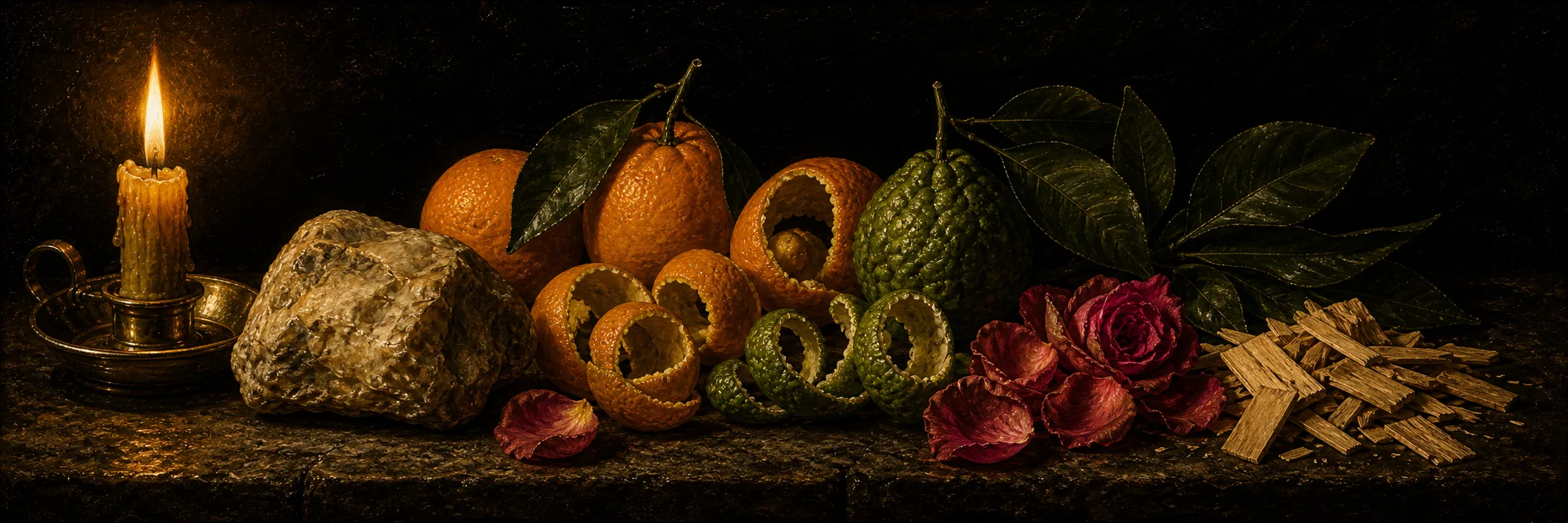
The opening is recognizably Acqua di Parma: a hesperidic flash of orange, bergamot, and petitgrain. But where the original Colonia stays bright, here the citrus is intentionally muted, present only to give the composition lift before it settles into something warmer and drier.
Beneath the citrus a woody-rosy structure builds. Cypriol and patchouli assert themselves with a dry, slightly smoky character, threaded by a wispy, semi-sweet rose that softens the edges without turning the scent floral. This middle is where the cologne starts to read as an amber rather than a citrus.
The heart and base are the real subject. A salty, musky, faintly animalic ambergris accord sits over sandalwood, labdanum, vanilla, and musk — dry and mineralic, marine-adjacent yet never quite oceanic. The vanilla is a warming accent rather than a sweetener, and the drydown is long and notably even, sometimes mistaken for flatness because it changes so little. The signature is that smoky-woody amber warmth lingering close to the skin.
Performance
Colonia Ambra performs better than its cologne lineage might suggest, with the caveat that it is built as a refined skin scent rather than a projection monster. Projection and sillage sit in the moderate range, while longevity tends to satisfy, with many wearers reporting roughly six to ten or more hours of base-clinging warmth. Skin chemistry clearly matters: reports run from excellent staying power to a rare outlier who got only about half an hour. The prolonged, hesperidic-to-woody arc feels built for warmth, where heat and humidity soften its angular edges.
Wearing Context
Marketed to men, it reads comfortably shareable in practice — refined and non-shouty, the kind of scent described as smelling modern and expensive rather than rugged or sporty. Cooler evenings suit it well, and it tends to land best on wearers in their thirties and up, though its Italian-cologne heat-friendliness keeps it flexible across seasons. Think casual-to-smart sophistication: an evening or polished daytime scent that doesn’t elbow anyone out of the way.
Comparisons & DNA
The defining reference is in-house: Colonia Oud. The two share much of their structure, and the common reading is that Ambra is essentially Oud with the oud and leather removed — fresher, more casual, and more linear, while Oud is woodier, warmer, and slightly more formal. Many find them close enough that owning one undercuts the case for the other. The synthetic-ambergris angle invites comparison to Ambroxan-forward releases like Dolce & Gabbana Intenso, while Tom Ford Oud Minérale serves as a thematic cousin in the salty-mineralic register. Histoires de Parfums Ambre 114 is another touchpoint for its salty-amber accord. Broadly, this is a woody-amber oriental with a mineralic ambergris signature and a citrus-cologne lineage.
Reception
Reception is polarized but generally respectful. Admirers, including critic Elena Vosnaki, praise the smoky-woody refinement and rate it near the top of the Ingredient trilogy, second only to Colonia Oud. Detractors are sharper, dismissing it as an exercise in Ambroxan, a one-dimensional musky scent, and among the weaker of the house’s premium “brown bottle” colognes. A common middle view is that it is high-quality and wearable but openly synthetic, and not the rare-ingredient luxury its marketing implies. The disagreement is less about quality than about whether the amber reads as compelling or generic, which is exactly why sampling first is the standard advice.
Versions & Reformulation
The nuance here matters. The original is the 2015 Colonia Ambra Eau de Cologne Concentrée in the brown bottle, sold in 100 and 180 ml, as part of the Ingredient Collection. It was discontinued and, in 2019, reissued as “Ambra” Eau de Parfum within the Signatures of the Sun collection in a black bottle. Buyers report the two are effectively identical, with one documenting both sharing the same formula number, so the EDP is widely regarded as the same juice rebottled rather than a true reformulation. When someone references Colonia Ambra, it is worth confirming whether they mean the discontinued brown-bottle Concentrée or the current black-bottle EDP.
Acquisition Notes
This is a luxury-tier release. At US launch the Concentrée was a department-store exclusive at $220 for 100 ml and $276 for 180 ml, with European pricing in the rough range of €170 to €200 for 100 ml. The discontinued 2015 Concentrée now commands elevated prices, while the 2019 Ambra EDP remains available at retail and directly from Acqua di Parma. Given the price and the polarized opinions, a decant or sample is the smart entry point, and it lets you compare the Concentrée against the EDP. At this price, buy sealed from reputable sellers.
Notable Facts & Lore
- Acqua di Parma was founded in 1916 by Baron Carlo Magnani, with Colonia originally used to scent gentlemen’s handkerchiefs.
- The house became a mid-century symbol of Italian chic, worn by Cary Grant, David Niven, Ava Gardner, and Audrey Hepburn.
- It was rescued from near-oblivion in the early 1990s by a consortium including Diego Della Valle of Tod’s and Luca Cordero di Montezemolo of Ferrari before passing to LVMH.
- The Ingredient Collection reframed the 1916 Colonia DNA through single hero materials, with Ambra the third entry after Oud and Leather.
- Despite its ambergris theme, the composition leans on synthetic ambergris molecules rather than the rare natural material.
- Demachy created nine fragrances for Acqua di Parma, and the line’s pattern of fast introductions and discontinuations is a recurring point of frustration.