Amouage — Attar Al Jawhar
Essence
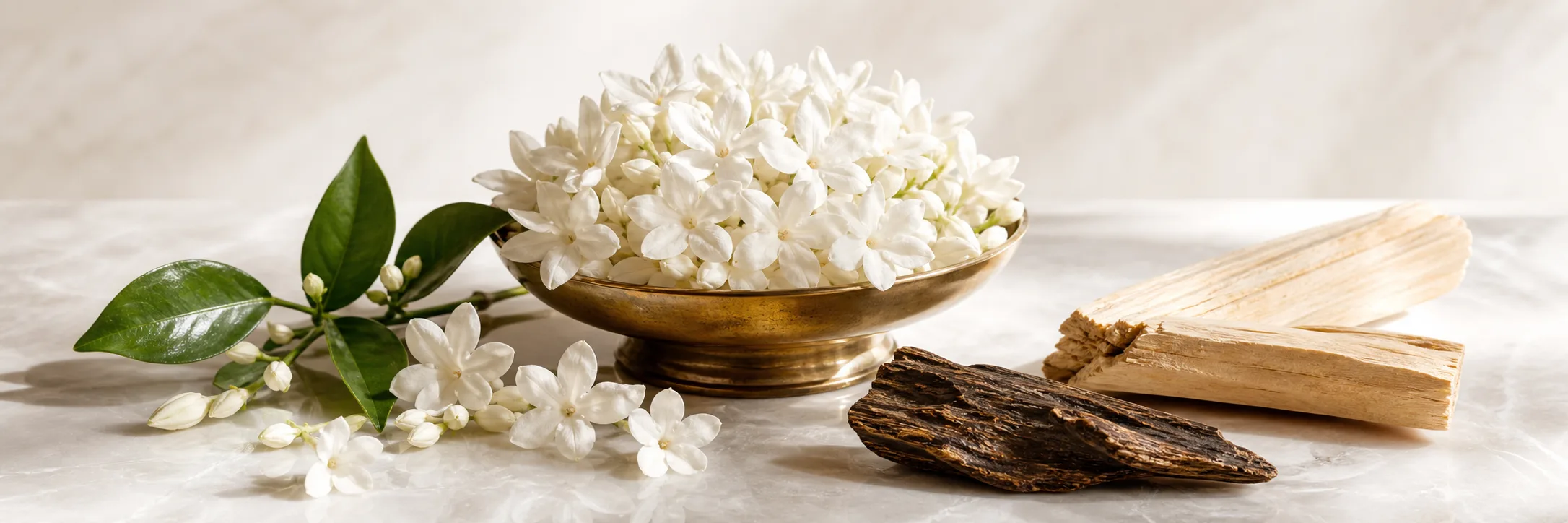
Attar Al Jawhar, whose name reads roughly as “essence of jewels,” is a 2007 Amouage oil concentrate released as one of the house’s Eid-themed special editions, grouped alongside Eidyya and Bel Aidien as occasion attars set apart from the year-round line. It is a narrow, focused composition - jasmine over a base of musk, oud, and sandalwood - and one of the rarest entries in the original attar canon, with almost no Western critical coverage and very little wearer response. Discontinued when Amouage wound down its attar collection in 2014, it now circulates almost entirely through secondhand listings out of the Gulf.
Scent Profile
Attar Al Jawhar is the white-floral entry in a collection otherwise dominated by rose, saffron, and incense. The opening is jasmine - the sole top note, and clearly identifiable on skin within the first thirty seconds. It is not the indolic, animalic jasmine sambac of high-natural Mysore or Tamil Nadu attars, nor the green-fruity jasmine grandiflorum of Grasse florals; it sits somewhere between, with a clear apricot-skin facet and a faint banana-peel undercurrent characteristic of well-handled jasmine absolute. Some enthusiasts file it instead as earthy-resinous, which is a useful corrective to the simple jasmine-over-wood pyramid, because the drydown is genuinely woody-resinous rather than white-floral throughout. The heart introduces musk and oud at once rather than in sequence. The musk is the soft, clean, slightly powdery type characteristic of the Amouage attar accord; the oud is a quieter, sweetish-medicinal Asian oud rather than the barnyard or fecal-leather oud of some attar-house specialists. The combination produces a hazy, near-translucent floral-wood register that wearers reach for words like “dawn in a white desert mosque” to describe - vague, but consistent with the real experience of a clean jasmine laid over warm sandalwood and discreet oud. The base is sandalwood. As with most Amouage attars of this era it is unlikely to be pure Mysore, since that supply chain was already constrained by 2007, but it reads as a creamy, slightly green santal rather than a raspy synthetic. The sandalwood gradually overtakes the jasmine across the first three hours; by hour four the fragrance is essentially a jasmine-tinted sandalwood-oud skin scent with a discreet musk halo. There is no incense, no rose, no spice - none of the standard Amouage maximalist architecture - and that minimalism is both the appeal and the limitation. The result feels closer to a Sultan Pasha or Areej Le Dore exercise in restraint than to a typical main-line Amouage.
Performance
Performance is high on the attar scale but moderate by the Tribute or Homage standard. A single drop delivers eight to twelve hours of skin presence, with strong projection in the first ninety minutes as the jasmine carries, then progressively quieter projection thereafter. Wearers consistently report well-above-average longevity and moderate sillage, placing it at the high end of the Amouage attar range despite the minimalist composition. The oil itself is dense and slightly viscous, characteristic of high-sandalwood attars; a glass-stick applicator delivers an appropriate dose, while excessive dabbing produces a heavy, sweet-soapy white-floral cloud that is unflattering in close quarters. As with all alcohol-free oils, the arc is non-linear: the first hour reads strong and dense, then the scent seems to retreat to the skin, but it stays detectable to those near the wearer for the full longevity span. Layering it under another jasmine scent is rarely useful - Jawhar is already a complete jasmine - but wearing it beneath a light incense or oud spray works well to add radiance.
Wearing Context
Attar Al Jawhar is a warm-weather attar by design. The jasmine register reads best in humidity and at moderate-to-high temperatures; in cold dry winter the opening compresses and the woody base takes over much faster, which is not how the fragrance is meant to be experienced. It is a daytime and early-evening scent, less suited to formal evenings than the smokier Amouage attars but ideal for Eid daytime visits - exactly the use case it was created for. It is technically unisex but leans feminine on Western perception because of the white-floral lead; in the Middle East, where jasmine attars are part of mainstream men’s grooming culture, it does not read as gendered at all. It layers beautifully under another light Amouage piece such as Honour Woman or Lyric Woman, but is strong enough to wear alone. It is not a gym, beach, or office-bombast scent. The Eid-edition framing matters: this is a celebration attar made for festive occasions where one wants to be perfumed but not heavy.
Comparisons & DNA
Within the Amouage attar collection, Attar Al Jawhar is the closest the line ever came to a jasmine soliflore, and it has no direct sibling - Tahani is the nearest in floral profile but reads sweeter and more diffuse, Mawaddah leans rose, and Asana is more complex. Outside the house, the most useful reference points are Hermes Cedre Sambac (lighter, drier, more cedar-forward), Mona di Orio Tubereuse (denser, more indolic, oilier), Serge Lutens Sarrasins (jasmine and ink, far stranger), and Maison Francis Kurkdjian Grand Soir or APOM Femme (lighter, more amber-forward, less woody). For wearers coming from the oud-attar tradition, Al Jawhar sits on the gentler, more floral end of the spectrum - closer in spirit to a fine sandalwood-jasmine joss stick than to the leather-and-tar register of Sultan Pasha Aurum Vitae or the heavy fecal oud of some Cambodian distillates. The Amouage attar house accord is present but muted: the creamy santal base is there, the discreet oud is there, but the absence of rose, saffron, spice, and incense removes most of what people associate with the Amouage attar identity. That singularity is the fragrance’s main interest.
Reception
Reception is the thinnest of any Amouage attar, which itself tells a story. Its page carries fewer reviews than the famous attars - Tribute, Homage, Asrar - and most of the comment is descriptive rather than evaluative, with wearers describing the scent without ranking it. It has gone essentially unreviewed by the major perfume critics, partly because samples were never widely distributed outside Gulf retail. Among Amouage-attar collectors - the relevant audience for this piece - Jawhar is treated as an under-appreciated completist attar that fills a white-floral gap in a collection otherwise saturated with rose, saffron, and incense. Sentiment is mildly positive but quiet; there is no “masterpiece” consensus of the kind that surrounds Tribute or Homage. The absence of strong negative reviews is itself notable: even minimalist Amouage attars usually attract a vocal minority who find them thin, and Al Jawhar has largely escaped that criticism, which suggests the scent is well-balanced even if narrow.
Versions & Reformulation
A single composition, with no known reformulations. The fragrance was produced primarily in 12 ml bottles, passing through the standard Amouage attar box generations - white box, then red-box variants, then black box - across its production life from 2007 to the 2014 cessation. There is no documented spray version, and no evidence of the batch-to-batch profile drift that fuels the Tribute debates.
Acquisition Notes
Attar Al Jawhar is among the rarer Amouage attars on the secondary market, partly because its Eid-edition framing meant smaller production runs than the year-round Tribute and Homage tier, and partly because Western distribution was minimal. Sealed 12 ml black-box bottles surface intermittently and tend to ask roughly $300 to $500, with the rarer red-box and white-box generations running higher. The realistic path is decants: a 1 ml sample, when available, typically prices in the $25 to $50 range.
Notable Facts & Lore
- “Al Jawhar” translates as “the essence” or “the jewel,” with the name reading as “essence of jewels” - a deliberate echo of the way perfumed oils have historically been valued as portable wealth in Arab and Persian gift-giving cultures.
- The Eid-edition lineage groups Al Jawhar with the house’s other Eid attars, Eidyya and Bel Aidien, set apart from the year-round line.
- Eid al-Fitr and Eid al-Adha are the two major Islamic festivals at which gifting fine attar is traditional, and these editions were produced explicitly for that occasion-gift market.
- The 2007 release places Attar Al Jawhar exactly at the inflection point of Amouage’s transformation under Christopher Chong - but by the house’s own account, the attar division operated under separate management, and these compositions were not Chong projects.
- The perfumer of Al Jawhar is not publicly documented and the nose field is left blank, in contrast to the main-line Library Collection and house releases of the same period, which were attributed to named noses including Bertrand Duchaufour, Daniel Maurel, Karine Vinchon Spehner, and Maurice Roucel.
- A separate database entry titled simply “Al Jawhar,” without “Attar” and with an unknown year, appears to be either a duplicate or a possible earlier variant, though nothing reliably confirms a distinct earlier release.
- The 2014 discontinuation applied across the entire attar collection, and the 2022 Attars Collection that followed - six new compositions by Cecile Zarokian, Dominique Ropion, and Julien Rasquinet - does not include a Jawhar successor.