Amouage — Silver Cristal
Essence
Silver Cristal is the obscure, pre-Christopher-Chong Amouage feminine from 1996 - a lush, slightly animalic floral chypre housed in the original Asprey London mosque-shaped lead-crystal flacon. It belongs to the same “Cristal” range that later morphed into the modern Gold and Silver lines after the 2008 redesigns. Where Gold is the operatic, sunny aldehydic floral, Silver Cristal is its quieter, greener, more powdery cousin: a muguet-and-carrot-seed top sitting on an old-school oakmoss-incense-civet base that no contemporary mainstream feminine would risk.
Scent Profile
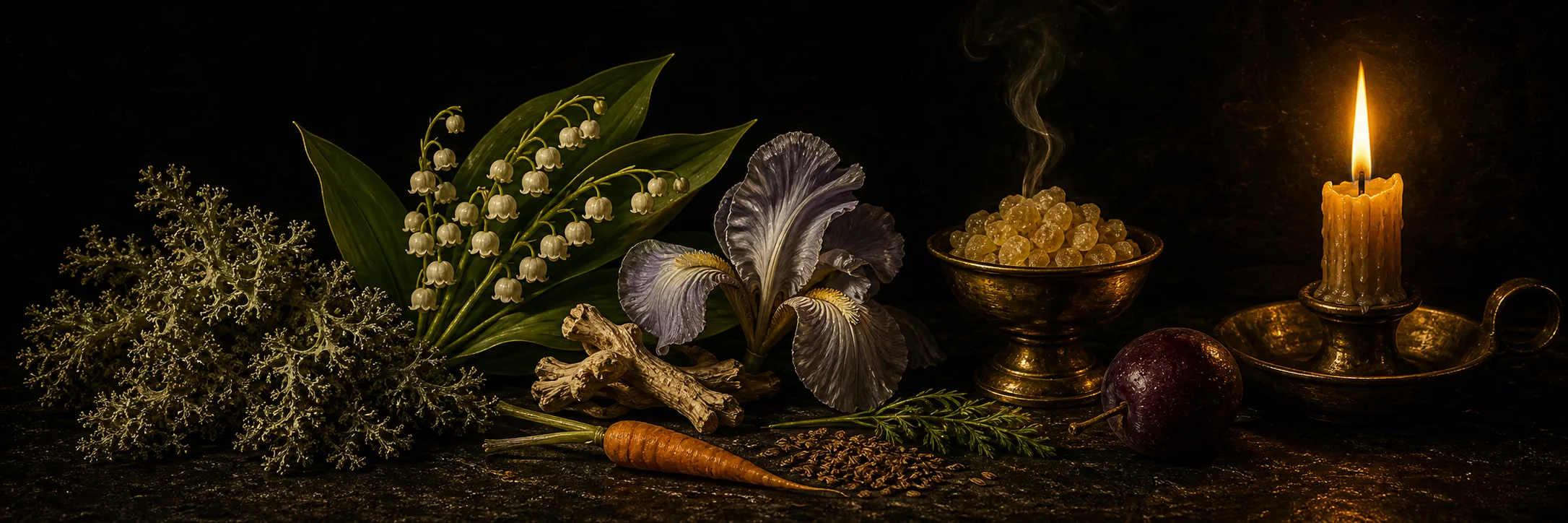
The opening is unmistakably 1990s European perfumery: a bright, slightly green muguet (lily-of-the-valley) lifted by cyclamen aldehydes and the curious dusty-orange carrot-seed note that gives the top its faintly retro powder. Ylang and rose sit underneath as a warm floral cushion rather than featured soloists, while geranium adds a thin metallic snap that earns the “Silver” name. This is not the loud, candied school of modern florals - it is airy, soapy, and deliberately demure for the first fifteen minutes, with a chypre dryness already telegraphed. By the one-hour mark the heart consolidates around iris (cool, dusty, lipstick-adjacent) and a sweetened muguet-jasmine accord lifted by heliotrope’s almond-vanilla creaminess. The peach and plum function as plush rather than fruit - they soften the white-flower edges and feed the powder. The clove is a structural spice, perceptible only up close, lending a faintly carnation-like backbone in the way mid-century chypres used eugenol. After three hours, the fragrance reveals what makes it unmistakably old-Amouage: a serious oakmoss-incense-civet drydown of a kind current regulations essentially prohibit. The civet is dirty in a respectable, well-tailored way - not feral, but enough to give the powder a body-warm dimension. Frankincense ties it to the Omani DNA shared with Gold, while sandalwood and amber round the base into something powdery and slightly sweet without going gourmand. Linear it is not: it evolves over six-plus hours from green-floral aldehydic through powdery-floral chypre into a soft animalic-incense skin scent. The signature accord is muguet-iris-civet over oakmoss - the kind of scent, as one reviewer put it, that your mother actually wore and that strangers stop you on the street to ask about.
Performance
Projection is moderate at first - the opening hour stays within a comfortable arm’s-length aura - but the chypre base is genuinely tenacious. Sillage develops as the heart settles, creating a defined two-to-three-foot trail by hour two. Longevity is excellent: a generous application reads on skin for ten to twelve hours and on fabric for a full day or more, and one wearer reported traces surviving a wash cycle, consistent with vintage oakmoss-civet-sandalwood architecture. Heat amplifies the powder and animalic facets and can push the civet forward in a way some find heavy; cool, dry weather is where the green-floral top reads cleanest, while humid heat flattens the muguet and over-emphasizes the heliotrope. Best application is one to two sprays to pulse points rather than clothing - the EDT is more concentrated than its category suggests, formulated when “EDT” still meant something substantial.
Wearing Context
It is best in fall and cool spring, autumn being the obvious sweet spot, where the powder, incense, and civet harmonize with cooler air. Daytime to early evening - this is not a club fragrance. It suits weddings, business meetings, the theater, anywhere the wearer wants old-world femininity rather than contemporary austerity or fruity-floral cheer. It falls flat in summer heat, where the oakmoss-civet base reads heavy and dated rather than elegant, and it feels wrong on anyone trying to project youthful sportiness - this fragrance has gravitas. Very few under forty wear it, and those who know it tend to associate it with mothers and grandmothers: an asset for buyers seeking heritage femininity, a liability for anyone wanting to register as current. It pairs better with structured tailoring than with athleisure.
Comparisons & DNA
The closest sibling is, predictably, Amouage Gold Woman (1983) - but where Gold is rose-jasmine-frankincense at full operatic volume, Silver Cristal is muguet-iris-civet at conversational volume, cooler and greener, less Arabian-baroque and more late-French-couture. Within the house, Ciel Woman inherited some of the bright muguet-aldehyde DNA but bleached out the chypre depth, Dia Woman is the most direct descendant in spirit (also iris-incense-powder, but lighter and more polished), and Reflection Woman shares the muguet-jasmine cleanliness while trading the chypre base for a transparent woody-floral musk. Outside the house, it invites comparison to vintage Chanel No. 19 parfum (sharing the green-iris-oakmoss spine, though No. 19 is drier and more galbanum-forward), Guerlain Chamade (a similar narcissus-aldehyde-powder feel, sweeter overall), and vintage Cristalle (a similar green-floral chypre, more hyacinth and less animalic) - Silver Cristal is louder and more animalic than any of them. There are no budget clones; it is simply too obscure, and the clone houses gravitate to the famous modern Amouages instead. The lineage matters: Silver Cristal sits at the tail end of Amouage’s Asprey-crystal “Belle Époque,” before the brand pivoted from Sultanate-of-Oman heritage perfumery to globally legible niche luxury. It started no trend; it ended one.
Reception
The major critics largely overlooked Silver Cristal - there is no dedicated critical review of it on record, which makes it genuinely a critic-overlooked fragrance. Wearers opinion skews enthusiastic but niche, with praise centered on its naturalness, its “scent of a real woman” character, and the way it triggers maternal-memory associations: one widely shared review called it “femininity itself, old school,” and others describe strangers asking “my mom had this perfume, what is it?” when catching the trail. The common counter-position, even among longtime collectors, is that it is wonderful if you happen across it but not worth hunting down given its scarcity. In vintage-Amouage circles the women’s Silver is a quietly devoted cult object, sometimes framed as the predecessor of the current Dia line. The fault lines are animalic tolerance (the civet is divisive), powderiness, and “vintage signal” - younger noses tend to read it as dated, older ones as classical. The blind-buy verdict is no: both the price and the polarizing chypre-animalic register make this a sample-first fragrance.
Versions & Reformulation
It was sold as Silver Cristal - a 50 ml EDT in the Asprey crystal mosque-shaped bottle - from the mid-to-late 1990s (sources disagree on the exact launch year by about two) through roughly 2000 to 2002, after which the Cristal range was rebranded, with the original crystal bottles produced until the 2008 redesign into modern glass flacons. The post-redesign feminine Silver appears discontinued without a direct modern descendant, though Dia is sometimes cited as the spiritual successor despite a clearly different formula. No formal reformulation is documented; what changed was the packaging and the gradual regulatory attrition of the oakmoss and animalic content typical of any pre-2003 chypre. It was a single concentration for the feminine. Amouage briefly revived the crystal-bottle concept in 2023 with a “Cristal & Gold” 40th-anniversary edition, but that is a Gold reinterpretation, not a Silver Cristal reissue.
Acquisition Notes
This is luxury territory with a vintage-scarcity premium. The bottle is 50 ml, and the fragrance is fully discontinued with no current production. On the second-hand market, 50 ml bottles have surfaced anywhere from under $200 to around $300 to $400 depending on condition, with sealed boxed examples climbing higher. One caution worth flagging: listings sometimes conflate the much pricier vintage “Cristal & Gold” with the cheaper Silver Cristal, so check the engraving on the base of the bottle. Decants are essentially nonexistent through the usual splitters, so a sample means a private split or a full-bottle purchase. Buy from established second-hand sellers.
Notable Facts & Lore
- The perfumer is not officially documented.
- Enthusiast folklore attributes Silver Cristal to Guy Robert - the legendary nose behind Hermès Calèche, Dioressence, and Amouage Gold (1983) - on the logic that the original Cristal range carried his signature.
- The attribution is plausible but unverified: Robert was active for Amouage in this era, but no primary source confirms his hand on the 1996 feminine specifically.
- The “Cristal” in the name refers to the Asprey London-made crystal bottle, not the juice - a point the brand’s modern messaging now states outright.
- The flacons themselves are objects of collector fascination: lead crystal with gold-plated metalwork, a mosque-dome cap for the feminines and a dagger cap for the masculines, produced with Asprey London and the Waltersperger crystallerie in Normandy.
- Amouage re-revived the concept with its 2023 anniversary edition, proof of how much the original crystal-bottle era now functions as the house’s mythological foundation.
- Silver Cristal sits as a footnote in that mythology - produced before niche-luxury logic took over, and discontinued before Christopher Chong’s tenure made Amouage globally famous. It is, in essence, an Amouage from before there was an Amouage cult, which is exactly what makes the small group of collectors who hunt it down so devoted.