Amouage — Sandal
Essence
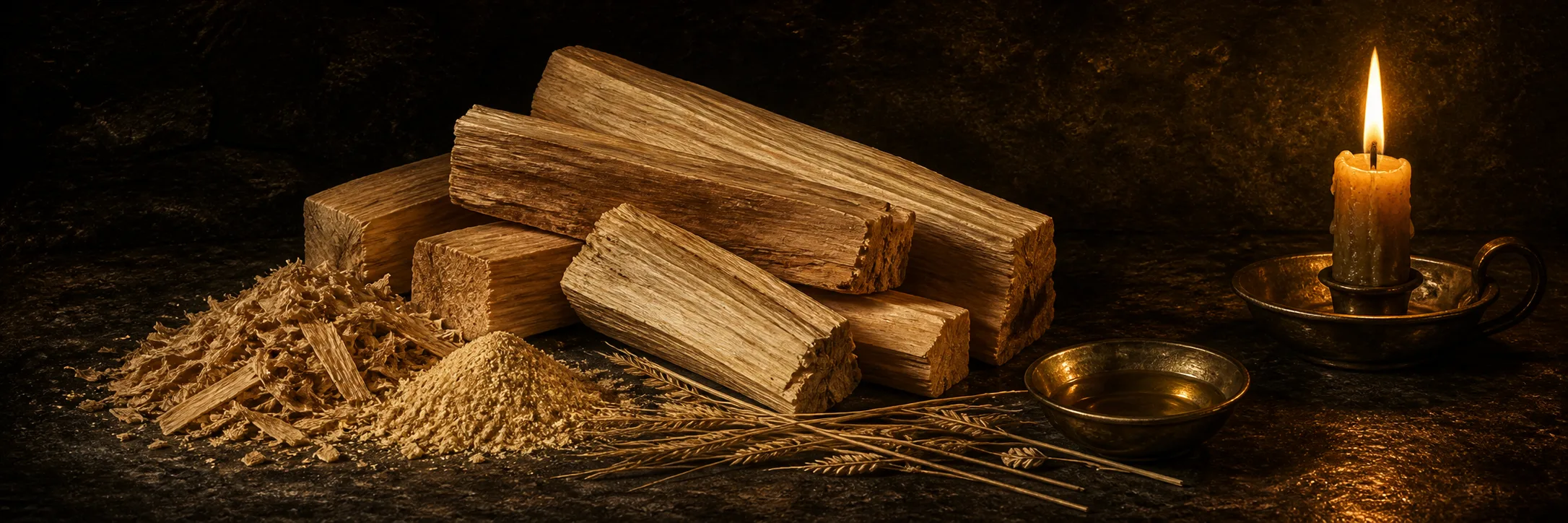
Sandal is one of Amouage’s discontinued original attars: a sandalwood soliflore in 100 percent oil concentration, sold in small 12ml dabber bottles roughly between the late 2000s and the spring of 2014, when Amouage halted all attar production rather than reformulate ahead of new regional regulations. Its perfumer is uncredited, in keeping with the old Amouage attar tradition, and it carries no listed top or heart notes - just sandalwood, read by some as a creamy, buttermilk Australian profile and by others as a smoother, Mysore-leaning wood. Far rarer than the house’s flagship Homage and Tribute attars but cheaper when in production, it survives today as a collector’s curiosity and a layering material.
Scent Profile
The opening is brief and slightly hay-like - a dry, faintly grassy top, with some wearers catching a lemony or lemongrass tinge, that resolves within five to ten minutes into a creamy sandalwood core. There is no spice, no smoke, no floral, nothing resinous or animalic; this is sandalwood presented as material rather than as a composition. The heart is the whole experience: a smooth, creamy, milky-woody sandalwood with the characteristic slight sweetness that sets off the perennial debate over its origin. One detailed reading describes a green creaminess that smells almost exactly like buttermilk with the faintest tinge of sourness, beautiful and soft but recognizably the lighter Australian sandalwood; another wearer, comparing it to vintage 1970s Mysore oil, found it warm, smooth, and close to real Mysore. The discrepancy most likely reflects genuine batch-to-batch variation, since Amouage’s attars are known to have differed across production runs. The drydown is essentially continuous with the heart - Sandal is the most linear of the Amouage attars by design. The sandalwood softens to a skin scent around the fifth or sixth hour and fades out entirely by the eighth or ninth on most skin. The signature, and the only accord, is creamy santal - sometimes lemony-green, sometimes warmer and spicier depending on the batch. There is no evolution to speak of; this is a soliflore in the truest sense.
Performance
Sandal is quiet. Projection is close to the skin from the first hour, hovering perhaps an inch above it before dropping to a true skin scent by the second or third, and sillage is essentially nil - no one beyond intimate distance will smell it. Longevity is moderate, around six to nine hours on skin and longer on clothing or hair, where the oil binds well. Wearer response rates both longevity and sillage as solidly average, lower than the louder Amouage attars. Heat warms and pushes the creamy facet forward, while cold can make it nearly imperceptible within a few hours, and dry climates suit it slightly better than humid ones. The consensus best use is layering: many wearers treat it less as a standalone scent than as a sandalwood base under other fragrances. For solo wear, apply generously and accept its intimate character.
Wearing Context
Sandal is at its best in cool, intimate settings - autumn, winter, indoor evenings - and the time of day hardly matters because its projection is so low it never imposes. It suits low-stakes daily wear, a sleep scent, post-bath skin wear, layering under other fragrances, and meditative or contemplative moments; the Buddhist-ceremonial sandalwood association feels apt, since this is closer to a ritual wood oil than to perfume in the Western projection-and-sillage sense. It falls flat anywhere you actually want to be smelled - loud rooms, summer outdoors, sport, big social events. It would be misread as weak by anyone whose reference point is a powerhouse like Interlude Man, but the framework is simply wrong: it is to those scents what a neat single malt is to a cocktail.
Comparisons & DNA
The obvious commercial reference is Diptyque Tam Dao, the go-to creamy-sandalwood soliflore; Tam Dao is woodier and drier, while Sandal is creamier, oilier, and quieter. Serge Lutens Santal de Mysore is heavier, more curried and spiced, making Sandal the lighter, gentler cousin, and Profumum Roma Santalum is close in concentration but richer and sweeter. Chanel Bois des Îles is a more classical, composed aldehydic sandalwood where Sandal is raw-material-forward, and Le Labo Santal 33 is essentially irrelevant as a comparison, since it is a violet-leather-cardamom construction wearing the sandalwood name while Sandal is the actual material. Among artisanal references, minimalist Mysore oils from independent attar houses come closest in spirit. In lineage, Sandal belongs to Amouage’s original attar lineup - a project of presenting traditional Omani attar materials in a perfumer-curated, brand-luxury format - and stands as the discontinued ancestor of the 2023 Amouage Santal Sohar attar, which reinterprets the idea as a sweeter, more composed sandalwood-spice-rose accord rather than a soliflore.
Reception
Critical coverage was always limited, and Sandal in particular lived in the shadow of Homage and Tribute. Wearers opinion is positive but quiet: it is praised as the real deal in sandalwood, smooth as butter, with an almost sweet creamy milkiness, while the common criticisms are weak sillage and longevity for the price, some batch variation, and the unsettled question of whether the wood is Mysore or Australian. The points of debate are essentially three: Mysore-or-not, which depends on the batch tested; standalone versus layering, where consensus has drifted toward layering as the main value; and value for money, where it was historically the cheapest of the Amouage attars and considered fair. Mainstream critics largely passed it by during its production life, so the usable reception data is overwhelmingly wearers-driven. The blind-buy verdict, when it was still available, was yes for sandalwood lovers willing to accept low sillage; today it is worth pursuing only by decant or through a trusted secondary-market source, since full bottles are scarce and authenticity is the dominant concern.
Versions & Reformulation
Sandal appeared in several batches with documented packaging differences - white-box, red-box, and black-box runs are referenced across collector discussions, with the white-box vintage versions the most prized. Reformulation between batches was acknowledged by attar enthusiasts, and it is plausible that the wearer who found genuine Mysore character simply had a different batch than the one that read as Australian. The whole original attar line, Sandal included, was discontinued in the spring of 2014, when Amouage’s Muscat factory ceased all attar production rather than reformulate to meet emerging regional regulations; remaining stock sold through into 2014 and 2015 from limited Gulf-region retailers. As of 2026 Sandal is not in production and has not been revived, though the 2023 Santal Sohar stands as the closest current replacement.
Acquisition Notes
Sandal was niche-to-luxury priced when in production and has been collector-rare since 2014. Historically it retailed around $250 for 12ml at Western boutiques in 2013 and 2014, and was notably cheaper, closer to $100, at Gulf boutiques a few years earlier, making it the most affordable of the Amouage attars at the time. The primary decant market for it is now essentially defunct, and what remains trades on the secondary market in original brass-dabber flacons and the white, red, or black boxes that mark the production batches. Authenticity is the main risk, so buy only from reputable secondary-market specialists or a verified collector.
Notable Facts & Lore
- The most telling Sandal-specific fact is its near-invisibility in Amouage’s marketing: while Homage and Tribute carried the attar legend, Sandal was a sleeper, often available only on request from the Oman, Dubai, and Bahrain boutiques rather than as a standard product.
- Its quiet status matched its function as a connoisseur’s pure sandalwood oil rather than a flagship.
- The dramatic part of its story is the discontinuation, which applied to the entire original line: in the spring of 2014 the Muscat factory stopped all attar production.
- The trigger was the prospect of new regionally enforced, IFRA-aligned regulations; although Amouage’s home country of Oman sat outside that jurisdiction, the brand chose to halt rather than reformulate or accept fragmented regulatory exposure, and contemporaneous reporting from a visitor to the factory described production ceasing entirely with only a sliver of stock left.
- Cécile Zarokian’s 2021 Renaissance Attar Collection was later framed explicitly as a tribute to and reinvention of that discontinued original line, the direct narrative successor to Sandal and its siblings.
- There are no celebrity associations or viral moments here, only the broader sadness of the 2014 attar discontinuation, which keeps the original Amouage attars a touchstone in collector circles.