Amouage — The Library Collection Opus VII
Essence
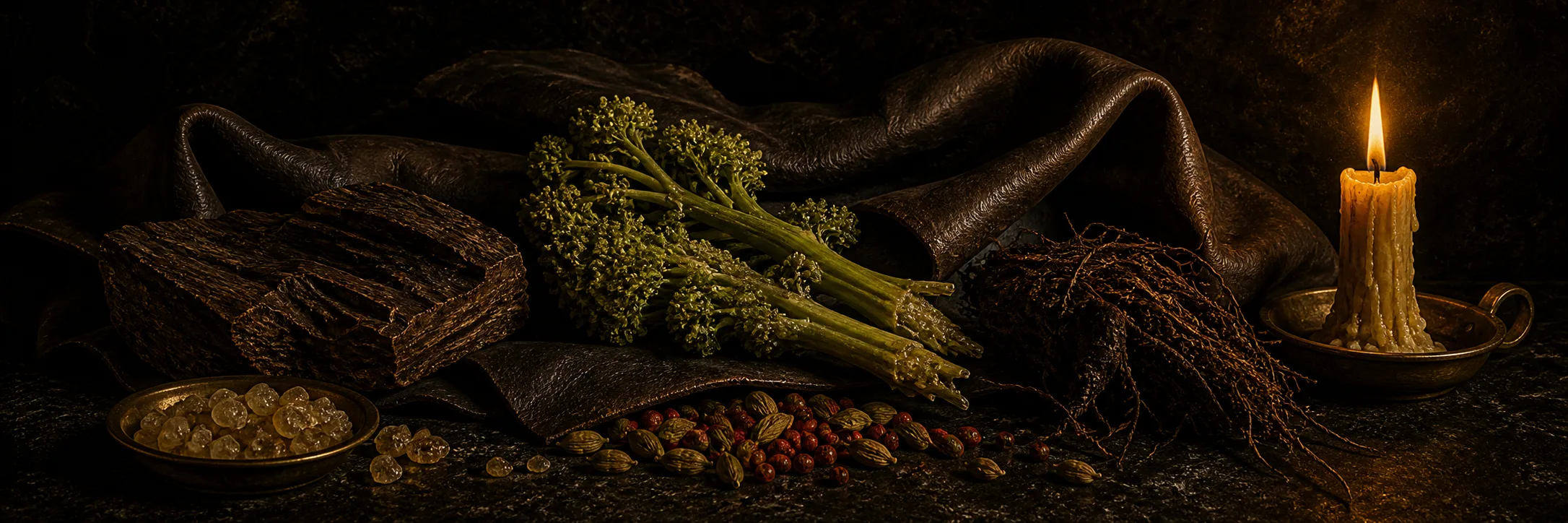
Opus VII is the green-leather extremist of Amouage’s Library Collection: a ferocious galbanum-and-spice opening that eventually descends into smoked leather, oud, ambergris, and resins. What makes it distinctive is that the leather does not arrive polished or smooth; it is earned through friction. The fragrance starts in a sharply vegetative register and only later settles into something recognizably leathery, so it feels less like a leather perfume with green top notes than an argument about how greenery becomes smoke, hide, and warmth.
Scent Profile
The opening is the main event for many wearers. Persolaise called it the greenest opening of any Amouage to that point, and specified that this was not herbaceous freshness but a peculiar green closer to peas and peppers: glassy, natural, and strange at once. That green comes from galbanum, but the sharp spices packed around it matter just as much, cardamom, nutmeg, pink pepper, and especially fenugreek, which adds an almost edible bitterness. Some wearers also catch a floral lift like a ghost of lily of the valley, even though the note structure is otherwise all green and spice. For the first twenty minutes the fragrance is loud, high-strung, and borderline abrasive by design. The mid-stage is where the title starts to make sense. Leather, oud smoke, ambergris, and patchouli come forward, but they do not erase the opening’s green bite. Persolaise describes the structure as green floral atop brown leather, and enthusiast reviewers speak of a drydown built around a trinity of leather, ambergris and sandalwood, and agarwood smoke, with galbanum and fenugreek still present. That is the right way to understand the heart: not a clean transition from green to leather, but an overlay in which the sharp opening keeps needling the darker materials underneath. The leather is perceptible, but not in the suede-jacket or glossy style of designer perfumery; it is rough, smoky, and embedded in resin. In the drydown the fragrance becomes browner, denser, and more reassuring without ever turning soft. Sandalwood, incense, cypriol, costus, musk, and the ambergris effect round it into a smoky, leathery, slightly furry base. Even here it usually keeps some oddity, with costus and cypriol holding the leather animalic and dusty while the incense prevents the base from going creamy. The signature accord is green galbanum-fenugreek spice fused to smoked leather and resins. It evolves clearly from sharp green to brown leather, but it never becomes linear or tame.
Performance
Projection and longevity are above average. Opus VII throws hard in the opening, often more than you would expect from a leather-marketed scent, because the green and spice materials are so assertive. A reasonable estimate is strong projection for the first two hours, then moderate but persistent radiation for much longer. The sillage is vivid and distinctive, not a syrupy trail but a spiced, resinous, leathery cloud people tend to remember. In hours, expect about ten to twelve on skin and a day or more on clothing. The real variable is not duration but how it behaves in weather: heat can make it sharper, sourer, and more cumin-like for sensitive noses, while cooler temperatures make the leather-resin base feel more coherent and luxurious. Because the opening is uncompromising, one to two sprays is the best default; more can turn the fragrance into an ordeal for anyone nearby who does not already love galbanum, fenugreek, and leather.
Wearing Context
Opus VII is best in autumn, winter, and cool spring nights. It suits dark clothing, dramatic spaces, and social settings where a challenging fragrance functions as part of a persona rather than as ambient grooming. Persolaise’s imagery of street food, flowers, joss sticks, and desert heat captures that this is a vivid smell-story rather than a generic leather. It works at art openings, for nighttime city wear, and in any context where interesting and intense is valued over smooth and handsome. It is a poor fit for office life, conservative environments, and hot daytime commuting. The scattered enthusiast signal supports that: one owner calls it a meaningful fragrance memory, another describes it as green leathery wood incense, and another files it in a love-to-hate category after several failed wears. Socially it reads intellectual, hard-edged, and almost confrontational. On the right person that is a feature; on the wrong one it becomes exhausting.
Comparisons & DNA
The most useful explicit comparison comes from Persolaise: Andy Tauer’s Carillon Pour Un Ange, because both share a green-over-brown-leather architecture. The distinction is major, though. Tauer’s perfume lives in a European garden touched by rain, while Opus VII belongs to the desert, where the sun dries every green thing into something sharper and stranger. That makes Opus VII less floral, more arid, more abrasive, and far more resinous. Within Amouage, Opus VI is the closest structural sibling in the base, with moments where the amber drydown of the two resemble each other, though Opus VII’s identity is greener, more leathery, and far more dependent on galbanum and fenugreek. The galbanum bite of Myths Woman is sometimes raised as an in-house point of reference, nowhere near as ferocious as this opening. For a cheaper alternative, Maison Alhambra’s Optus VII is openly discussed as a more affordable echo, but even those who like it say it is not exact and starts rougher, making it an option for the vibe rather than a guaranteed replacement.
Reception
No major critic review surfaced, but critical reaction was among the strongest of its peers. Persolaise called it a perplexing triumph after recounting a room full of extreme first reactions, and other editorial coverage framed it as a deeper, darker continuation of the shadowy territory Memoir Man had already explored. This is a fragrance critics tended to take seriously precisely because it was so unlike the market around it. Wearer reception is good but highly polarized. Admirers praise the originality of the green opening, the eventual smoked-leather base, and the way it reveals new textures on repeated wear, while detractors complain of pickle tones, hot plastic, cumin-like heat, or simply too much aggression. The split is clear in the enthusiast reviews: one praises the reassuring drydown trinity of leather, ambergris and sandalwood, and agarwood smoke; another dismisses the arc as a strident galbanum start followed by generic sweet sandalwood; a third calls the opening horrid and obscured by cumin. As a blind buy it is an emphatic no; this is sample-only territory.
Versions & Reformulation
Versions matter here. The original 2013 Library Collection Opus VII was later rebottled and retitled as Opus VII Reckless Leather during Amouage’s 2022 Library Collection reshaping. By the house’s own account this was not a new fragrance, just the addition of a subtitle and a broader, curated distribution of selected Opus entries, and current databases present Reckless Leather as the same 2013 scent in the ongoing line. Sources are thin on claims of any major change to the juice, so the most accurate summary is renewal and renaming rather than documented reformulation.
Acquisition Notes
Opus VII is one of the easier of its peers to source authentically, because the current Reckless Leather presentation remains in production. That gives you a legitimate modern route instead of chasing only discontinued stock; the original 2013-branded bottles are more collector-oriented, while the renamed version is the practical purchase. There is also a cheaper echo in Maison Alhambra’s Optus VII, though it is a rougher, non-identical homage rather than a dead-on clone. Given how polarizing the opening is, sampling before buying is strongly advised.
Notable Facts & Lore
- Opus VII’s concept and presentation are unusually explicit.
- Christopher Chong wanted the scent to capture humanity’s tumultuous journey in pursuit of knowledge and the euphoria of attaining it, and it was the first Opus to appear in a black flacon with gold criss-cross lines representing the mind when thoughts are diverted and subjected, which makes the bottle design part of the fragrance’s identity rather than mere packaging.
- Alberto Morillas, who composed Opus VII with Chong, described the process as a challenge driven by very different ingredients and by Chong’s passion, recounting that he improvised a new accord in Geneva in front of Chong, who loved it immediately.
- That helps explain why Opus VII smells less like another Morillas leather and more like a curated collision of green, spice, smoke, and hide.
- No viral social moment attaches to it; its fame remains that of the enthusiast world rather than the mass market.