Amouage — Rose Aqor
Essence
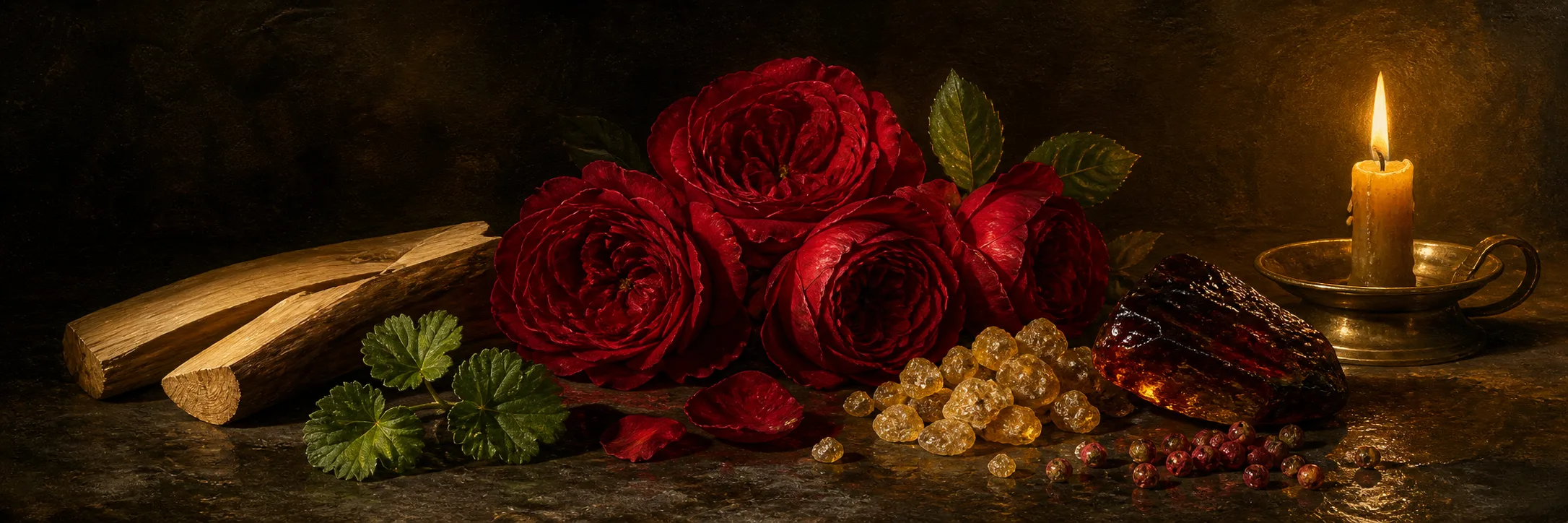
Rose Aqor is a pure perfume oil - Amouage’s 2021-2022 reimagining of the attar format under creative director Renaud Salmon. Composed by Cecile Zarokian, it is a rose-frankincense-sandalwood trio inspired by the rock roses of the Al Aqor village on Oman’s Sayq Plateau. Despite the attar label, it wears like a thick, alcohol-free extrait: a smoky, peppered, spicy-ambery rose that reads as an oilier sibling of Zarokian’s own 2009 Epic Woman. It arrived as part of a luxury attar relaunch that some critics judged a brand-positioning exercise more than a return to the old attar tradition.
Scent Profile
The opening is a deceptively bright burst of geranium-tinged rose lifted by something that reads as pink pepper or a peppery aldehyde - a soda-fizz rose, in one critic’s memorable phrase, the sparkling white incense she identifies as a Zarokian fingerprint. Frankincense is present from the first minute but stays cool and resinous rather than smoky, and the sandalwood is felt as creaminess underneath rather than a discrete note. Several reviewers also catch what is almost certainly amber, cinnamon, and patchouli, though none are on the official three-note list - a sign of Zarokian’s habit of overdosing aroma-chemical adjuncts around her naturals. By the one-hour mark the structure shifts: the geranium-pepper edge softens, the rose deepens into something jammier and slightly fruited - one critic likens it to raspberry, another calls the rose sensual, lush, and breathtakingly lovely - and the incense steps forward. This rose-incense accord is the dominant mid-stage, recalling Amouage’s own Opus XII Rose Incense but with more amber padding and less smoke. In hours two and three the sandalwood turns audibly creamy and, by several accounts, increasingly synthetic-leaning on skin. The drydown is a quiet duet of ambered rose over creamy santal, with a labdanum-resinous warmth pulling everything into Zarokian’s signature golden register, and a faint smoky-honeyed residue lingering past hour eight. The signature is unmistakable - peppery rose over crystalline frankincense over creamy sandalwood-amber - essentially Epic Woman’s DNA recompressed into oil. The evolution is real but constrained, broadly linear with two clear inflection points: the incense surge around hour one and the santal-amber dominance around hour three.
Performance
For a pure oil, Rose Aqor’s performance is divisive. Projection is moderate - roughly arm’s length for the first couple of hours when applied generously, then close to skin for the remainder - and the sillage is intimate, not the trailing wake of an Amouage eau de parfum. Longevity runs eight to fourteen hours on skin depending on how much you apply, and on clothing or in beard hair it can exceed a full day, with wearers reporting traces the next morning. It behaves well in heat: the rose-amber accord blooms without going screechy, and the oil format resists the alcohol-driven blow-off of a spray. In cold, dry weather it can wear surprisingly close, so apply more and consider hair as a substrate. The intended ritual is to dab, never rub, onto pulse points and the underside of the jaw, and a single drop worked into the hair is a reported trick for a little more projection without losing the close-wear character.
Wearing Context
Rose Aqor is a cooler-weather fragrance by default - autumn and winter highlight the resinous incense-amber spine - though in hot Gulf climates it works year-round because the oil anchors so well. It reads best from late afternoon through the evening, at formal dinners, ceremonial or religious events, and cultural functions, anywhere the close-wear intimacy of an oil is taken as deliberate refinement rather than under-projection. Where it falls flat: warm-weather casual settings where you would want a sprayed scent’s lift, loud nightclubs or sweaty bars where the dignified spice-rose register feels mismatched, and everyday office use, where it is quiet enough not to offend but the cost per wear is hard to justify. Socially it reads as unambiguously high-end, even devotional, in Middle Eastern contexts - one Turkish wearer affectionately compares it to the rose oils sold near mosques - and as wealth-signaling Amouage-fan-club material in Western niche circles, while to everyone else it simply smells expensive.
Comparisons & DNA
The closest reference point, stated outright by more than one critic, is Amouage Epic Woman (2009, also Zarokian): Rose Aqor is a near note-for-note recreation of it in oil format, slightly sweeter and doughier thanks to a benzoin nuance. Amouage Epic 56 Woman, the 2021 extrait companion, sits between them - louder than Rose Aqor, more aromatic-green than Epic Woman - and is widely considered the best value of the three. Amouage Opus XII Rose Incense is the other in-house comparison: airier, more transparent, less ambered, more about radiant incense than peppery rose. Amouage Lyric Woman is the fruitier, brighter rose-spice-incense ancestor in the house canon, with Rose Aqor as the spicier, darker descendant. The comparison it invites and arguably loses is to the original discontinued Homage attar - as one critic put it, Rose Aqor smells like a niche perfume in oil format, a complete composition clearly made in a temperature-controlled lab, where Homage smelled like something violently wrested from the earth. Outside Amouage, Frederic Malle Portrait of a Lady shares the spiced-rose-on-incense-amber template but is louder, more patchouli-driven, and far cheaper per milliliter, and Parfums MDCI Rose de Siwa shows Zarokian’s recognizable hand in a different rose register. For a budget rose-incense-sandalwood there are accessible references, but none replicate the oil-format intimacy, and as of now there is no known direct clone of Rose Aqor. In lineage it descends from Epic Woman through Lyric Woman and ultimately the Taif-rose-and-frankincense template of the original Homage attar, and it belongs less to a trend than to Amouage’s broader repositioning under Salmon toward concentrated, aged, narrative-rich limited editions.
Reception
Wearers opinion is split. The praise runs to absolutely stunning, all-day longevity, and Zarokian magic; the critique targets the price-to-novelty ratio, with complaints that it is just synthetic sandalwood and little else, that Epic 56 offers more for less, and that the old glory of the Amouage attars is now history. Two fault lines dominate: whether you accept the attar label at all - natural-perfumery voices insist the term implies majority-natural materials, while brand-friendly editors are happy to use it - and whether the redundancy with Epic Woman and Epic 56 disqualifies it at this price. One wearer’s blunt verdict is not to blind-buy, but to try a sample from the discovery coffret first. Among critics, one called it sensual, lush, textural, and breathtakingly lovely, the stuff of goddesses and witches and princesses, while another, admiring it as lovely, noted plainly that since it is a near note-for-note recreation of Epic Woman, anyone who is not specifically in the market for this exact spicy-ambery-incense rose probably already owns something very like it. The major perfume publications did not run individual reviews of Rose Aqor, and influencer video coverage has been thin, consistent with the attar line’s limited, Middle-East-skewed distribution.
Versions & Reformulation
A single composition, launched at Cannes in mid-2021 and widely available from January 2022, sold only in a 12 ml format and specified by the house as a pure oil with four weeks of ageing and four weeks of maturation. No reformulation has been reported, and batch-to-batch variance is small relative to the original 2005-2014 Amouage attars, which were notorious for formulation differences between box colors.
Acquisition Notes
This is ultra-luxury pricing within the attar category: retail is USD 540 for 12 ml, roughly forty-five dollars per milliliter, which sits above most niche eau de parfums per milliliter but below the true ultra-luxury attar houses. An official discovery coffret of six attar samples launched at around USD 200 and remains the most reliable way to sample. The decant ecosystem is limited and intermittent. Counterfeiting is low for this format - the limited distribution and dabber-bottle make replication unprofitable - so the main risk is decanted oils from unverified sellers; buy from Amouage boutiques or established authorized retailers.
Notable Facts & Lore
- Cecile Zarokian’s inspiration is specific and documented.
- She has described walking the Sayq Plateau from village to village among the rose bushes, following the old irrigation channels, with the cliff-top view of green terraced rose fields against the dry dark rocks of Jebel Akhdar - the region whose Omani Damask rose feeds local rose-water and attar production - and named the scent for the first village, Al Aqor.
- The collection’s launch was itself notable: at Cannes in 2021, Renaud Salmon hosted a party at which Zarokian created edible olfactory versions of the attars to be sprayed onto bespoke cocktails, the public unveiling of Amouage’s repositioning under Salmon, who had succeeded Christopher Chong.
- Zarokian was named one prominent editor’s personal perfumer of the year for 2021, and the attar collection became a recurring subject of debate over authenticity - whether the new attars delivered against the old attar legacy or simply rebranded niche perfume oils - with one widely-read editorial concluding that, oil or alcohol, today’s Amouage belongs to the world rather than to any one local tradition.