Amouage — Saffron Hamra
Essence
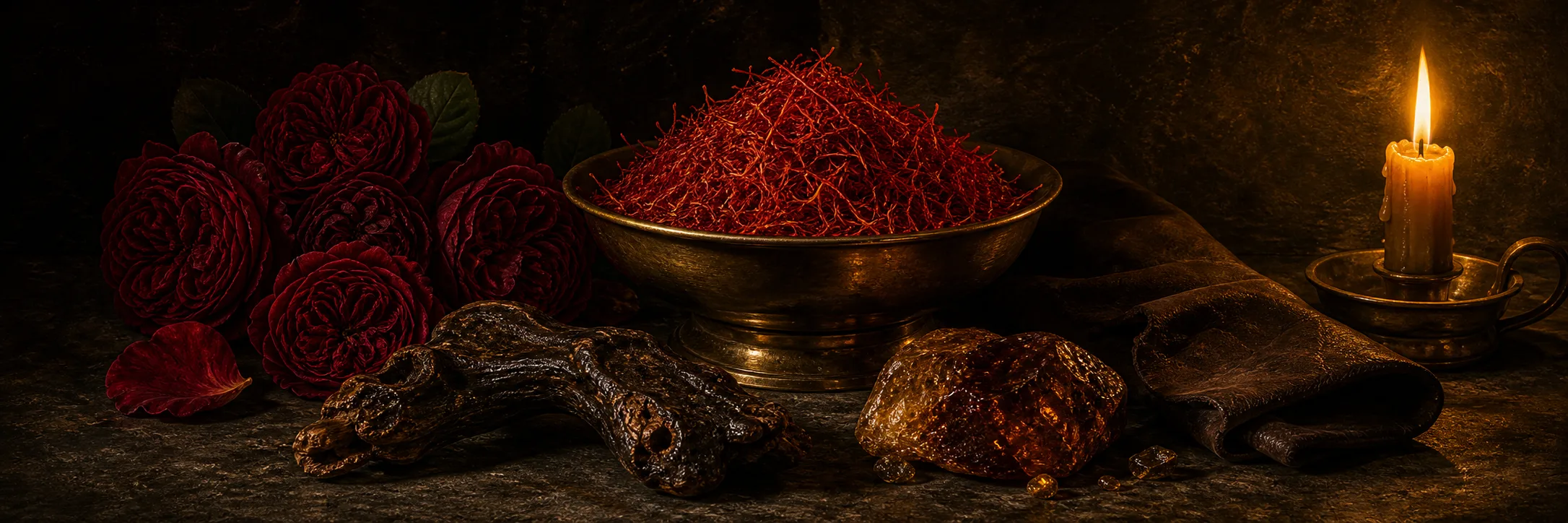
Saffron Hamra is Cecile Zarokian’s 2021 saffron-rose-cade contribution to Amouage’s relaunched attar collection - a 100-percent-oil composition named for Al Hamra, a brick-red mud-brick village in Oman’s Jebel Shams region. Of the six attars in the set, it is the one critics most agree feels authentically attar-like in the traditional Middle Eastern sense, built on the saffron-rose-sandalwood triangulation that anchors the Arabian mukhallat genre. Bigger, smokier and more dimensional than its sibling Rose Aqor, it is widely judged the connoisseur’s pick of the line - and the one critic Claire Vukcevic argued was worthy of a place in Amouage’s original attar line-up.
Scent Profile
The opening is the boldest of the line: a heady, slightly medicinal saffron that lands like iodine-stained gauze and faintly burnt rubber for the first couple of minutes - a raw, traditional quality that wearers raised on Western niche may need a moment to parse. Within five minutes a generous, very natural Rose Centifolia absolute blooms underneath, wrapping the saffron’s sharp edges in a sweet, jammy cushion. Cade oil - a juniper tar - is present from the start but muted, lending leather-resinous body rather than the smoky-bandage profile cade can deliver undiluted. Many wearers register an ambery-vanillic warmth beyond the three-note brief, and the critic Michael Devine described a sumptuous, smoky leather accord forged from the cade. Through the heart, the saffron and rose lock into the classic mukhallat duet - sweet, medicinal, slightly metallic - while the cade contributes what one wearer called smoke dancing away from a small fire, and an oud-like dirtiness that surfaces even though no oud is listed. The rose is unreliable across skins: some find it co-dominant with the saffron, others find it fleeting or nearly absent. The mid-stage is heavier, more ambery and more leathery than Rose Aqor - variously described as sweet saffron tea, saffron-infused milk tea, and, in Vukcevic’s memorable phrase, vanilla custard tinged with iodine and dirty bandages, delicious and unsettling in equal measure. In the drydown, which runs many hours, Saffron Hamra settles into a leather-saffron-amber base with the rose receded, and several wearers report a chocolatey facet emerging late, likely a labdanum-cade interaction. A minority catch a metallic note in the far drydown that they find harsh - a real if divisive signal. The signature, in short: saffron, rose and cade over a leather-amber underbase. It is more dimensional than Rose Aqor, and while the broad arc is predictable - medicinal opening, spice-rose heart, leather-amber base - it does not wear flatly linear.
Performance
Strong for an oil. Projection is moderate-to-strong in the first half hour, when the saffron and cade are at their loudest, then settles closer to the skin for the next few hours. Sillage is notable for an attar, and longevity is excellent - ten to fourteen hours on skin is typical, with heavier application pushing well beyond, and a full day or two on clothing, which can hold a faint residue even after laundering. Heat amplifies the saffron-rose bloom and pushes the leather forward; cold mutes the smoky cade and emphasizes the sweeter rose-amber. Dry climates flatter it, while humidity slightly flattens the spice. One or two dabs is plenty - a single drop can project a foot or more in dry indoor air, and over-application can push the medicinal-iodine opening into uncomfortable territory. Restraint is the move.
Wearing Context
Best in autumn and winter, in the evening or any cool indoor setting: formal dinners, weddings, religious functions, theater - anywhere a dimensional spiced-leather oriental suits the dress code. It shines at small, well-lit dinners, in libraries, and in cigar lounges, where the cade-leather is sympathetic to tobacco smoke, and it rides wool or cashmere beautifully in cold weather. It falls flat at the gym, on a summer beach, or anywhere cardio-driven, since saffron in heat and sweat turns medicinal in an unflattering way; it can also read overdressed in a minimalist office, and the iodine opening is a challenging first impression for fragrance novices. Socially it reads as unambiguously high-status in Gulf and South Asian settings and as serious-collector territory in Western niche circles - a signal of familiarity with the mukhallat tradition rather than trend-chasing. Several wearers note it draws compliments far more reliably in Gulf social settings than in Western ones.
Comparisons & DNA
The clearest reference is L’Artisan Safran Troublant - a rose-saffron-vanilla that Vukcevic framed as the Parisian-salon version of this idea, where Saffron Hamra removes that comfort to “the harsh planes and arid environment of the Rub’ Al Khali desert.” She also likens it to a smoother Arabian Oud Al Siraj, her benchmark saffron mukhallat, placing Saffron Hamra firmly in the Gulf tradition rather than Western niche. Other recurring neighbors include the discontinued By Kilian Incense Oud, which is greener and more frankincense-forward where this is more leather-rose; Histoires de Parfums 1740, which shares the medicinal-leather-saffron dimension but leans more immortelle; and Tauer’s Shadid for the rose-spice-incense overlap. Same-hand comparison to Zarokian’s own Opus XIII Silver Oud is instructive: Silver Oud works the saffron-leather-oud register but louder and more synthetic, aimed at the spray audience. No one-to-one budget clone has emerged; the nearest affordable adjacents are saffron-rose-leather mukhallats from the Gulf houses, without the Amouage polish. In lineage, Saffron Hamra descends from the traditional Gulf saffron-rose-oud mukhallat genre but is composed by a Paris-trained perfumer working within modern material constraints - part of Amouage’s broader project of compressing the mukhallat into a luxury-branded, perfumer-credited format.
Reception
Wearer response is the most positive of the new attar collection, with wearers repeatedly naming Saffron Hamra the standout - for many, the best of the attars available outside Oman. The common praise is for its complexity beyond a three-note list, its longevity, the authenticity of the saffron-rose-cade triangulation, and Zarokian’s restraint in not letting the saffron go fully medicinal. The common criticisms: the cade can read metallic or chemical in the far drydown for some, the rose is unreliable on certain skins, and the price-to-volume ratio is steep. Among critics, Michael Devine found something almost mystical in it, calling it a gorgeous, complex offering that may need several wearings to fully appreciate, while Claire Vukcevic judged it the most traditionally attar-like of the collection - saffron’s medicinal properties allowed to play out in full, then cushioned by a soft, sweet rose. The major perfume blogs otherwise largely passed on individual reviews, several only reproducing the press announcement. Opinion polarizes on three axes: whether the medicinal-iodine opening is a feature or a flaw, whether the cade drydown reads as leather or as metallic, and skin-chemistry variability on the rose. Blind-buy verdict: a conditional yes if you already love saffron-rose-leather mukhallats, and a no if your reference points are Western niche florals. The discovery coffret is the recommended entry.
Versions & Reformulation
A single composition, launched at Cannes in mid-2021 and widely available from early 2022, sold only in the 12ml dabber bottle. No reformulations have been reported. Some Gulf retailers have floated discontinuation rumors in recent years, but Amouage has not announced any, and the attar remains listed as of the latest availability checks.
Acquisition Notes
This sits at the ultra-luxury tier, retailing around $540 for 12ml - roughly $45 per milliliter - through Amouage boutiques and authorized luxury retailers. The decant ecosystem is limited, so the official six-attar discovery coffret, at around $200, remains the most reliable way to sample before committing. Buy from authorized retailers only.
Notable Facts & Lore
- Zarokian’s stated inspiration is the village of Al Hamra in Oman’s Jebel Shams region - a palette of browns and greens, mud houses on brick-red hills dotted with palm trees - and the fragrance reads like that landscape at sunset, a multi-hued glow dividing light and dark.
- Amouage frames it as the union of a King and Queen in the stark redness of the Hamra Mountains.
- Zarokian has spoken about the technical challenge of the format: traditional attars reach 100-percent concentration, which makes respecting modern safety norms genuinely tricky, but she found the constraint stimulating and the result intensely olfactory.
- For the launch party she even created edible olfactory versions of several attars to be sprayed onto bespoke cocktails, a mixology collaboration she described as natural - mixologists, she said, do essentially the same work as perfumers.
- One nice irony sits at the center of the collection’s lore: the pricier Oud Ulya contains real agarwood while Saffron Hamra contains none, yet many wearers find Saffron Hamra the more convincing mukhallat of the two.
- Zarokian was named Perfumer of the Year for 2021 in part for this composition.