Amouage — Crimson Rocks
Essence
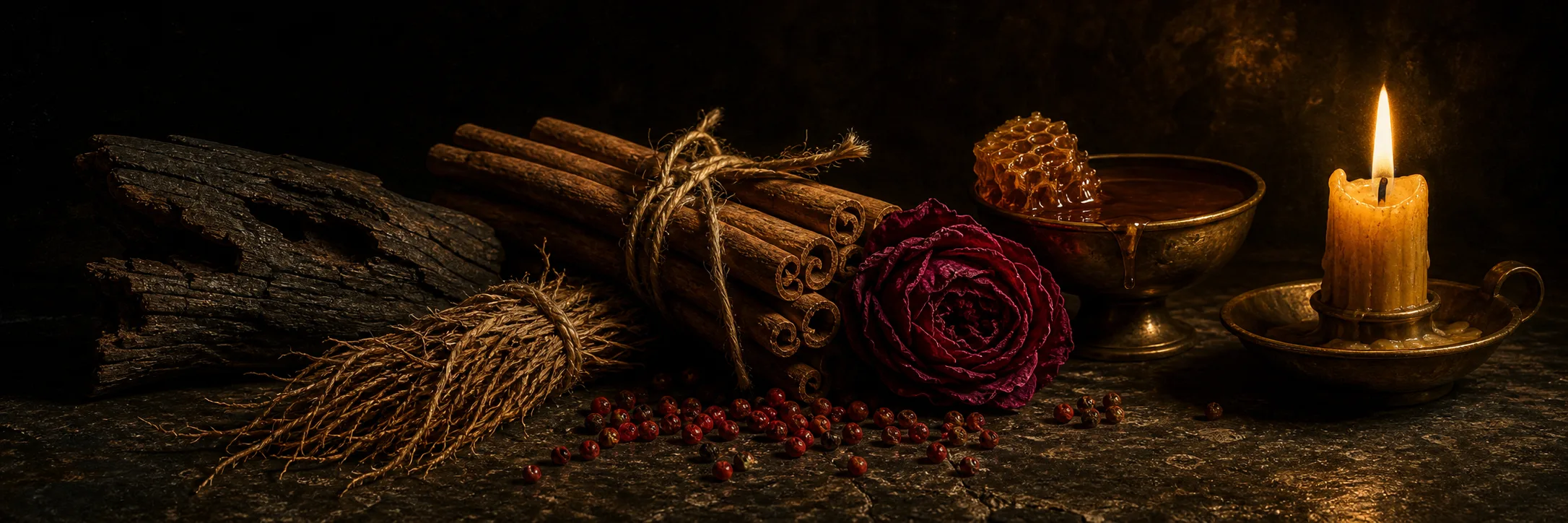
Crimson Rocks is the rose at the heart of Amouage’s 2020 Renaissance Collection - the first fragrances released after Renaud Salmon took creative charge of the house. Composed by Domitille Michalon Bertier, it sets an intense Damascena rose against cinnamon, pink pepper, jujube honey, and a dry oakwood-cedar-vetiver base, explicitly evoking the Al Hajar mountains of Oman lit by the last rays of the April sun. It is the clearest statement of Salmon’s “back to Omani roots” direction, leaning harder on modern dry-amber materials than the house’s earlier catalog ever did - and it has split Amouage loyalists down the middle ever since.
Scent Profile
The opening is sharp and assertive: pink pepper and cinnamon arrive at the same time and loudly. This is the bark-essential kind of cinnamon, dry and woody rather than the gourmand baking-cinnamon of something like Tom Ford Tobacco Vanille, and the pink pepper amplifies its spice while adding a peppery-rosy edge. Reactions to these first minutes range from “spice market” to “potpourri” to “spicy baby wipes” - sharp, sneeze-inducing, and divisive. The critic Kafkaesque also flagged a powerful dry-amber aromachemical running underneath, lending a bone-dry, smoky, woody-amber tonality that Luca Turin once dismissed as among the most nuclear of perfumery’s “power tools.” Through the heart, between roughly one and three hours, the rose emerges and the honey arrives - and this is where Crimson Rocks finds itself. Bertier used two rose extractions to build a dark Damascena that reads more oriental and dried than the dewy roses of earlier Amouages. The declared jujube-honey accord is the standout: thick, sticky, slightly fermented, and gently animalic. That honey-rose-cinnamon triad is what makes the fragrance recognizable, with reviewers reaching for comparisons to Mancera Roses Vanille, Serge Lutens Santal Majuscule, and a souk spice market. Past three hours it moves into dry woody-amber territory. Atlas cedar gives a pencil-shaving sharpness, vetiver adds an earthy roundness, and an oakwood material lends the distinctive dry, resinous, whiskey-barrel tail. Persolaise called it “perhaps the straightest of the four: a solidly-constructed rose with fruity, spicy facets, bolstered by woods.” It evolves more than it stays still, though the cinnamon-pepper and that dry-amber note are present at every stage; the cinnamon, pink pepper, honey, and rose are all clearly readable, while the oak, cedar, and vetiver work structurally beneath them.
Performance
Projection is moderate to strong in the opening, where the cinnamon-pepper duo throws hard for the first hour. From the second hour it settles into a moderate aura at arm’s length, then to a close personal halo by hour five. Sillage runs on the quiet side, but longevity is well above average - most wearers get eight to twelve hours on skin, with some reporting it stronger the next morning, and twelve-plus hours on clothing easily. This is not a hot-weather scent: the cinnamon-honey-amber combination turns cloying and headache-prone in summer, and many wearers warn against it outright in heat. It performs best in cool weather - autumn, winter, and cold spring evenings, especially in dry cold. Two to three sprays is the sweet spot; over-application is what triggers the “spice market” criticism, and spraying onto clothing rather than skin can soften the dry-amber edge. It does not blend with other sweet or spicy scents - it dominates.
Wearing Context
Autumn is the consensus best season - the cinnamon-honey-rose lines up neatly with cool, spiced weather - followed by winter and cool spring evenings. Summer is best avoided entirely. It leans evening over daytime, though cool autumn days suit it, and it shines at date nights, dinners, intimate gatherings, and cold-weather casual wear, with discreet office use possible. Where it works is as a distinctive, “expensive”-smelling signature in a Middle-Eastern-adjacent register without going full attar. Where it falls flat is warm weather, conservative settings (the cinnamon can read as “Christmas candle” to untrained noses), and the summer office. It reads as deliberate and stylized rather than as an easy crowd-pleaser - many note it draws either strong reactions or none, with little in between.
Comparisons & DNA
Dior Ambre Nuit is the closest mainstream relative, sharing the rose-cinnamon-amber structure - though Ambre Nuit is sweeter and softer where Crimson Rocks is drier and woodier; fans often frame it as Ambre Nuit with a stronger rose and smoother spice. Serge Lutens Santal Majuscule shares the dusty-woody-rose direction with a creamier sandalwood base, while Serge Lutens Arabie is a peer for the sheer “spicy assault,” and Atelier des Ors Rouge Saray sits in adjacent rose-honey-spice territory. Within Amouage, Lyric Woman and Epic Woman are the predecessor roses it is most often measured against - and the rose here is deliberately a different animal: drier and more oriental than those dewy florals or the gourmand honeyed-saffron roses of the house’s old attars. Tom Ford Noir de Noir gets a nod for the dark-rose facet. On the budget end, there is no consensus dupe. A few Middle-Eastern clones have been promoted online, and Lattafa Asad or Armaf Club de Nuit Intense for Women approximate the rose-cinnamon-amber direction, but none is a true match. In lineage terms, Crimson Rocks descends from the 2010s honeyed-spiced-rose trend crossed with the Middle-Eastern rose-attar tradition, and it signaled Amouage’s modern, aromachemical-forward return to overt Omani themes.
Reception
Opinion is genuinely split. The overall lean is positive, but with vocal critics. The praise tends toward its uniqueness - one memorable line calls it a “sassy rose” that “pepper-sprays you right in the nose” - along with its addictive, beautifully dry rose-honey-spice and an exceptional honey note that stands out even within the Amouage catalog. The criticisms cluster around the harsh woody-amber aromachemical, too much cinnamon for the rose to breathe, a “Christmas potpourri” register, cloying honey, and the occasional headache. The fault lines are clear: those who hear the dry-amber material as modern sophistication versus those (Kafkaesque among them) who find it overbearing; Chong-era loyalists who read the release as a decline versus Salmon-era fans who welcome the Omani turn; and simple cinnamon tolerance. Critical coverage was unusually rich for a niche rose - Persolaise reviewed it as part of the Renaissance Collection, and Kafkaesque published a detailed dedicated piece praising the cinnamon, sticky honey, boozy and oaky opening while flagging the dry-amber material as the limiting factor. The honest takeaway: this is a sample-first fragrance, not a blind buy.
Versions & Reformulation
There is a single composition with no known reformulations - released in 2020 as a 100ml EDP, with no flankers, concentration variants, or eau de toilette. It remains in active production as part of the current catalog. Per Amouage’s own briefing, the formula runs a 25% oil concentration with a six-week ageing process of three weeks’ maceration and three weeks’ maturation.
Acquisition Notes
This sits in the luxury-niche tier, with the 100ml EDP retailing roughly $325-360 at Amouage’s boutique and authorized retailers; discounters typically land lower. It comes in a single 100ml size. Given the price and the polarization, the decant route is reliable and genuinely worth using before committing - 1ml, 2ml, and 5ml decants are widely available, and Amouage discovery sets occasionally include it.
Notable Facts & Lore
- Domitille Michalon Bertier has spoken about her intent on the record: “I was inspired by the crimson colour of the Rock Rose of Al Hajar and the shade of its mountains illuminated by the last rays of the April sun.
- I have used two different and innovative Rose extractions, allowing their majestic scents to unveil directly in the top note and then to reveal other facets in the heart of the composition.
- It is textured with Cinnamon Essential, which ‘smells red’ in my mind, but also with a surprising Jujube Honey Accord, recalling the specialty of the region.
- Finally, I have built a potent dry down with the heady, addictive notes of Oakwood, enhanced with Vetiver and Red Cedarwood.“
- The Renaissance Collection was Renaud Salmon’s first major creative statement at Amouage.
- As he put it, “With Crimson Rocks I was going after something bolder and spicier, it’s a fragrance about finding one’s comfort in the dark.
- And with Ashore, it’s the opposite.“ The four-fragrance set - Enclave, Crimson Rocks, Ashore, and Meander - was conceived around different Omani landscapes, with Crimson Rocks tied specifically to the Al Hajar mountain range. There are no verified celebrity associations and no viral moment; within the house’s story, it stands as the spicy-rose anchor of the Salmon era, the scent that announced Amouage’s return to overt Omani inspiration after the more abstract late-Chong phase.