Amouage — Fate Woman
Essence
Fate Woman is Amouage’s 2013 chypre-oriental that deliberately steps away from the house’s signature incense-oud-resin DNA and toward classical French perfumery. Built by Dorothee Piot under Christopher Chong’s direction, it is a spice-dusted floral amber descended directly from the Opium and Shalimar lineage: a rose-and-labdanum heart wrapped in cinnamon, frankincense, and a vanilla-castoreum base. Luca Turin awarded it five stars. What makes it distinctive within Amouage is its weightlessness; it is rich and diffusive yet airy, radiant dust rather than the brand’s usual baroque density. It is now discontinued and collectible.
Scent Profile
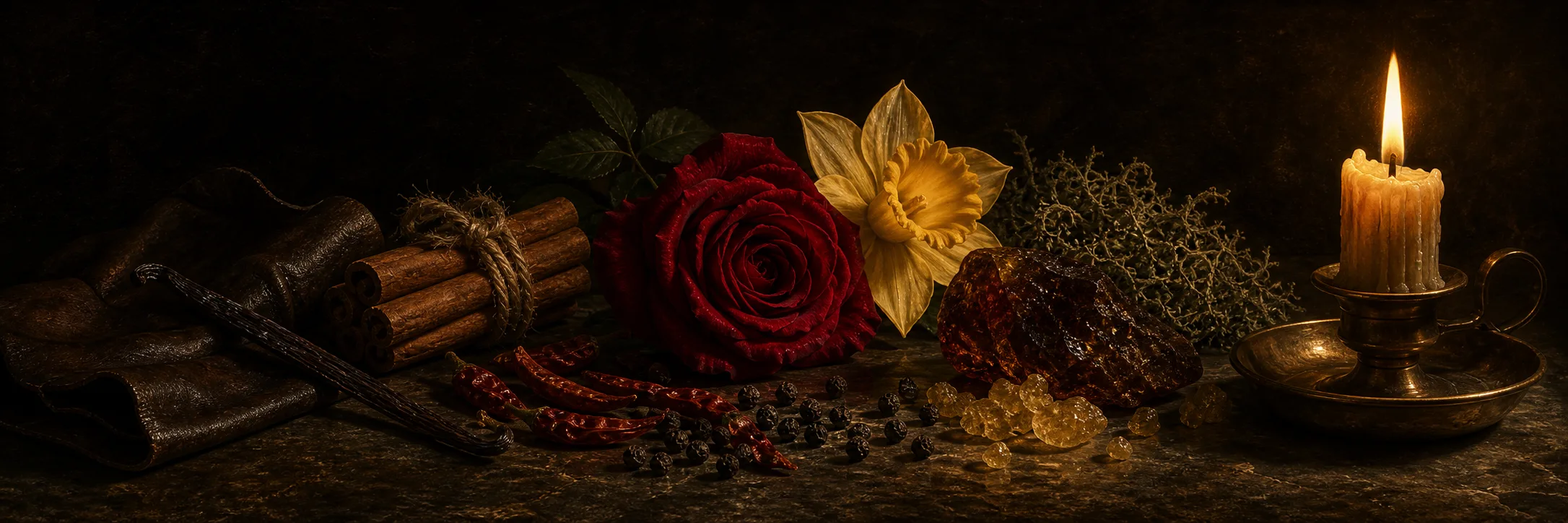
The opening is the most overtly spicy stretch: a quick flash of bergamot that fades fast, immediately overtaken by cinnamon, black pepper, and the listed red chilli. The first ten minutes read as heady, narcotic, and sweet, but also very dry and crisp. The chilli is subtle warmth rather than literal heat, stumbling in around the twenty-minute mark and bumping into the florals. Some skins read those first minutes as ambiguously sweet, a sweetness no one can quite name, not candy floss, not chocolate, not caramel. Into the heart, across roughly one to three hours, the rose moves to center stage with narcissus sharing the spotlight and jasmine receding to the wings. This is where the chypre-oriental hybrid declares itself: labdanum gives the florals richness, body, and a touch of powder, while frankincense adds a soft, sweetened, almost sunny smoke rather than the sharp, austere incense typical of Amouage. A subtle soapiness threads underneath, and several wearers single out a soapy, myrrh-like labdanum as the most prominent note. The oakmoss stays restrained, green and slightly mineralic rather than a forceful classical chypre mossiness. The drydown, from about three hours on, goes warm balsamic amber: bitter-sweet, slightly powdery, with vanilla emerging as a late star balanced against resinous benzoin. Castoreum and leather provide a smooth, faintly animalic warmth, and patchouli supplies a peppery, earthy facet. The much-touted dark and destructive accord turns out faint; one reviewer described the leather and castoreum as two little claws you have to dig through rose, labdanum, and incense to find, claws that all but vanish into a pretty ordinary amber by the skin-scent phase. It evolves clearly from spicy-fresh to floral to balsamic-amber, but the through-line is seamless and blended, and many enjoy simply not picking out notes. The signature accord is a rose-labdanum-vanilla amber dusted with cinnamon and powder, an Opium and Shalimar idea sanded smooth.
Performance
Projection is strong early, with reports of monstrous sillage wafting several feet across the room in the first hour before softening by the start of the third. It is forceful even when dabbed. Longevity is excellent: wearers log anywhere from twelve to fifteen hours on skin, with the scent becoming a quiet skin presence around the sixth hour but lingering in muted, silken form for hours more. There is a minority report of low sillage paired with excellent longevity, so skin chemistry matters, and on fabric it will easily last beyond a day. The pair was described as having overnight longevity and above-average sillage, with Fate Woman the more extroverted of the two. Given all that projection, a light hand is wise, and Turin’s verdict captured it: just don’t wear it to supper. It is best in cool weather, where the balsamic base blooms without turning cloying.
Wearing Context
This is a cool-weather evening fragrance, made for fall and winter, for dinners, the opera, and formal occasions. Turin’s image fits it: the rush of physical glee you get when you sit in the front row of the stalls and a great orchestra begins to play. It skews mature and dressed up, and its richness and elegance keep it from feeling particularly casual. It would feel wrong in heat, in an office, or anywhere projection-sensitive, since the opening alone can fill a room. Socially it reads as classic, glamorous, old-world feminine, the sort of scent tied to a time when people dressed elegantly. Anyone who adores vintage orientals like Opium, Cinnabar, and Shalimar will feel at home; those wanting something modern, fresh, or discreet should look elsewhere. Despite the feminine designation, the spice-amber base is unisex-friendly for anyone comfortable in the Opium idiom.
Comparisons & DNA
Fate Woman is openly an heir to YSL Opium. Turin wrote that Fate is to Opium what Mitsouko was to Coty’s Chypre, a transfiguration, borrowing Opium’s woody-balsamic core plus the cool minty note that separates Opium from the warmer Guerlain Shalimar and Estee Lauder Cinnabar. Wearers read is blunter: Fate Woman takes Opium’s blueprint and sands down the edges, dialing back the spices, smoothing the structure, and drifting the base toward Shalimar’s vanilla, which prompts some to ask why not just get Shalimar. One reviewer suggested Shalimar Philtre as a worthwhile alternative, and another noted a touch of Frederic Malle Musc Ravageur DNA without the bite or spice, or summed it up as Shalimar and Bakir having a baby. Within Amouage it wears somewhat like Interlude Woman on some skins despite smelling nothing alike, and it is the deliberate stylistic opposite of the brand’s incense-forward canon. As a discontinued niche release, there is no true clone; the closest alternatives are the vintage orientals it descends from.
Reception
Critical reception is strong. Luca Turin gave it five stars, a Masterpiece rating, in his Guide, calling it one of the most intricate and beguiling fragrances in years and writing that nothing this big, complex, and beautiful had been done since the first Boucheron. Persolaise called the Fate duo large, bold, and utterly unafraid of the limelight, and Kafkaesque called Fate Woman astoundingly beautiful, complex, and refined. The specialist press praised the materials, the blending, and the performance. The wider wearer response is more split: one reviewer admired the polish but found that it somehow still comes off as detached, while wearers host the sharpest dissent, calling it a redundant amber, too French and not Amouage enough, wishing it were bolder and more Arabian. Others who expected an Opium-style powerhouse found it much smoother and subdued, lacking Opium’s oomph and clovey aggression. Common praise lands on its elegance, seamlessness, performance, and radiant powdery opening; common criticism is that it is derivative of Opium and Shalimar, emotionally cool, and not distinctive enough to justify the price. A sample is essential, and given its discontinued-collectible status and that five-star verdict, a blind buy is defensible for confirmed oriental-chypre lovers.
Versions & Reformulation
Released as an EDP in the summer of 2013 and now discontinued, which drives its collectibility and secondary-market pricing. There is no widely documented reformulation of Fate Woman itself, though enthusiasts in the broader Amouage context worry about regulation-driven muting of oakmoss and animalic materials over time, with one noting they would buy a bottle before it gets muted down. Treat batch-to-batch variation as possible but undocumented. There is also a male counterpart, Fate Man, by perfumer Karine Vinchon-Spehner, an immortelle and cumin-driven dry woody composition, a different scent rather than a concentration variant.
Acquisition Notes
This sits in the niche-luxury tier, with an original retail around 375 USD for 100ml in Amouage’s iridescent crystal bottle with a Swarovski-accented cap. Because it is discontinued, acquisition now means the secondary market and decant houses, several of which have carried Fate Woman decants explicitly flagged for its five-star reputation. Expect rising prices as with any discontinued Amouage, and prefer sealed stock from reputable resellers.
Notable Facts & Lore
- Christopher Chong framed the Fate pair as the end of the first cycle of the Amouage narrative, exploring the uncertainty of the future.
- Of Fate Woman specifically, Amouage’s official brief described a chypre oriental with a rich floral heart intensified by a dark and destructive accord resonating with the tumultuous unknown.
- Chong said he wanted to celebrate the power of mystery and end the narrative without a defined conclusion, setting the characters free into the world rather than pre-ordaining their fortunes.
- One review built an extended thesis around entropy, arguing that both Fate fragrances show Amouage’s engineering after it has become outdated and begun to show its age, with hints of discord and chaos underneath the beauty.
- The launch generated unusual pre-release buzz, partly through a teaser social-media campaign and the much-admired iridescent bottle, and the destructive-accord framing became a frequent talking point, with reviewers repeatedly hunting for a darkness the perfume only faintly delivers.