Amouage — The Library Collection Opus IV
Essence
Opus IV is the Library Collection entry where Amouage’s incense-resin language gets lit from the front with bitter citrus and sharpened by a spice core that many wearers read as cumin-like, even though the official heart centers on caraway and cardamom. Its character is not merely “spicy incense”; it is a bright-to-warm progression from tart, herbal citrus into a smoky, resinous, slightly bodily oriental. The distinctiveness lies in that friction: polished frankincense beauty made a little sweaty, a little festive, and much more human.
Scent Profile
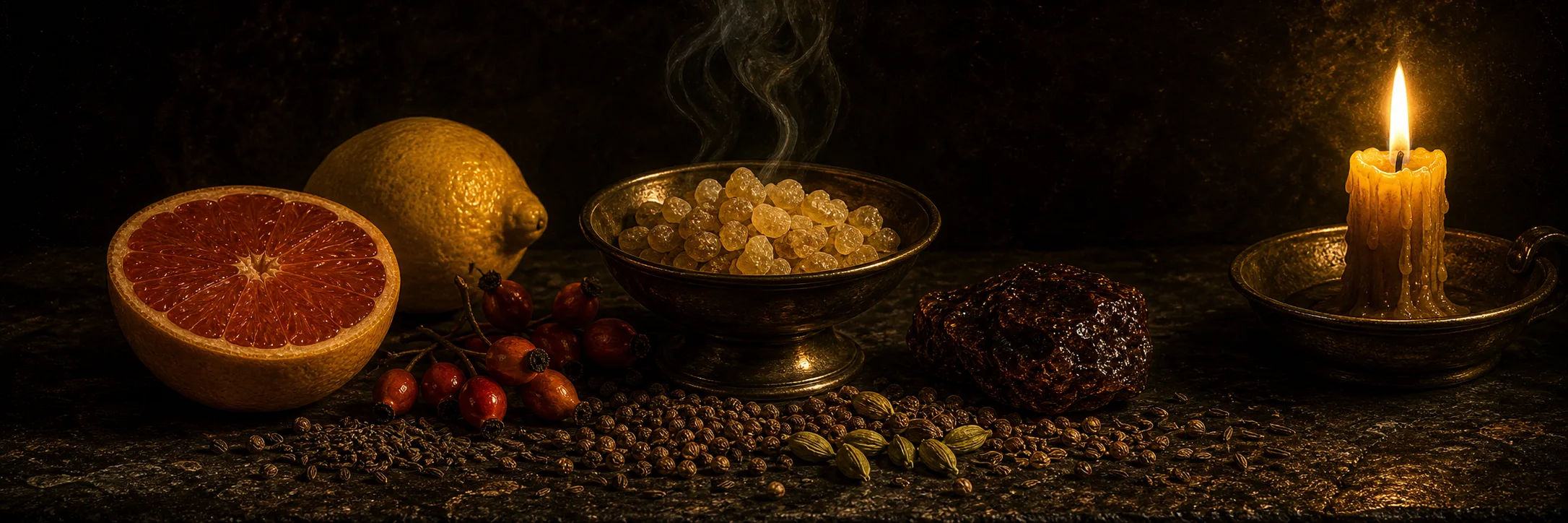
The first fifteen minutes are much brighter than Opus IV’s reputation suggests - a vivid citrus fanfare led by lemon, mandarin, and grapefruit, with coriander giving the opening a green-herbal edge rather than a fresh-cologne feel. On skin, the citrus does not read sparkling for long; it quickly thickens into something more resinous and savory. Wearers consistently describe the top as sour-tart, old-school, and immediately incense-adjacent, the citrus functioning less as freshness than as a sharp light source aimed at the spice core - a cornucopia of juicy citruses suddenly illuminating a culinary spice cabinet. From roughly the half-hour mark into the second and third hour, the heart’s signature emerges. The caraway-cardamom-elemi-rose structure is perceptible in effect, but not all notes are equally legible. What most people actually smell is a cumin-adjacent spice cloud, as caraway, coriander, and cardamom fuse into a dusty, bodily warmth - the very effect that led the critic Persolaise to praise the fragrance for its “dusty, sweaty cumin.” Rose and violet leaf are not the stars; they act as tonal modifiers, adding tartness and a thin green-purple sheen rather than a recognizable bouquet, while elemi bridges the sharp, lemony side of the incense with the warm resin. The heart therefore reads less floral-spicy than spice-resin with floral shading. Past the third hour, Opus IV settles into frankincense, labdanum, musk, and balsamic residue. It becomes denser, warmer, and less argumentative: the citrus recedes almost entirely, the spice turns less culinary and more bodily-resinous, and the composition becomes a smoky, ambered skin scent with a dry, church-incense quality. The base is, for many, the most memorable part. Evolution is real but not theatrical - neither a shapeshifter nor strictly linear. Its defining accord is the collision of bitter citrus and caraway-cardamom spice over resinous incense-labdanum, and it stays audible all the way down even as the fragrance grows softer and more abstract.
Performance
Opus IV performs in the strong half of Amouage’s older Library style. On current or later bottles, expect moderate-to-strong projection for the first two to three hours, usually around an arm’s length; on older bottles, wearers report it much louder, with one calling a 2012 bottle’s projection nuclear. The sillage is a noticeable spiced-incense wake rather than a modern room-filler, especially in enclosed air or when the scent warms on fabric. For longevity, a source-honest estimate is roughly eight to twelve hours on skin for most wearings, with older bottles plausibly going further, and a full day on clothing is easy. The main caveat is bottle-era variability: older pre-2014 stock is widely held to be richer and longer-wearing than later bottles. In heat the spice turns more bodily and the citrus sourer; in cold the incense-labdanum base reads smoother and more luxurious, while humidity thickens the caraway effect. Application is best kept conservative - two sprays is usually enough, three if the bottle is clearly newer and softer.
Wearing Context
This is fundamentally a cool-weather fragrance, though not in the plush-vanilla amber sense. It works best in autumn, winter, and cool spring evenings, where the citrus top can flash before the spice-incense body takes over. It is warm, spicy, and holiday-adjacent - one critic’s “Christmas punch” comparison is apt, so long as you understand the scent is drier, smokier, and more adult than that phrase implies. It shines in evening social settings, dinners, concerts, and museums, anywhere “interesting” beats “easy.” Where it can fall flat is in hot offices, crowded daytime environments, or any situation where you want to smell polished but unobtrusive. The spice core can read cumin-like or sweaty depending on skin and distance, and some simply find it a “cardamom and cumin bomb” that isn’t for them. Socially it skews mature and self-possessed - not especially formal, yet not casual either: it smells like someone who chose fragrance as an aesthetic statement rather than an accessory.
Comparisons & DNA
Within the oriental-resin space, Serge Lutens Ambre Sultan and Tauer L’Air du Desert Marocain are the most useful reference points, but the deltas matter. Against Ambre Sultan, Opus IV is brighter up top, more citrus-herbal, and less wrapped in sweet amber smoothness. Against L’Air du Desert Marocain, it is less mineral and windswept, more culinary-spiced, and more explicitly bodily in the heart - which is why it appeals to incense lovers who want more bite and skin-warmth than the desert-amber archetype usually offers. Inside Amouage, it sits near Epic Man, Memoir Man, and Opus VI but is not interchangeable with any of them: Epic Man is darker and more overtly ambery-spiced, Memoir Man is smokier and more absinthe-shadowed, and Opus VI is an amber exercise first, whereas Opus IV stays anchored by its tart-spice opening and cumin-like heart. Some compare the citrus-spice architecture to Cartier Declaration territory, but with much more depth, resin, and oriental density. The real DNA marker is not “amber incense” alone; it is the unusual marriage of bitter citrus, coriander-caraway-cardamom spice, and a resin base that feels both festive and faintly animalic. No dedicated clone or note-for-note stand-in exists.
Reception
Dedicated critical coverage is limited but unusually vivid where it exists. The critic Persolaise considered Opus IV the best Library release of its moment, arguing that its greatness came from that sweaty-dusty cumin effect, and memorably likened it to “Omar Sharif dressed as Santa Claus.” It was also celebrated elsewhere as both an artistic and a philanthropic success, named a favorite within the Library Collection. That combination of admiration and amused bewilderment is completely typical of the scent’s reception. Wearer response is broadly positive but clearly polarized by spice tonality. Praise clusters around the quality of materials, the bright-to-incense evolution, and the way the composition feels unlike anything else in the incense-amber set. Criticism clusters around the sweetness, the cumin-like body note, and occasional disappointment with later-bottle projection. The blind-buy verdict is no, unless you already know you enjoy cumin-adjacent spice, dry incense, and old-school oriental density - this is one to sample rather than buy unseen.
Versions & Reformulation
There was a single official composition, but wearer evidence strongly suggests bottle-era variation, with collectors singling out pre-2014 bottles as richer and stronger and treating older stock as especially desirable. No formal reformulation is documented, so the safest reading is an anecdotal vintage preference rather than a verified formula change. The original Opus IV is now discontinued.
Acquisition Notes
This was luxury-niche Amouage from the start, with a launch retail price around $325, and its afterlife is now decisively secondary-market. Because it is discontinued and older bottles are collector-coded within wearers, buying authentic stock means leaning on trusted secondary sellers, reputable split circles, or decant-first purchasing rather than impulsive marketplace hunting. Most real-world circulation now appears to be full bottles plus private decants.
Notable Facts & Lore
- Opus IV’s most distinctive non-olfactory fact is that it was tied to a concrete philanthropic program rather than a vague cause campaign: half of its worldwide profits were directed to Oman’s National HIV/AIDS Prevention and Control Program, and the fragrance launched on World AIDS Day, December 1, with creative director Christopher Chong present at MiN Apothecary in New York.
- That makes it one of the rare niche releases whose lore is not just concept and moodboard but a documented public-health fundraiser.
- Beyond that, the fragrance has developed a smaller but durable cult around the idea of “older Library Collection Amouage” as a lost, harder, stranger period of the brand.
- Enthusiasts describe the early bottles as collectible and unusually well-made, and Opus IV is often framed as the most compelling Library entry of its moment.
- With no perfumer-specific commentary on record, its lore is anchored less in stated intent than in what it achieved: a citrus-spice-incense oriental that many still treat as one of the collection’s sleeper landmarks.