Amouage — The Library Collection Opus IX
Essence
Opus IX is the Library Collection’s most operatic floral-animalic statement: a jasmine-led perfume where beeswax, leather, civet, and ambergris turn a nominal flower theme into something bruised, sensual, and almost theatrical. It is not a fresh white floral and not really a classical leather - it is a dirty, waxen, abstract floral with a genuine emotional arc. Its distinctiveness lies in how convincingly it makes “camellia” mean something, despite that flower being effectively scentless in reality.
Scent Profile
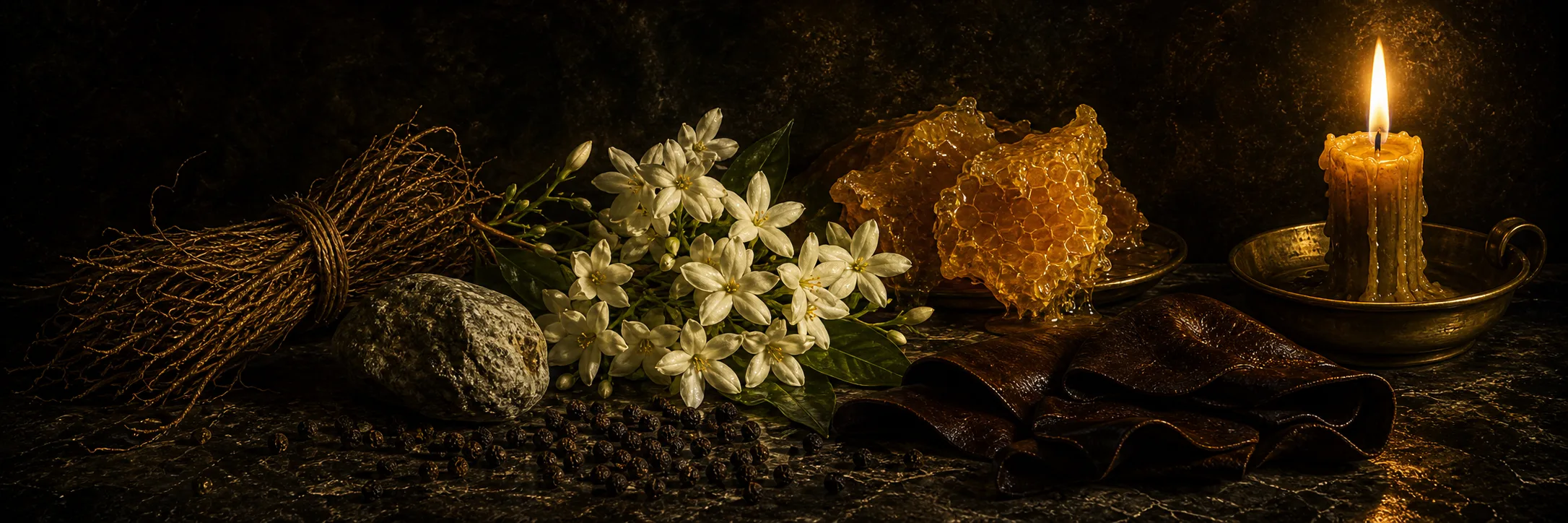
The opening is a fast strike of jasmine and black pepper, with the camellia idea working more as texture than as a separately identifiable smell. The composition makes no attempt at naturalism, embracing instead a synthetic, abstract floral construction - and that is exactly how it wears. The first twenty minutes are floral, spicy, and immediately thick rather than breezy; some wearers even read a juicy floral that hints at tuberose, and the start can feel atypically fresh and spicy for Amouage before the jasmine grows larger and darker. The pepper registers mostly as bite and structure. Jasmine is the real frontman, and it is not a clean salon jasmine - it is indolic, saturated, and already hinting at bodily warmth. The middle, roughly the first to third hour, is where Opus IX earns its reputation. Beeswax and leather move forward, but neither turns blunt or literal. The beeswax gives the floral body density, a honeyed film, and a faintly cosmetic depth; the leather adds shadow and sadness more than biker-jacket realism - one critic’s phrase about “waxen woods” and “haunting leather sadness” captures the mood precisely. This is also where guaiac wood starts to matter, less as dry pencil-shaving wood than as a smoldering, faintly tarry support beneath the floral core. The arc is clearly evolutionary, and the perfume’s emotional center lives here rather than in the opening blast. In the drydown, civet, ambergris, and vetiver matter more structurally than literally. The listed base notes can be hard to isolate one by one, but their effect is unmistakable: the late phase goes salty, musky, warm, and slightly dirty, more skin-bound without ever becoming minimal. Civet is more felt than identified, lifting the jasmine’s indoles and keeping the leather from going smooth-suede pretty; vetiver adds a dry undertow, and ambergris lends diffusion and a faint saline shimmer. The signature, then, is not simply jasmine plus leather - it is indolic jasmine fused to beeswax over a mournful leather-animalic base.
Performance
Performance is one thing wearers agree on: Opus IX wears large. Both projection and longevity rate above average, and current wearers describe it as a very loud jasmine that some owners hesitate to wear to the office. In practice that means strong projection for the first two hours, often well beyond arm’s length in the opening, then a slow contraction into a still-noticeable floral-animalic aura, with a distinct wake - especially on skin that amplifies indoles and ambergris. A fair estimate is roughly ten to fourteen hours on skin and at least a full day on clothing; this is not a white floral that burns off fast. Heat makes it riskier, since indoles, leather, and civet all swell and can tip it from sumptuous to oppressive, so cool weather and dry air give the best balance, and one to two sprays is the smart strategy.
Wearing Context
Opus IX is most at home in autumn, winter, and cool spring evenings. Its natural habitat is anywhere drama is an asset - dressed dinners, nighttime events, theaters, low-lit bars, private dates, gallery openings - anywhere a floral can be strange and magnetic rather than merely pretty. Because its emotional tone is dark and sensual rather than cheerful, it can feel mismatched in bright casual daytime or in settings where clean, legible grooming is the goal. The biggest caveat is social perception: more than one wearer reads it as strongly feminine-leaning despite its unisex positioning, and even fans sometimes find it too loud or too floral for the office. But the skew is real rather than fixed - one wearer who finally wore it to work reported two colleagues offering to buy the bottle. This is not a people-pleasing daily reach; it is a statement floral that rewards confidence, a taste for indoles, and tolerance for animalic warmth.
Comparisons & DNA
The nearest internal reference is Opus VIII. Where VIII offered a flinty, brighter jasmine, IX abandons naturalism even more aggressively and turns the floral idea into an abstract, carnal creature - if VIII is the mineral, austere jasmine chapter of the series, IX is the smoky dressing room after the final act, and many feel the exploded-jasmine concept simply landed better here. Outside the collection, it is often mapped near Amouage Memoir Woman and Epic Woman, Tom Ford Black Orchid, Frédéric Malle Musc Ravageur, and Frédéric Malle Portrait of a Lady, though only at altitude: it is more floral-animalic and less incense- or spice-dominated than the Amouage siblings, less dessert-dark and more indolic-waxy than Black Orchid, and where Musc Ravageur centers on musk-amber, Opus IX puts a full jasmine on stage. It has also been grouped with spicy florals like Aedes de Venustas Oeillet Bengale and even JAR Golconda. The practical takeaway is that it belongs to the family of dark, adult florals, but its jasmine-beeswax-leather accord keeps it from smelling like a copy of any of them, and no widely recognized clone exists.
Reception
Critical coverage is limited but unusually aligned in tone. Persolaise called it a “weirdly woody, animalic floral” and praised Amouage for continuing to embrace stranger territory, while ÇaFleureBon called it a “fiery floral beauty” carried by waxen woods and “haunting leather sadness,” judging it one of the brand’s most unusual and emotional perfumes in years. That is the right summary of the high-level response: admiration for the daring, with a clear understanding that this is emotionally theatrical and not meant to be universally lovable. Wearer response is strongly positive among experienced wearers and strongly cautionary toward newcomers - much enthusiast writing frames it as an example of what the house achieved when it was still recklessly bold, and repeatedly describes it as a “dirty jasmine,” too animalic for some and unforgettable for others. Praise centers on the indolic jasmine, the beeswaxed leather depth, and the sheer emotional weirdness; criticism centers on its challenge level, its perceived femininity, and plain incompatibility with some tastes. As a blind buy it is a hard no - sample first unless you already know you love white florals built on leather, civet, and a waxy amber undercarriage.
Versions & Reformulation
There is a single composition with no known reformulations. The original Opus IX is documented as discontinued, and there is no renamed continuation comparable to some of the collection’s later reissues.
Acquisition Notes
Opus IX launched in luxury-niche territory at a debut price of around $355, and since it is now discontinued, acquisition usually means second-hand full bottles or decants rather than normal retail stock. Because it is loud, odd, and relatively expensive even by Amouage standards, sampling before buying is especially sensible here. As with other discontinued Amouages, the safe route is trusted wearers splits and established niche resellers with strong reputations, plus healthy skepticism toward suspiciously cheap “sealed” bottles.
Notable Facts & Lore
- Opus IX’s lore is unusually well documented because its inspiration is explicit: it was conceived in relation to Giuseppe Verdi’s La Traviata, specifically through the camellia motif, and critics tend to build their readings of the perfume around the opera’s heroine.
- The crucial analytical point is that camellia is effectively scentless, which freed the perfumers to treat it as an abstract symbol rather than a botanical rendering - which is why the fragrance feels conceptually true to its inspiration even though it smells nothing like an actual flower garden.
- The link has been pushed further by tying the perfume to Maria Callas’s 1958 Lisbon performance of La Traviata, cementing its reputation as one of the most operatic perfumes of its era in both structure and mood.
- It survives as a cult object: a favorite “dirty jasmine” to some, too animalic for others, and - on the right wearer - astonishingly attractive rather than merely challenging.