Amouage — Lyric Woman
Essence
Lyric Woman is the 2008 floral-oriental rose that, for many critics, defined what the Christopher Chong era of Amouage was meant to be: a luxurious, dramatic, spicy-resinous rose translated from the Arabian rosy-sandal attar tradition into a Western eau de parfum. Where Lyric Man is dry, green and reserved, Lyric Woman is dark, plummy, narcotic and theatrically lit. It is widely regarded as one of the great rose fragrances of the 2000s - Luca Turin gave it four stars and wrote one of his most-quoted modern reviews about it.
Scent Profile
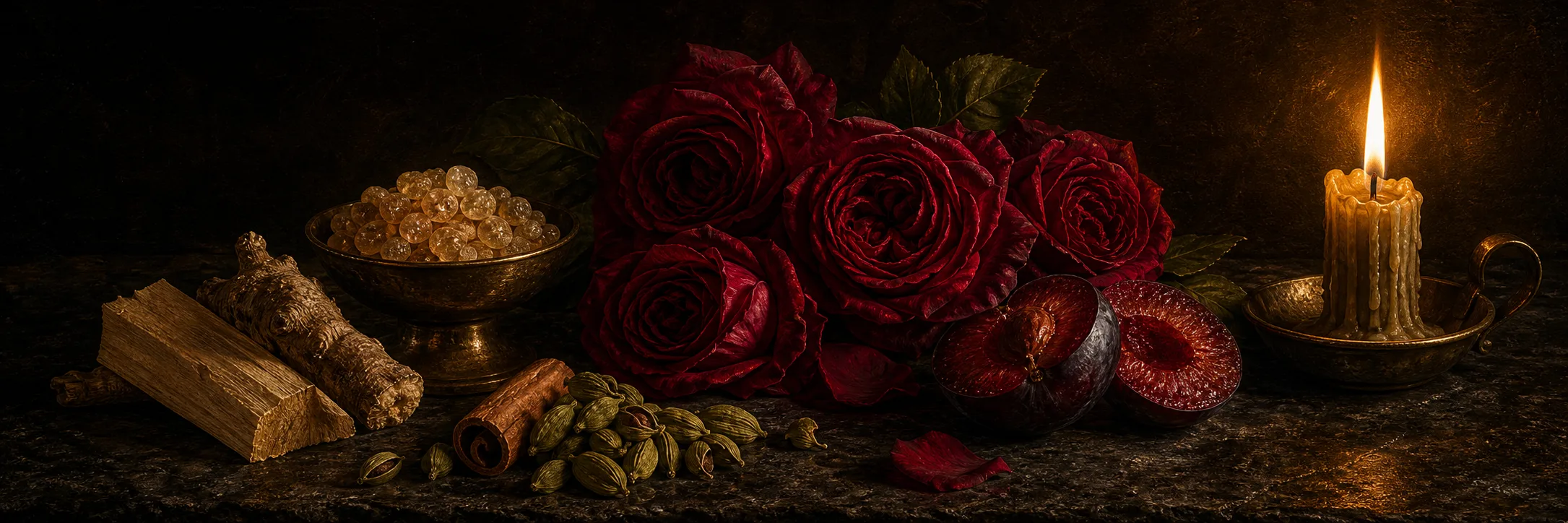
The opening is bright and spicy rather than citrusy. Bergamot lifts off quickly while cardamom, cinnamon and ginger set a warm, faintly Middle-Eastern frame within minutes. Cardamom is the structural spine here - it recurs through the whole wear - and it gives the early stage a piquant, almost pickled-ginger crispness. This first ten minutes is brisk and a little surprising, and most wearers note it is the least rose-forward stage despite rose being the marketed centerpiece. Around the twenty-minute mark the heart blooms, and the rose holds court for hours. But it is a complex rose: dewy and crimson on the surface, with a plum-jam underlayer that Turin famously identified as a “plangent, overripe note, the exhalation of forgotten fruit in a sealed room.” That is the defining trick - a rose with a faintly rotting-fruit ghost beneath it, the same effect that animates the peach in Mitsouko. Geranium adds a metallic green sharpness that keeps the rose from going syrupy, while ylang-ylang is the second major character; on some skins it amplifies into a creamy, banana-custard richness that wearers either love or find heavy. Orris lends a powdery, rooty quality, and jasmine and angelica fill out the middle without stepping forward. From roughly the second hour, the slow drydown into resin and wood begins. Frankincense threads through - softer and sweeter than church incense, but unmistakable - and the sandalwood is what makes the base remarkable; the critic Victoria Frolova called Lyric Woman the most accomplished translation of the traditional rosy-sandal attar motif into a Western format, crediting the piquant cardamom and that sandalwood alongside the fruity rose. Oakmoss, patchouli, tonka, vetiver and vanilla all blend underneath without any one asserting itself. The late drydown is rose, tonka, incense and sandalwood - warm, faintly powdery, intimate. The signature, start to finish: rose and plum over sandalwood and frankincense, with cardamom as the recurring punctuation. This is a fragrance that genuinely evolves, and a fine teaching example of how spice, fruit and resin can scaffold a rose without turning it into candy or tea.
Performance
Projection is strong in the first two hours - easily arm’s length, often beyond - with generous but not aggressive sillage; this is a slow-warming wake rather than a sledgehammer. Longevity on skin is genuinely long, with nine to twelve hours the typical report and the upper bound documented near thirteen. On clothing it lingers for days. It is largely a cold-weather fragrance. In heat the rose can go soapy and the ylang-ylang can turn cloying; in dry cold it blooms and the incense shows at its best. Two sprays is usually plenty - over-application tips the fruity facet from celestial to genuinely overripe in a hurry - so pulse points plus a touch on a scarf or collar is the move.
Wearing Context
Autumn and winter evenings are its natural home. It wears like a dressed-up signature scent - opera, dinner, holiday occasions, anywhere you are meant to register as elegantly fragrant rather than discreet - and some wearers deploy it as a cold-morning power perfume. One reader summed up the modal experience as feeling like a femme fatale whenever she wears it. It falls flat on hot summer days, in the gym, and in casual daytime settings where the size of the rose-incense statement reads as overdressed. It is also widely considered mature - younger wearers often describe it as smelling like their grandmother’s drawer, a function of the powdery orris-tonka base meeting Western expectations of “rose perfume” rather than any flaw. Socially it skews toward perceived wealth and sophistication rather than flirtation or youth, and in practice it is unisex: plenty of men wear Lyric Woman in preference to Lyric Man precisely because it is darker, more resinous, and has more bite.
Comparisons & DNA
Caron Parfum Sacre is the comparison cited most often - both opulent rose-incense-vanilla compositions, though Parfum Sacre is woodier and drier where Lyric Woman is fruitier and creamier. The in-house sibling is Amouage Epic Woman, a more direct Parfum Sacre echo with stronger peppery bite, while Frederic Malle Portrait of a Lady is the contemporary touchstone Lyric arguably predicted - louder, more frontal and more patchouli-driven, where Lyric is creamier and more attar-like. Serge Lutens Rose de Nuit is a cousin in dark-rose space but built on honey rather than that fruity facet, and Amouage’s own Opus XII Rose Incense is the louder, more linear modern take. On cheaper alternatives, Lyric Woman has resisted replication: its particular fruity-rose has not been convincingly cloned at designer prices. Lattafa’s broader rose-amber output and various rose-amber releases borrow the territory loosely, and Rehlat - though modeled on Lyric Man - has crossover appeal for fans of the feminine thanks to its saffron-rose-amber DNA. In lineage terms it descends from Parfum Sacre, Guerlain Nahema and the Arabian rosy-sandal attar tradition, and it reads now as an early signal of the dark-rose-with-resin niche category that came to dominate the late 2010s.
Reception
Critical reception was excellent. Luca Turin’s four-star review in his Guide became one of the most-quoted modern pieces of perfume writing - he described the chord at Lyric’s core as a rose extended by a dry, dusty, woody accord in the manner of Oman, surprised at the other end by that “exhalation of forgotten fruit in a sealed room,” an effect “initially almost unpleasant” that “soon becomes celestial,” and signed off that Thelonious Monk would have understood the fragrance instantly. Victoria Frolova praised it as the finest translation of the rosy-sandal attar motif, and Angela Sanders gave it a glowing launch review and has long listed it as a personal favorite. Wearer response is strongly positive on quality and craft. The recurring praise is for the rose’s realism, the spice integration, the fruity “secret weapon,” the sandalwood, and the overall blending. The recurring criticisms cluster on four points: ylang-ylang dominating on some skins, the older-skewing powdery base, the price, and a brighter, more synthetic musk in newer batches. Polarization runs mostly along ylang-ylang amplitude and powder tolerance - get the banana-custard ylang or dislike powder and you under-rate it; get the rose-fruit-sandalwood axis and you call it a masterpiece. Serious rose enthusiasts treat it as a canonical sampling target. Blind-buy verdict: cautious at most - the ylang skin-amping risk is real enough that a decant first is strongly recommended, though for confirmed dark-rose lovers it is one of the safer Amouage bets.
Versions & Reformulation
The original 2008 launch came in the heavy magnetic-cap bottle, and many long-term wearers report that magnetic-cap-era bottles smell meaningfully different from current production - newer batches losing some rose presence and gaining a brighter, some say cheaper, musk. Amouage has announced no official reformulation. A Lyric Woman Extrait was released as part of the house’s Exceptional Extraits initiative; reviewers describe it as more rose-fluid and jasmine-rich in the opening with stronger incense, but with less of the eau de parfum’s dynamic range. Vintage 2008-2014 bottles trade at a premium on the secondary and split markets.
Acquisition Notes
Pricing sits at the niche-luxury tier: authorized retail runs about $395 for 100ml and $300 for 50ml, with discounters occasionally dropping the 100ml on older stock. The decant ecosystem is excellent - this is one of the more reliably available Amouages, stocked across the major split houses in sizes from tiny samples to travel sprays - which is the sensible way to test the ylang-ylang skin risk before committing. Buy bottles through Amouage or established luxury retailers.
Notable Facts & Lore
- Christopher Chong’s stated inspiration was specific: the “lyric-spinto” soprano voice, which sings with lyric-soprano lightness but a darker timbre.
- He framed the perfume at launch as the story of “a fragile beauty with a rare, other-worldly talent and her quest for perfection and immortality,” and gave it the tagline about a poignant song lingering “without a beginning and an end.” Perfumer Daniel Maurel composed it, and it is generally regarded as his most accomplished and most-discussed work.
- Turin’s review effectively cemented the fragrance’s reputation in the English-language perfume world - the “forgotten fruit in a sealed room” line is among the most-quoted things ever written about a 2000s rose, and is partly responsible for the perfume’s enduring sampling demand more than fifteen years on.
- There is no celebrity tie-in or viral moment here; Lyric Woman’s footprint is squarely in the enthusiast world, where it sits in the canonical “rose education” curriculum alongside Portrait of a Lady, Nahema and Parfum Sacre.
- The most persistent piece of lore is that fruity facet itself: half of long-term wearers swear it is unmissable, the other half are simply anosmic to it - a split first identified by Turin that remains the most interesting dividing line in the discussion.