Amouage — Tahani
Essence
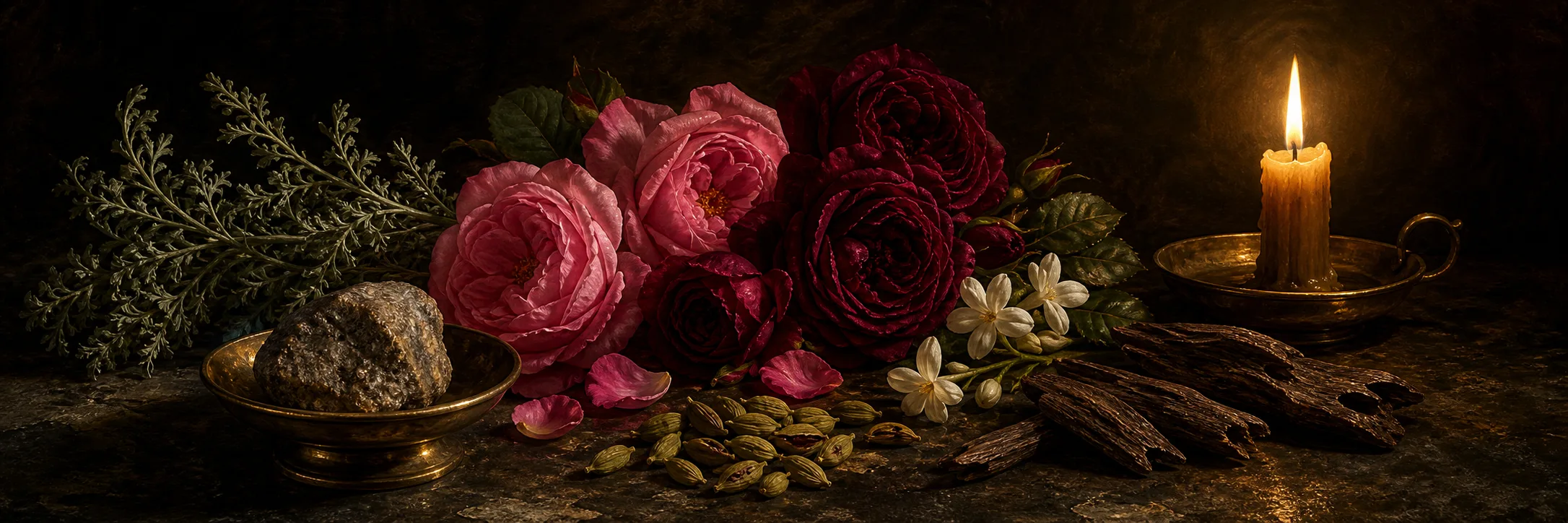
Tahani is an oil-based perfume from Amouage’s traditional attar line - a 12 ml dab-on concentrate sold mainly through the brand’s Omani boutiques and a London department store in the early 2010s. It is a rose-oud composition built on a duet of Taif and Bulgarian rose, dosed with cardamom, jasmine, artemisia, ambergris, and Cambodian oud. Within the Amouage attar canon it is the gentler, rose-water-and-soap sibling to the house’s smoky giants Homage and Tribute - recognizably Amouage in pedigree, but more demure, more powdery, and more wearable in mixed company.
Scent Profile
Tahani opens with what anyone who knows the Amouage attars will recognize instantly as the house signature: a saturated, jammy Taif rose laid over the deeper, more wine-colored Bulgarian rose, with cardamom snapping at the edge of both. In oil form the rose is not the fresh garden rose of European perfumery but a rose conserve - petals cooked down with sugar and a thread of resin - and that conserve quality, with the cardamom, is what most wearers register as biryani-like or rose-water-on-warm-bread in the first ten minutes. The artemisia is technically a heart note but makes itself felt very early as a bitter, slightly licorice-like herbal lift that enhances the oud’s medicinal edge. Jasmine stays submerged, present only as a creamy soapiness in the middle phase rather than a nameable white floral. Through the first to third hour Tahani settles into its dominant mid-stage character: a creamy, soapy white-floral over a spicy oud base, the kind of powdery floral aura more than one wearer has compared, without insult, to a classic milled soap. It is a precise description of how the rose-jasmine-ambergris triangle reads once the cardamom has burnt off. The oud is the smooth, incense-style Cambodian oud Amouage favored in this period, not the barnyard fermentation type, and on some skins it eventually swallows everything else. Ambergris is the quiet workhorse, never reading as itself but as a salty radiance that keeps the rose from collapsing into bath-product sweetness. The drydown, four to six hours in and well past twelve on cloth, is the most chypre-like phase - as one reviewer put it, a classic floral chypre once the oud settles, not sweet at all, the amber simply adding resinous warmth. Tahani is more evolutionary than linear: the rose is constant, but the supporting cast rotates from spice to soap to incense-wood, around a signature of rose, cardamom, and clean oud bound by ambergris.
Performance
For an oil this is unusually projective. By the most-cited account it is among the strongest of the Amouage attars - a tiny dab radiates strongly, unusual for an alcohol-free attar, and can survive a shower. A single dab on the pulse points throws a noticeable scent bubble of roughly thirty to sixty centimeters for the first two to three hours, then collapses into a true skin scent that lasts ten to fourteen hours on skin and two days or more on clothing, typical of Amouage’s traditional attar production. On cool skin the rose-incense-oud accord holds longest; on hot, humid skin the cardamom and jasmine bloom faster and the artemisia turns sharper, which some find unflattering. It stains both skin and fabric. Application is the opposite of less-is-more: a single dab does not quite get the concept across, and Tahani wants three to five contact points - wrists, behind the ears, the base of the throat - to read as the soft, ambient cloud it was designed to be. Allow ten to fifteen minutes for the raw oil’s initial pungency to settle; like most attars, it is raw on first contact and only blooms once it marries with skin warmth.
Wearing Context
Tahani is a cool-to-cold weather, evening or formal-event composition. Its powdery white-floral phase reads cozy in autumn and winter; in summer humidity the oud-incense base can feel heavy and the cardamom-rose phase pushes toward perfumed soap. It is most at home where wearing a perfume oil is socially legible - a formal dinner, a wedding, a religious occasion, the kind of evening where you want presence without spray-fragrance pyrotechnics. It works on either gender and reads light, modern, and sophisticated in a complimentary register. It falls flat in athletic, casual, or daylight-office contexts where its formal incense-rose register reads as overdressed, and its social signature is unmistakably expensive-Middle-Eastern-occasion - wearers report being told they smell of rose water, which can register as ceremonial in Western settings.
Comparisons & DNA
Within Amouage’s own catalogue Tahani is the lighter twin of two heavyweights and a clear cousin to a third. Homage Attar is the most-cited reference - a denser, smokier, more frankincense-forward Taifi rose with the same Cambodian oud DNA; Tahani is Homage without the church-incense register and with more cardamom-rose conserve. Tribute Attar is darker, leather-tobacco-saffron forward, with the rose buried under smoke; Tahani is its clean white-flower sister, same rose-oud spine without the tobacco or leather. Salamah Attar, the other exclusive paired with Tahani at the early-2010s retail launch, is the smoky one of that pair to Tahani’s floral. Ayoon Al Maha is a simpler rose-sandalwood-oud; Tahani is more complex but less laser-focused on rose. Lyric Woman shares the rose-incense-spice spine in spray form but is glossier and sweeter, and the artisan Sultan Pasha Feral Rose is a niche parallel, more honeyed-waxy where Tahani is creamier and soapier. In lineage, Tahani belongs to the wave of Amouage attars commercialized under Christopher Chong that took the brand’s traditional Omani mukhallat production and repackaged it for international luxury retail - a sub-line that ended definitively when Amouage halted all attar production around 2014 to 2015.
Reception
Wearer reception is best summed up as respected but not adored: Tahani sits in the middle of the Amouage attar tier list, with most wearers acknowledging its quality and value, especially at its modest original price, but few ranking it above Homage or Tribute. The common praise is its slowly emerging complexity, the ambergris-rose dynamic, and its cleaner, more mixed-company-friendly character. The common criticism, from a frequently-cited review, is blunt: forget the roses and ambergris and jasmine and cardamom and artemisia, because for a non-trivial subset of wearers this is simply oud, the incense type of oud, and the other notes may or may not come through at all. The polarization runs along two axes - whether the soapy-clean reading lands as a compliment or a disappointment to those who wanted the dense attar-oriental experience, and whether the artemisia bitterness is a highlight or reads dental-medicinal. The blunt verdict is that it is not a blind buy: less because of quality than because the price is too high to gamble and the powdery-floral-over-clean-oud character is specific enough not to suit every attar lover. Sample first if you can.
Versions & Reformulation
Tahani was produced in two known box editions - the standard Omani boutique box and a later black-box retail edition for international markets - and, like other Amouage attars of this era, suffered documented batch variability, so two bottles labeled identically can differ noticeably in how much rose, tobacco, or vetiver comes through. There is no later concentration variant: it exists only as the alcohol-free dab-on oil, in 12 ml and 30 ml, and all production ceased when Amouage shut its attar manufacturing line around 2014 to 2015, leaving only residual stock.
Acquisition Notes
This is now an ultra-luxury secondary-market proposition, though it was relatively accessible at retail - one of the more affordable entries in the attar line, far below Homage. It came only as 12 ml and 30 ml dab-on flacons, never a spray. Because production is dead, decant availability is thin and shrinking, and the most reliable sources for samples now are private collector split threads and small decants from established sellers. Counterfeits exist, so authenticity matters: look for the embossed seal on the box, the lacquered cap, a glass (not plastic) dab rod, and a viscous yellow-amber oil. Sealed 12 ml bottles have traded roughly in the few-hundred-dollar range and up depending on edition and provenance, with the earliest box editions commanding the highest premiums; buy from sellers with a long Amouage trading history.
Notable Facts & Lore
- The perfumer behind Tahani is not publicly documented - Amouage has historically credited only the noses of its main-line eau de parfums, with the attar line attributed to its in-house Oman team working with French perfumers.
- The name Tahani means congratulations or greetings in Arabic, fitting for a perfume meant for celebratory and gift-giving occasions, and the surviving documentation - an authorized retailer’s 2012 catalogue listing it among newly released attars, alongside its launch at a London department store - points to a 2011 debut.
- The most consequential lore around Tahani is collective.
- It is one of the perfumes whose discontinuation became a flash point for wearer evidence critique of European fragrance regulation and its spillover onto Middle Eastern perfumery, after the entire Amouage attar line was shut down.
- Amouage’s later attar collection is sometimes pitched as the spiritual successor, but the consensus among veteran enthusiasts is that those are concentrated Western-style perfume oils rather than true attars, a couple of steps removed from the original tradition.
- Tahani has accordingly acquired a grail-adjacent status - not as worshipped as Homage or Tribute, but reliably named in best-of-the-lost-Amouage-attars discussions.
- And a persistent bit of wearers trivia: nearly every Western reviewer admits to first misreading the name as tahini, after the sesame paste.