Amouage — Love Tuberose
Essence
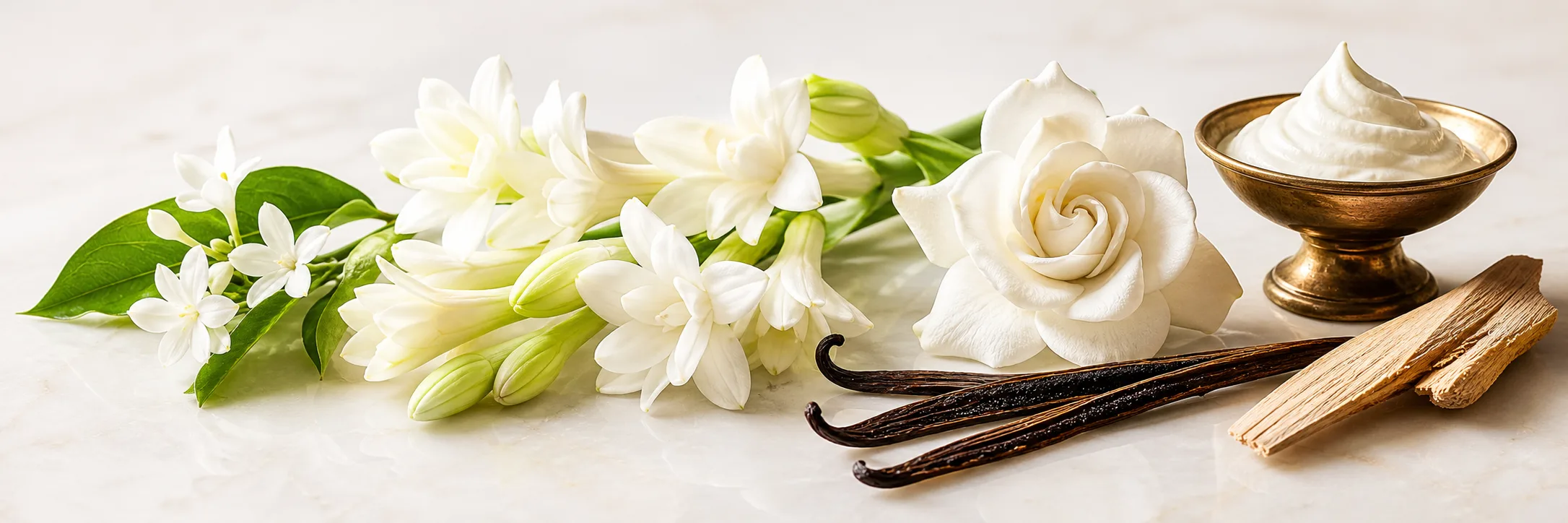
Love Tuberose is Amouage’s 2018 “white-floral-as-dessert” gesture: the third installment of the Secret Garden trilogy, in which Nathalie Lorson, under Christopher Chong’s direction, smothered tuberose, gardenia, and jasmine in Chantilly cream and vanilla, then dropped the indoles. It is the Amouage you give someone who finds Amouage too challenging. Functionally a creamy floral gourmand rather than a classical tuberose soliflore, it trades the carnal, mentholated, rubbery sides of the flower for a marshmallow-and-vanilla-custard softness - recognizably Omani-luxe in finish but uncharacteristically friendly in attitude.
Scent Profile
The first ten to twenty minutes read as a triple-blossom bouquet held above a freshly whipped pastry bowl. Tuberose is unmistakably central, but it is the bubblegummy, fruit-leaning facet rather than the camphor-rubber-meat one; gardenia provides a waxy lift, and jasmine sits behind, more floralcy than indole. There is a distinct vanilla-cream-soda fizz up top - a carbonated effervescence from the sandalwood interacting with the lactonic heart bleeding upward early. Almost no green stem, no menthol-mothball tuberose bite, no fecal indole: the brief is hyper-feminine and frictionless. By the thirty-to-ninety-minute mark the heart settles in, with the whipped-cream and vanilla notes dominating as a lactonic-coconut milkshake layer draped over the flowers - what one critic memorably called a milkshake made out of tuberose petals. The cream reads specifically as Chantilly, sweeter than ordinary whipped cream, and the indole-free brief makes this feel like Honour Woman’s flirtier little sister. Gardenia stays moderately perceptible, jasmine is largely submerged, and the cream-vanilla axis is fully forward. From three hours onward the drydown shifts to a warm, slightly powdery floral-vanilla skin scent. The sandalwood-and-cedar base is felt more as creamy support than as standalone wood - the Virginian cedar a dry resinous spine, the sandalwood reinforcing the lactone. Several wearers note a vintage-Guerlain L’Heure Bleue echo here, without the melancholy. Linearity is high after the first hour: opening burst, then a cream-vanilla floral plateau, then a softer floral-musk skin scent. The signature is a tuberose-Chantilly-vanilla-sandalwood “white-flower wedding cake” accord.
Performance
Projection is moderate for the first ninety minutes - roughly an arm’s-length cloud on average skin - then drops close. Sillage is good early and intimate after two hours. On skin, expect six to nine hours; on clothing and hair, well past twelve and onto the next day, with the sandalwood-vanilla base anchoring stubbornly. The older silver-cap bottles are the ones wearers describe as lasting almost indefinitely on fabric; the post-2023 repackage is widely felt to be weaker (see Versions below). The fragrance is at its best in moderate and cool weather. In heat and humidity the cream-vanilla axis turns cloying and the gardenia can read soapy; in cold, dry air the base anchors better and the flowers stay legible longer - many wearers treat it as a cold-weather scent only. Two or three sprays to pulse points plus one to the chest under clothing is the sweet spot, and spraying onto fabric markedly extends the floral phase. Avoid neck-blasting in summer; it tips into bridal-cake territory fast.
Wearing Context
Love Tuberose shines in cool weather, from autumn through early spring, and in the evening: date nights, weddings (it is a perennial bridal pick), and any context where you want a dressed-up, demonstratively feminine, complimentary scent. It is a dinner-out, opera-house, holiday-party fragrance. It falls flat in heat, where it reads too sweet, and in clinical or professional settings, where the cream-vanilla axis can feel intrusive. The social read is unambiguous: feminine, romantic, slightly ingénue rather than vampish, with wearers often reporting “you smell delicious” reactions more in the gourmand-compliment register than the seductive one. Late afternoon through evening is ideal - the cream-vanilla heart blooms warmest after an hour on skin. For office or daytime, two sprays at most, or skip it. It is also one of the more unisex-tolerable tuberoses in this register, softer than Fracas and less indolic than Carnal Flower. It is at home at candlelit restaurants, winter gallery openings, and weddings; it is the wrong tool for summer outdoors, the gym, or the beach.
Comparisons & DNA
Robert Piguet Fracas is the reference gourmand-adjacent tuberose; Love Tuberose is Fracas with the carnal indolic snarl filed off and a pastry pumped in - sweeter, creamier, less confrontational, but also less sexy. Frederic Malle Carnal Flower is the green-eucalyptus-camphor masterpiece tuberose; Love Tuberose is its bourgeois sister, where Carnal Flower is botanical and animalic and Love Tuberose is dessert. Tom Ford Tubéreuse Nue is drier and more raw petal; Love Tuberose adds the bakery and removes the green. Estée Lauder Tuberose Gardenia is the most direct lineage cousin - both feminine, both polite - but leaner and more white-floral-traditional, where Amouage’s is fluffier and more gourmand. Givenchy Organza is the spiritual ancestor often invoked for the powdery, creamy, 1990s tuberose vibe. Designer clones are not really a thing here - Love Tuberose has not been targeted by the Middle-Eastern dupe houses the way some Amouage masculines have been. Wallet-friendlier overlapping scents include Chopard Sparkling Love and Carolina Herrera Tubereuse Nymph. As for lineage, this is the third of Amouage’s Secret Garden / Love series, after Lilac Love (2016) and Blossom Love (2017) - both also Nathalie Lorson under Christopher Chong, all built on the same gourmand-floral template - and was later joined by Love Mimosa and Love Delight. Its commercial success helped solidify the luxe-but-easy lane Amouage has since leaned into.
Reception
Wearer sentiment is broadly positive. The praise centers on the creamy, non-indolic accessibility - “a tuberose for people who don’t like tuberose” - along with the heavy, high-quality bottle presentation and the wedding-day-keepsake quality. The polarization is predictable: value versus performance (many feel the price for a creamy floral that becomes a skin scent is hard to justify, especially after the repackage); beautiful versus boring (detractors call it mainstream and unchallenging for a house known for difficult brilliance); and the reformulation debate, where the silver-cap original is widely held to be stronger and more floral than the later white-cap version. The most enthusiastic critical reception came from Robert Herrmann, who called it a breezy and splendid non-indolic white floral that is easy to wear and has great sillage, with a drydown that evokes L’Heure Bleue. Wearers most often pair it with Givenchy Organza, and the broad consensus treats it as a competent, very feminine, somewhat overpriced floral-gourmand - frequently recommended for weddings, rarely chosen as a holy grail. The blind-buy verdict: cautious on the current version at full price given how consistent the reformulation complaints are, a conditional yes on a sealed older silver-cap bottle, and sample first either way - the profile is distinctive enough that ten minutes will tell you.
Versions & Reformulation
Love Tuberose has a single concentration - an Eau de Parfum at a high oil concentration with a six-week ageing process - sold in a 100 ml bottle through Amouage and authorized retailers, with a 50 ml also available. A packaging changeover around 2023, however, marked a widely reported formula shift. The original silver-shouldered bottle with the silver cap, from the Christopher Chong era, is described as richer, more cream-and-floral-forward, and stronger in projection; the newer white matte bottle from the Renaud Salmon era repackage reportedly skews thinner, more transparent, and noticeably vanilla-leaning, with reduced longevity. Amouage has not publicly confirmed a reformulation, but the complaints are consistent enough that silver-cap bottles command a premium on the secondary market. If buying, it is worth asking a seller to photograph the cap and bottle silhouette.
Acquisition Notes
Niche-luxury pricing: 100 ml runs about 395 USD on Amouage’s US site, with the 50 ml around 270 USD; UK and other authorized retailers sit a little higher. Decants and samples are abundant in 1 to 10 ml sizes, and Amouage’s discovery sets occasionally include it, so it is easy to try before committing. Authorized channels include Amouage directly and the usual luxury retailers. Given the reformulation question, the one piece of practical advice is to confirm which bottle generation you are buying.
Notable Facts & Lore
- Christopher Chong, then Amouage’s creative director, framed Love Tuberose around classical Russian arts, describing “a woman kidnapped by love with dreams that only the Russian classical arts have been able to paint.” It was the third of his Secret Garden trilogy, after Lilac Love and Blossom Love, and the most commercially successful of the three.
- The brief called specifically for an unrequited-love angle, which in olfactory terms became the soft, slightly innocent, non-carnal treatment of three traditionally seductive flowers - a deliberate inversion of the Fracas archetype.
- Nathalie Lorson reused the same Chong-era playbook that produced Honour Woman and Memoir Woman: large white florals built for the Amouage finish.
- One critic recounted strangers at a farmer’s market stopping to compliment the scent, which fed its reputation as a compliment monster.
- The Chong era ended in 2019, after which Renaud Salmon took over; the 2023 repackaging into matte bottles and the additions of Love Mimosa and Love Delight to the line are Salmon-era moves.
- No celebrity association or viral moment attaches to it, though it features regularly on wedding-fragrance lists and reviewer favorite-wedding-scent roundups.