Amouage — The Library Collection Opus VIII
Essence
Opus VIII is one of Amouage’s strangest white florals: a jasmine-centered Library release that keeps pretending to be something else. Critics and enthusiasts circle the same paradox - dryness before bloom, a floral narcotic haze set against parched woods, incense against a creamy yellow-white heart. What makes it distinctive is not raw note novelty but the way it keeps toggling between tropical opulence and austere, dusty abstraction, which is exactly why it has a small but intense cult rather than broad Amouage consensus.
Scent Profile
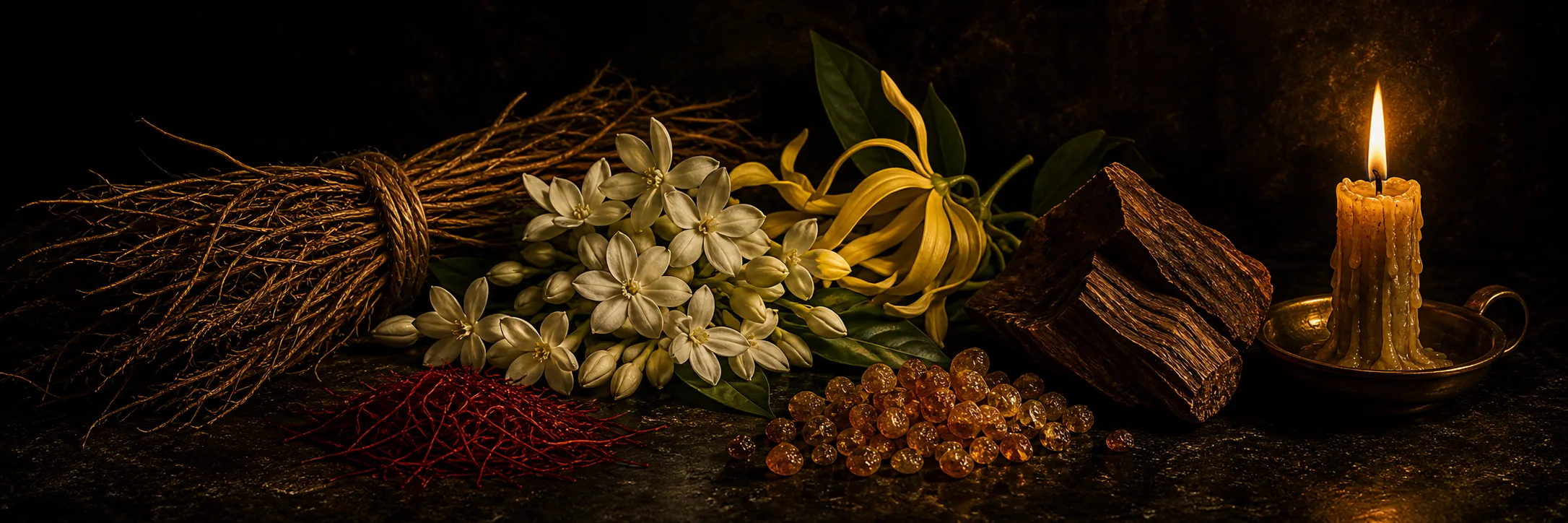
The opening is not the lush jasmine blast the note list might suggest. Several writers describe a dry, almost tannic, parched first impression before the floral core comes into focus - one critic talks of a drought-like aridity, another catches a brief varnish-and-pigment illusion before the sambac rises. In practice the first ten to twenty minutes read as a golden-yellow floral cloud, orange blossom and ylang supplying brightness and cream, but the real surprise is texture: dusty, woody, faintly camphoraceous freshness rather than syrupy white-floral sweetness. Saffron, ginger, and bay are not always individually legible; they behave more like a bitter, spicy lift around the petals than standalone notes. In the heart the fragrance stops teasing and shows its hand: jasmine becomes the signature material, though even here it is more indolic, earthy, and strange than plush - major, beguiling, and unfathomable once you realize the background weirdness is the jasmine itself. Incense and benzoin push forward around the one-to-three-hour mark, giving the composition a smoked, resin-sweet halo, while vetiver adds a soapy, slightly rooty edge and guaiac contributes warmth rather than an obvious campfire. The defining accord is a dry white-floral incense - less church incense than powdered petals warmed over embers. The drydown keeps enough movement to avoid feeling linear without any radical plot twist: after three hours what remains is a softer woods-and-resins frame wrapped around traces of creamy yellow floralcy, benzoin sweetness and guaiac warmth and a faint soapy vetiver, with a lingering jasmine imprint that turns less narcotic and more atmospheric. The evolution is real but subtle - arid-strange opening, narcotic floral-incense heart, then a warm woody skin scent with floral ghosts still visible through the smoke.
Performance
Endurance is above average. The fragrance lasts all day on skin and longer on fabric, and projection is strongest early, where the white-floral top can throw to roughly arm’s length before settling after the first hour into a moderate aura rather than full-room domination. Sillage is steady rather than enormous: people will notice the trail, but this is not a powerhouse projector. A safe estimate on skin is a full workday or better, with the resinous woody base outlasting the floral drama, and a day or more of residue on clothing or scarves - worth keeping in mind before you spray near a scarf you do not want smelling of Opus VIII for days. Heat helps the jasmine and orange blossom shimmer and expand, which is why some find it ideal for warm, sunny weather, while cold makes the wood, benzoin, and dryness more prominent and the whole thing feel more severe. Best application is restrained but not timid: two to four sprays, since overspraying compresses the illusionistic structure into a blur of white floral and resin.
Wearing Context
Opus VIII is more versatile by season than its reputation suggests, but it is mood-dependent rather than occasion-agnostic. Warm spring and summer pull out the luminous jasmine and orange-blossom facets; fall highlights the sweet-smoky, woody base. One critic could not decide between spring freshness and fall coziness, which feels accurate - this is a fragrance that wears bright or austere depending on climate and wearer. Daytime works if the setting tolerates expressive white florals; evening works even better, because the incense-benzoin core reads more intimate and deliberate once the opening settles. Where it shines: art spaces, dinners, reflective solo wear, and any setting where complexity matters more than approval. Where it can fall flat: crowded offices, blind social settings, or any context where a straightforward pretty white floral is expected, because Opus VIII is too odd, dusty, and resin-tinged for that role. Socially it skews slightly feminine in wearer discourse despite being officially unisex, mostly because the floral body is so pronounced - this is unisex in niche terms, not in anonymous-designer terms.
Comparisons & DNA
The comparison that comes up most directly is Le Labo Ylang 49 - both live in the borderland between white floral, soap, wood, and something faintly uncanny, and they reward being smelled side by side. Opus VIII is less leather-chypre than Ylang 49 and more resinous, incense-dusted, and benzoin-warmed; if Ylang 49 is the sharper, more angular cousin, Opus VIII is the drier, more narcotic one. Critics also hear echoes of Mugler Alien, Tauer Le Maroc Pour Elle, and Isvaraya, which help triangulate the DNA: compared with Alien it is far less linear and less bluntly jasmine-radiant, with much more dryness and woody abstraction; compared with Le Maroc Pour Elle it is less amber-spice plush and more floral-resinous. Against Tom Ford Black Orchid, which its admirers often also like, it is less gourmand, less earthy-dark, and much higher in white-floral luminosity. Amouage’s own Ubar is a useful in-house reference - both are big florals with vintage-adjacent swagger, but Ubar is more animalic and voluptuous while Opus VIII is drier, more incense-threaded, and more conceptually difficult. It did not launch a trend, and there is no real clone discourse around it. Its lineage is less a market template than a Christopher Chong Library oddity - a fragrance descended from Amouage’s experimental Opus ethos, where image, metaphor, and formal strangeness outrank mass appeal, which is why its real peers are other niche perfumes that deliberately destabilize their floral center rather than mainstream white florals.
Reception
The consensus is polarized but respectful. One critic treats it as a genuinely complex construction that keeps wrong-footing the wearer; another calls it an unfashionable, jolie-laide perfume and predicts it will never be a broad fan favorite - but that the people who love it will love it wildly. That matches wearers behavior, where it shows up more often as a hidden gem than as an entry-level Amouage recommendation. Praise clusters around three things: the quality of the jasmine, the dry white-floral and incense tension, and the way it smells expensive without smelling conventionally seductive, with fans responding to the illusion effect - first woods, then weirdness, then the realization that the center was jasmine all along. The criticisms are equally consistent: some find the named spices and woods too blurred to matter, some miss a prettier or creamier jasmine, and some simply find the whole thing too abstract or too feminine for comfort. As a blind buy it is not safe even for Amouage fans, because the appeal depends on liking white florals under tension - dusty, bitter, resinous, and slightly aloof; if you already enjoy Ylang 49 or strange jasmines it becomes much more plausible, and if you want a straightforward creamy jasmine-incense it can feel like a puzzle instead of a pleasure.
Versions & Reformulation
A single composition with no known reformulations.
Acquisition Notes
This was a luxury-niche Amouage even at launch, listed around USD 365 for 100 ml in 2014. The bigger acquisition story today is scarcity: it is discontinued, and the practical route is the secondhand market - collectors, swaps, and decants. There is no fragrance-specific counterfeit problem of note around Opus VIII; the real risk is simply overpaying for old or badly stored stock. Because the scent depends on freshness and nuance, provenance matters, so ask for box and bottle photos, storage conditions, and fill level rather than relying on lore. Samples and decants do circulate, and many owners report finding a sample first and then hunting down a bottle through local collectors.
Notable Facts & Lore
- Opus VIII’s documented concept is trompe l’oeil: Christopher Chong framed it as a study in perception, truth, and illusion, and the packaging itself was designed to echo that visual-trickery theme.
- The brief maps unusually cleanly onto the actual wear, because the perfume really does misdirect - dry wood first, then odd freshness, then the delayed recognition of a very strange jasmine - making it one of the rarer Amouages where the stated artistic concept and the smelling experience line up.
- It also sits squarely in the Chong-era Library philosophy: the Library line was the space where Chong said he had freedom to develop and challenge knowledge, away from the main line’s more codified house signatures, which is why Opus VIII feels less like a house-style variation than like a thought experiment in white-floral form.
- Its cult status today comes from exactly that mismatch between concept-art ambition and the expectations people usually bring to a jasmine perfume.