Amouage — The Library Collection Opus I
Essence
Opus I is the inaugural 2010 release of Amouage’s Library Collection, the sub-line creative director Christopher Chong designed as a raw-materials study to counterpoint the brand’s grand, orchestral main range. Composed by Daniel Maurel of Robertet and classified as a chypre-floral, it is in practice a retro white-floral oriental: a bitter-orange, cardamom, and plum opening over a heady ylang-tuberose-jasmine heart, settling onto a frankincense-papyrus-tonka woody base. It is the gentler, more Western-classical bookend to the Library Collection’s later, more experimental entries.
Scent Profile
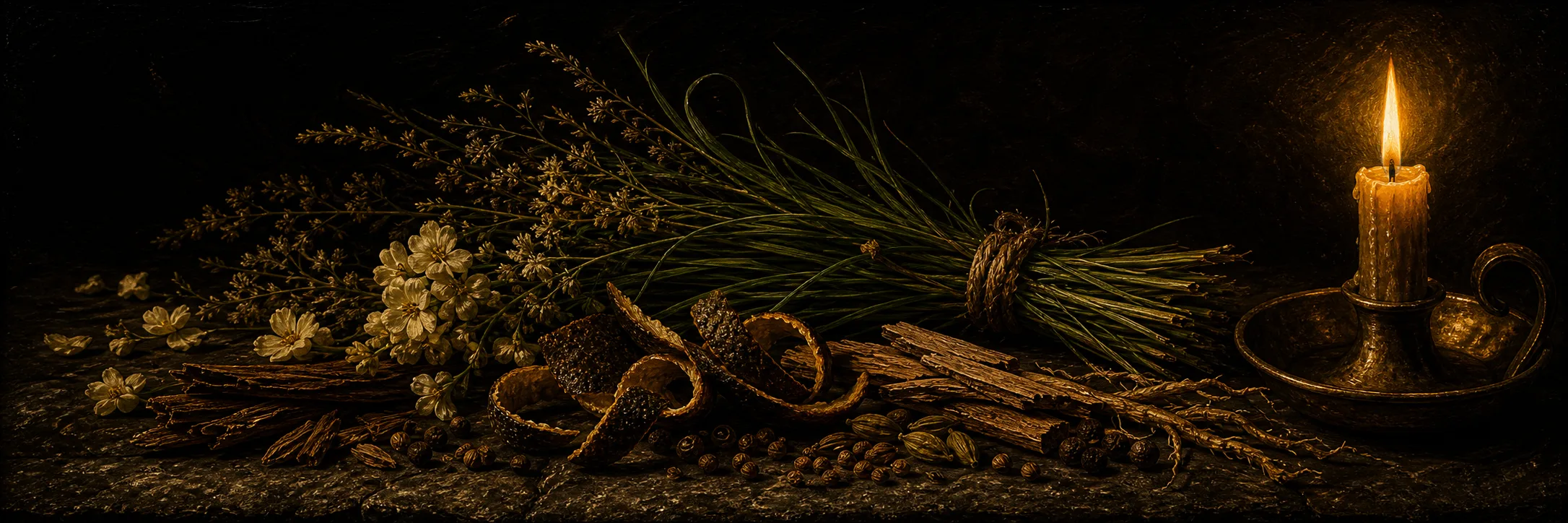
Opus I opens with what one critic memorably called a jarring, really great bitter bigarade - bitter orange peel, like traditional citrus-rind confit - which is the most distinctive top note in the composition. It is balanced by cardamom, which most wearers register as a green-spicy lift rather than a discrete spice, and a plum accord that reads pudding-rich rather than fruit-fresh. The first ten to twenty minutes are dominated by this bigarade-cardamom-plum triangle, with the white florals still submerged; some wearers even catch a phantom medicinal-clove impression, likely an artifact of cardamom and tonka, since clove is not in the formula. By the half-hour mark and through the first three hours, the dominant mid-stage emerges: a heady, slightly retro white-floral cluster with ylang-ylang in the lead, tuberose just behind, and jasmine and a thin lily-of-the-valley facet rounding the edges, while the rose reads as supporting structure. Persolaise’s much-quoted description - florals preserved in a delicate Japanese jelly - captures the texture exactly: these are not raw, animalic flowers in the manner of Fracas, but blooms suspended in a gauzy, semi-transparent medium. That tension between the bitter-pudding top and the gauzy floral middle is the signature of Opus I. From three hours on, the base assembles: papyrus is the most distinctive element, dry and mossy with a faintly fishy edge that some find daring and others off-putting, supported by Virginia cedar, guaiac wood, sandalwood, vetiver, frankincense, and a tonka sweetness that keeps the wood from going austere. The drydown is the warmest, most cohesive phase, building rather than fading - one reviewer described perceiving the base as a climax rather than a conclusion, the woods and a fine incense growing increasingly voluminous. The progression is clearly pyramidal. The official chypre label is loose, since there is no classical oakmoss-bergamot-labdanum structure; the chypre association comes from the bitter-orange top and the mossy papyrus base, and functionally it reads as a woody white-floral oriental.
Performance
Projection is strong for the first three to four hours, the bigarade-cardamom-plum opening sharper than the typical Amouage start and carrying roughly two to three feet from the skin before the heart florals draw it into a moderate bubble. Sillage is, as most describe it, wonderful without being overwhelming - a polite trail rather than the room-filling register of Interlude Man or Lyric. Longevity runs eight to twelve hours on skin and a day or more on clothing. Cool, dry air extends the wood-incense drydown and keeps it close, while heat and humidity bloom the ylang-tuberose heart larger and can sharpen the bigarade unpleasantly. Restraint matters: oversprayed, the white florals turn dense and harsh, so two to three sprays is the most it wants.
Wearing Context
Opus I is a cool-weather, evening, formal-leaning composition, at its best in autumn and winter, where the retro white florals and woody-incense base reward cold air. Spring works with a light hand, while summer is risky because the ylang-tuberose heart can turn cloying in humidity. It skews toward evening, though the bigarade-cardamom top makes a restrained daytime wear plausible. It shines at formal dinners, concerts, galleries, and any wearing-perfume-as-art context, carrying unmistakable Amouage gravitas without the louder house’s projection, and it falls flat at the gym, the beach, and in hot, crowded spaces. Socially it leans slightly feminine in Western markets, where the heady florals and powdery drydown read as old-school elegance, but the bitter bigarade and the papyrus-cedar base keep it in unisex territory, and men who like classical retro white florals wear it without issue.
Comparisons & DNA
Within Amouage, Opus I sits adjacent to Lyric Woman, Memoir Woman, and Jubilation 25 as the floral-incense side of the house, but it is more Western-classical and less smoky-rich than any of them - Lyric is sweeter and more rose-led, Memoir more incensed and somber, Jubilation 25 more honeyed and fruity. Robert Piguet Fracas is the recurring lineage reference for its almost-animalic tuberose, though Fracas is bigger, creamier, and more weaponized where Opus I is a gauzy, modern rereading. Among its own Library Collection siblings, Opus II is a drier aromatic fougère, Opus III a softer powdery violet-mimosa floral, Opus IV a grapefruit-cumin-clove composition some critics rate as the best of the early line, and Opus VI a woody amber widely seen as the commercial peak before a later reformulation. Main-line florientals like Fate Woman and Beloved drew on the floral-incense vocabulary Maurel established here. As the founding entry, Opus I helped launch the entire Library Collection - framed by the house as timeless adventures indifferent to trends, and by one critic as études rather than orchestral pieces, with Opus I specifically a study in bigarade and what it does to lush florals. It was too specifically retro to attract the budget-clone ecosystem.
Reception
Reception was warm and respected at launch and has stayed that way, strong by Library Collection standards. Common praise centers on the complexity, the bigarade-floral tension, the smooth retro white-floral handling, and the elegant Robertet workmanship; common criticisms are that the many notes do not always coalesce for every wearer, that it sharpens on overspray, and that post-2018 bottles show the broader Amouage reformulation slippage. Opinion divides on three axes: whether the retro white-floral register reads as timeless or dated, whether the chypre-floral label sets up a mismatch for chypre purists expecting oakmoss, and whether the papyrus is a daring highlight or simply fishy. Comparing the early Opus releases, Persolaise placed Opus I as the gauziest and most successful of the first trio and suggested future releases would do well to follow its lead, while Elena Vosnaki called it the most surprising new Amouage in the collection. The blind-buy verdict is defensible but not advised: the retro white-floral register is specific enough, and the secondary-market price high enough, that sampling first is the rational move, especially for anyone who came to Amouage through lighter modern releases.
Versions & Reformulation
Opus I exists in a single concentration - Eau de Parfum, 100ml, in the original white-and-silver Library Collection bottle - with no EDT or extrait variant. Reformulation concerns have shadowed the Library Collection broadly since around 2018, most loudly around Opus VI, with reports of degraded longevity and projection in later batches; Opus I has drawn less of that complaint, but pre-2018 production is generally considered superior. In 2022, under new creative director Renaud Salmon, the Library Collection was reshaped: only a handful of Opuses were kept and repackaged, while Opus I and most of its siblings were discontinued and moved to the Amouage Archives while supplies lasted, with effective availability running out across most boutiques during 2023.
Acquisition Notes
Once niche-luxury, Opus I is now an ultra-luxury secondary-market proposition. It launched in 2010 at around $325 for 100ml and was sold only in that size at retail, with small official samples and discovery sets available historically. With the line discontinued, the decant market is shrinking but collector splits remain findable, and sealed bottles in 2025 and 2026 typically run from around $400 to $650 depending on production year, with pre-2018 bottles preferred. Counterfeiting is low for the Library Collection, whose distinctive bottle is not a common fake target, so the main caution is simply favoring sellers with a long Amouage history and verifying batch and bottle quality.
Notable Facts & Lore
- Daniel Maurel of Robertet, who also composed Amouage’s main-line Memoir Woman, Epic Woman, and Lyric Woman, was chosen for Opus I, making it stylistically continuous with the trio of feminine compositions that substantially defined the Chong-era women’s range.
- The official brief frames it as a chypre inspired by the start of a pilgrimage in search of knowledge, built around a warm floral heart with spicy top notes and a bold woody-tonka-frankincense close.
- Christopher Chong described the Library Collection’s purpose as wanting a collection that gave him the freedom to explore, free of the signature accord that anchors the main range, and Opus I, II, and III were positioned as its founding triptych - Amouage’s first explicit move into a parallel niche-luxury sub-line.
- Structurally, Opus I mattered because it inaugurated the practice of bringing outside perfumers into a concept line running alongside the main collection, an approach the house has reused repeatedly since.
- When the Library Collection was reshaped in 2022, the discontinuation of Opus I prompted real mourning among enthusiasts, many calling it a crime that something so breathtaking had been dropped, and in retrospect it has become a marker for Amouage’s earlier, more idiosyncratic phase before the later pivot to simpler, sharper, more commercial releases.