Amouage — Beach Hut Man
Essence
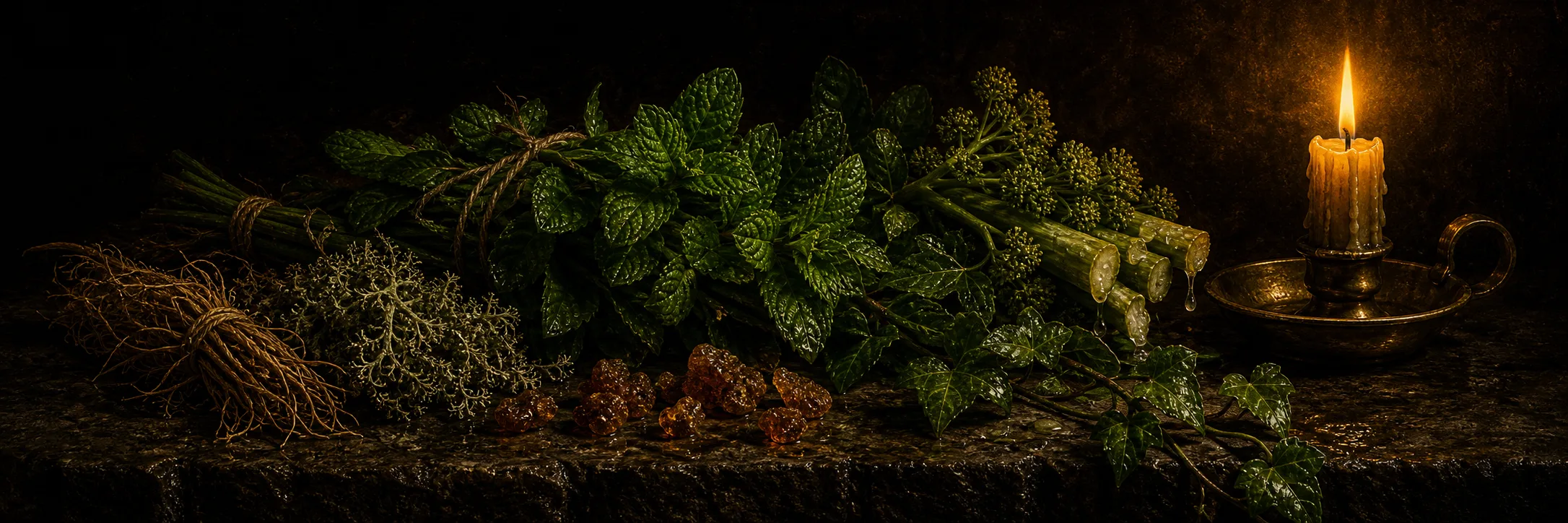
Beach Hut Man is Amouage’s 2017 sleight of hand: a structurally serious green chypre dressed up as a summer release. The name promises sunscreen and sea air, but what you actually get is wind-blasted, herbal, and almost 1980s in feeling - peppermint and galbanum over wet ivy and a damp, mossy patchouli-myrrh base. Christopher Chong slotted it into the house’s Midnight Flower Collection alongside Bracken Man and Sunshine, yet it has very little to do with sand or surf. What makes it stand out is that, at niche prices, it bothers to deliver genuinely natural-smelling green tonality and a concentration most of its peers never approach.
Scent Profile
The first ten minutes are confrontational in the best Amouage way. A bright, almost toothpaste-adjacent peppermint arrives first, then gets pulled green and bitter by galbanum almost immediately - that resinous, slightly sour cut-grass-and-stems smell. Orange blossom is on the official list, but on skin it reads as a quiet floral cushion that keeps the mint from feeling pharmaceutical rather than as an identifiable flower; many wearers never notice it at all. There is a brief flash of indolic warmth before the citrus-floral overlay collapses. Around the half-hour mark the structure shifts. Peppermint recedes, and the gap fills with geranium (often misread as more mint), clove, and a wet, leafy ivy. This is the “jungle” middle that many enthusiasts prefer to the opening. Oakmoss and vetiver carry a genuinely dirty green-chypre signature, and the perfume locks into a steady aromatic cadence for hours, with a faintly leathery, eighties-masculine spine that makes it feel older than its 2017 release date. After about three hours the green dampens and the base takes over. Patchouli leads - not the chocolatey modern version but a darker, more terpenic 1980s patchouli - sitting on a sweet, slightly licorice-tobacco myrrh and dry cedar. The drydown reads warmer than the opening, with a faint resinous, church-incense glow. It is not strictly linear, but it spends most of its life in that long heart, with two clear gear changes: mint-to-moss around thirty minutes, green-to-resin around three hours. The defining character is bitter green that will not let go - nothing beachy about it.
Performance
Projection is strong in the first two hours - an arm’s length, sometimes a small room when sprayed generously - settling to moderate at the three-to-six-hour mark and a confident skin scent after that. Sillage is genuinely above average for a green-fresh; Persolaise praised exactly this, noting it as the price you pay for the composition’s commendable tenacity, and adding that he was not complaining. Reviewers report four-plus hours of significant sillage and ten-plus hours of total longevity on skin, and on clothing the mossy-patchouli base can survive a full day. Heat behavior is excellent. Galbanum and mint amplify in humidity without turning sour, which is why it has become a cult summer pick; dry desert heat, by contrast, can flatten it, and cold weather thins it out and can push the mint toward medicinal. Spray modestly - two sprays project for hours, while four can tip into soapy, synthetic territory. One caveat worth knowing: there is ongoing debate in wearers about newer batches projecting more weakly, so batch variance is a real risk.
Wearing Context
Late spring through mid-autumn is the natural window, with peak performance in humid summer. It is best in daylight and early evening - the herbal-mossy bitterness can read odd under fluorescent office light first thing in the morning but lands beautifully outdoors. Think casual to smart-casual: weekends, a country house, long walks, drinks on a patio. It is the rare Amouage that does not do formal evening - too rustic, too herbal for that. Where it struggles: indoor winter formalwear, anything tropical-aquatic-coconut (it actively fights the beach archetype it names), and tight conference rooms, where the galbanum and mint can clear the air. Socially it reads as expensive in a quiet, non-flashy way - most people register it simply as fresh, herbal, and clean without pegging it as luxury. The compliments are real but understated. It rewards confident wearers; overspraying out of insecurity turns it shouty. This is not a youth, club, or date-night scent - it projects an adult who chose it on purpose.
Comparisons & DNA
The clearest lineage runs to the bitter-green chypres of the late 1970s and 1980s - enthusiasts and critics consistently invoke Chanel Pour Monsieur Concentrée, Dior Eau Sauvage Parfum (2010), Guerlain Vétiver, and Estée Lauder Aramis as ancestors. Eau Sauvage Parfum is the closest direct relative: the same isobutyl-quinoline plus green-herbal axis, but Beach Hut Man is louder, more mint-forward, and more resinous in the base. Inside Amouage, Bracken Man (2016) is the immediate predecessor - Chong described Beach Hut Man as “a continuation of the Bracken story” - though Bracken is drier, more of a lavender-fougère, and lacks the loud mint. Sunshine Man is sweeter and more conventionally summery. Outside the house, fans point to Lorenzo Pazzaglia Adam and Eve’s Dress (greener, figgier), Imaginary Authors Saint Julep (minty but much sweeter), and Geoffrey Beene Grey Flannel (cheaper, drier, more violet-leaf where this is mint-galbanum). There is no known credible budget clone as of 2026 - the mint-galbanum-oakmoss-patchouli structure is unusual and commercially unfashionable enough that the dupe houses have not bothered. The closest budget alternative in spirit, not scent, is Paco Rabanne’s Paula’s Ibiza (cheaper, brighter, less mossy). Beach Hut Man did not start a trend, but it is one of the small handful of post-2015 niche releases enthusiasts cite as proof that the bitter green-chypre style is not dead.
Reception
Consensus is firmly positive among experts and enthusiasts, and more polarized in casual and influencer circles. Ratings across wearers sit in the high good-to-very-good range, and enthusiasts regularly call it an overachiever in nearly every metric. Persolaise offered qualified praise - “as carefree and exuberant as some of the main Amouage fragrances are dignified” - while flagging some overly-synthetic edges in the late drydown. Robert Herrmann, writing for ÇaFleureBon, was effusive, calling it the olfactive equivalent of a weathered, grey, wind-blasted cottage hidden in the dunes amid tall grass and sand, a place to hide away from drama and reconnect with the wild medicine of nature. The dissenting voice came from Kevin at Now Smell This, who pegged the opening as smelling like cheap candy - a rare negative from a respected critic. The common praise: realistic mint that is not toothpaste, genuine green-chypre depth, beast-mode performance for a “fresh,” real uniqueness against the aquatic crowd, and perfect humid-summer behavior. The common criticism: the name (nearly everyone jokes it should be “Jungle Hut Man”), the price-to-uniqueness ratio for casual buyers, a few synthetic moments in the mid-to-late drydown, and the recent batch-strength debate. Polarization tends to fall along three lines - mint tolerance, green-chypre tolerance, and which batch you happen to own. The honest blind-buy verdict: go for it only if you already know you like green chypres or bitter herbal masculines; otherwise sample first, because the mint can be a dealbreaker and regret at this price is expensive.
Versions & Reformulation
There is a single composition - EDP only, with no parfum, extrait, or flanker. Reformulation chatter, however, is real. Enthusiasts identify a batch from roughly late 2022 as the last of the original formula, with later bottles reported as weaker and lighter on myrrh and mint; other owners of 2025 and 2026 bottles dispute this firmly. Amouage has not publicly acknowledged any reformulation, so it is wise to treat anything past 2023 as potentially altered and to sample before committing. The outer packaging art was also updated after 2023 - the illustrated box gave way to an oil-painting-style design - which some collectors use, anecdotally, as a visual marker for the later batches.
Acquisition Notes
This sits in the luxury-niche tier. The 100ml EDP runs around $370 retail directly from Amouage, with a 50ml available at roughly two-thirds of that; authorized discounters routinely carry authentic bottles well below MSRP. Decants in the 1-9ml range are widely available if you want to test before buying. It remains in production as of 2026 within the Midnight Flower Collection, so there is no discontinuation pressure on pricing.
Notable Facts & Lore
- Christopher Chong has been the most documented voice on this release, framing it explicitly as a continuation of Bracken Man: “This is a continuation of the Bracken story.
- We are still in the Hippie days in the 1970s.
- With this fragrance I want to capture the spirit and mood of a Beach Hut towards the end of the Summer.“ That 1970s hippie-cottage-by-the-dunes brief explains the choice of a bitter green, mossy palette over coconut and ozonic clichés - Beach Hut Man was never trying to be a Caribbean cocktail.
- Perfumer Elise Bénat composed it for the house.
- The name itself became a low-grade wearers joke - early online threads mocked it as sounding like a cartoon - and the gap between expectations (suncream and fresh aquatics) and the actual bitter-herbal reality became part of the hook around the release.
- In the late 2010s and early 2020s a wave of YouTube reviewers made it a recurring “best green summer niche” pick, which drove a secondary-market uptick and probably sharpened the emotion behind the later batch-strength complaints: people who chased the hype bought new bottles and felt shortchanged against the older juice they had sampled.