Amouage — The Library Collection Opus XI
Essence
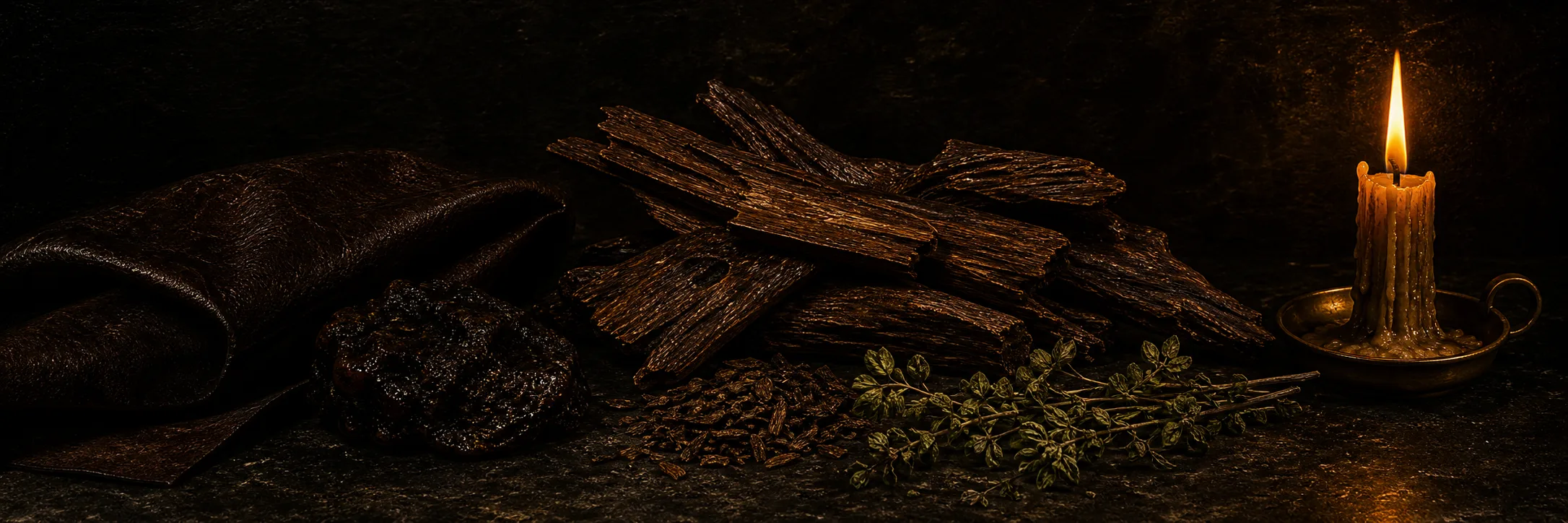
Opus XI is stripped-down oud by Amouage standards: bitter marjoram, a stylized oud, styrax and leather, and a purposefully synthetic thesis running underneath it all. It stands apart because it is not trying to sell a plush Middle Eastern fantasy; it is trying to blur real oud and fake oud, natural and artificial, truth and illusion. That makes it one of the Library Collection’s most openly conceptual fragrances and one of its most polarizing - some smell brilliant futuristic leather, others smell gasoline, medicine, and dirty socks.
Scent Profile
The opening is aggressively herbal, bitter, and green rather than plush or resinous. Marjoram is the initial star - dry, pungent, lifting, almost effervescent for the first twenty minutes - and this is not garnish-level freshness but the entry point of the whole perfume, immediately framing the oud as something abstract rather than naturalistic. If you expect barnyard, resin syrup, or warm woody richness, Opus XI denies it from the start. The heart is where the concept becomes obvious. Persolaise describes the fragrance as an ingenious mix of natural and synthetic ouds, and the oud effect reads dry, musky, medicinal, and artificial by design: instead of a deep agarwood bloom, you get a stringy, astringent, petroleum-adjacent impression. Styrax adds balsamic darkness at first, but its leathery facet soon comes forward, so the mid-stage lands as bitter herbal leather with oud fumes woven through it. The signature is therefore not oud and leather in the usual sense, but synthetic-seeming oud over medicinal herbs and leathery styrax. In the drydown the fragrance becomes smoother and more leather-forward, though never conventionally cozy. Some wearers report a high-quality leather finish after the rougher opening; others find the late stage turns cheesy or sweaty. That divergence is the scent’s key risk: the same stripped woody-musky materials that read as severe elegance on one person can tip toward body-odor unpleasantness on another. What remains after three hours is a close, dry, bitter leather-wood with the oud illusion still hovering rather than blooming. The evolution is clear, but the minimal palette magnifies every shift.
Performance
Opus XI does not read as loud the way denser Amouages do, but it has good persistence. The sparse structure makes projection feel controlled rather than explosive - noticeable in the opening and early heart, then increasingly close to the body as the leather-wood base takes over, settling into moderate projection and moderate sillage rather than room-filling force. Longevity is better than the stripped note list suggests, drying down in distinct gradients and still showing stages hours later, with a solid day on skin and the medicinal oud-leather residue holding longer on clothing. Heat sharpens the bitter, gasoline-like edges and makes the synthetic oud more abrasive, while cooler air frames it better and lets the leather emerge with more dignity. Apply conservatively - two or three sprays - because overapplication magnifies the most medicinal facets rather than adding richness.
Wearing Context
This is a cold-weather fragrance first: fall and winter suit its bitter herbs, dry oud illusion, and leatherwood frame, while warmth can turn it too medicinal and chemically sharp. Evening is its natural habitat, especially where the setting rewards unusual niche compositions, and it works better for private wear than social wear, since much of the pleasure here is intellectual - smelling the trick rather than basking in prettiness. It shines on wearers who like austere, conceptual oud and leathery aromatics, and it struggles in offices, casual daytime, and any context where pleasant matters more than interesting. Social perception skews masculine because of the leather-herbal profile, but the stronger divide is not gender so much as tolerance for bitterness and synthetic ambiguity: if medicinal leather scents like Gucci Guilty Absolute appeal to you, there is a way in here; if not, it can feel hostile.
Comparisons & DNA
The most direct comparison is Gucci Guilty Absolute, which is brighter and more aromatic where Opus XI turns more bitter, herbal, and medicinal; both are leather-forward and proudly non-crowd-pleasing, but Opus XI is drier, less engine-oil masculine, and far more invested in oud illusion. Tom Ford Oud Wood works mostly as a negative image - placed nearby by similarity but much creamier and more polished than this harsher thing. Against Nasomatto Black Afgano it is leaner and more herbal; against Amouage’s own Opus VII it is radically sparser and less resinously lush; and Lalique Encre Noire helps triangulate the bitterness, though it lacks the leather-oud illusionism that is the whole point. There is no real clone tradition. The true lineage is conceptual: Opus XI arrives after oud mania and turns the trend inward, asking what oud even means once the market is saturated with substitutes and simulations, so its DNA matters less as genealogy than as critique.
Reception
Reception is sharply polarized and tied tightly to the concept. Persolaise praises the fragrance as an ingenious blend of natural and synthetic ouds, while wearer reaction splits between admiration for an unusual leather and complaints about gasoline, medicinal bitterness, and an unpleasant late-stage funk. The people who love it tend to love the exact thing that repels everyone else: its refusal to pretend synthetic oud is anything softer than synthetic. Praise centers on originality, minimalism, and leather quality; criticism centers on wearability. It is not enough to like oud in general - you need to like bitter herbs, abstraction, and a composition that can smell intentionally fake. The blind-buy odds are very low: even among Amouage collectors this is a test-wear fragrance, rewarding the narrow audience that wants the illusion-of-reality thesis rendered in smell rather than a beautiful, easy oud.
Versions & Reformulation
Opus XI is a single composition with no known reformulations.
Acquisition Notes
At launch it was listed around $290 for 50ml and $375 for 100ml, squarely in luxury-niche territory. The acquisition problem now is simply that it is discontinued and rarely seen outside collector channels - something you have to hunt down. Because the scent is concept-heavy and its character is so material-dependent, storage matters: a well-kept bottle is worth paying for, while a mystery bottle from poor storage can turn the medicinal, cheesy facets rougher than intended.
Notable Facts & Lore
- Opus XI is one of those rare fragrances whose stated theme is genuinely unusual: Christopher Chong said it was inspired by fake news, modern Orientalism, and the barrage of inaccurate information in contemporary life.
- His solution was to combine real oud with materials that merely project an oud impression, creating what one published review called an illusion of reality - a brief that is unusually literal in the smell itself.
- That makes Opus XI more than another late-2010s oud release; it reads like a meta-commentary on the oud boom, on authenticity, simulation, and the industry’s dependence on lab-built agarwood effects.
- In a market crowded with polished, polite oud woods, Opus XI became instead a small cult object for the people who wanted the argument, not just the accord.