Amouage — Interlude Black Iris
Essence
Interlude Black Iris is Amouage’s 2020 overpainting of its 2012 cult smoke-bomb, Interlude Man - the same resinous, incense-and-amber DNA, but with the original’s combative oregano note removed, the rosemary dialed back, and a creamy, mineral orris (iris) woven through. The result is darker, cooler, smoother and more wearable: still smoky, leathery and oud-tinged, but elegant rather than confrontational. It is historically significant as the very first flanker Amouage ever produced and the debut release under Renaud Salmon’s creative direction. Perfumer Pierre Negrin, who composed the original, returned for this one.
Scent Profile
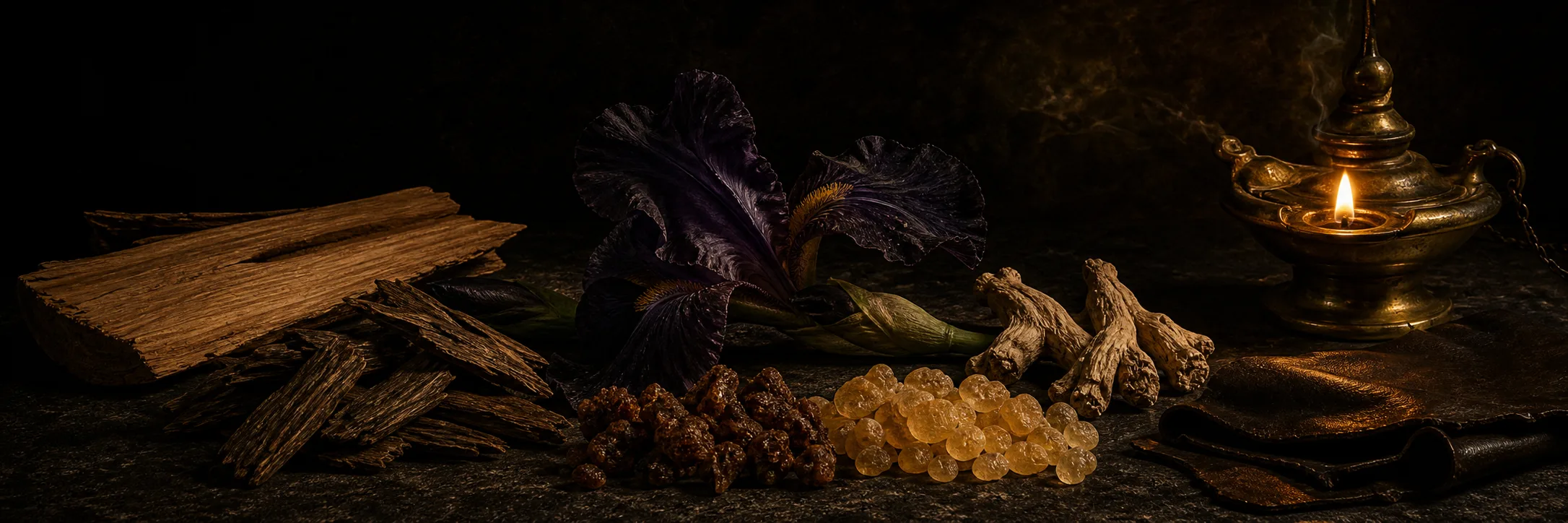
The opening is markedly smoother than the original Interlude’s notorious oregano-and-pimento assault. Bergamot gives a brief zesty lift, with green violet leaf and herbaceous rosemary providing an aromatic top. The iris registers early but briefly - several wearers say the distinct orris moment lasts roughly ten minutes before the smoke takes over. This is not powdery, cosmetic iris; it reads metallic and mineral, like stone polished by centuries, and to others greasy, buttery and creamy rather than waxy. A minority find that the meeting of powdery iris with sharp spice and oud creates a metallic, barbwire effect. Through the heart, across the first one to three hours, the composition moves into classic Interlude territory: a resinous, hazy incense core of olibanum (frankincense) and myrrh, warm amber and labdanum, smoothed by vanilla. This is the dominant mid-stage character - smoky, sweet-resinous, ceremonial. The iris persists for some wearers as a cool, creamy thread; for others it recedes, leaving what reads as burned rosemary ash with hints of leather. The vanilla is more prominent here than in the original. The drydown, from around three hours on, lands on leather, agarwood (oud), sandalwood, patchouli and cedar, with vanilla amplifying the sweetness in the sandalwood. Notably, although oud is listed and contributes a smoky-woody depth, this is not an oud-forward fragrance - it is an incense-amber-leather scent with oud as a supporting char. The skin-scent stage is smoky-sweet, woody and resinous, leathery and softly powdery. It evolves at the top but stays fairly stable from heart to base. The signature accord is charred incense-resin over creamy mineral iris and vanilla - what one critic memorably called charred petals dipped in oily tar.
Performance
This is a strong performer in classic Amouage fashion. Longevity is commonly reported at ten to twelve hours, with some wearers getting all-day wear from just two sprays. Projection is potent but present rather than full beast-mode - it surrounds the wearer rather than blasting a room, though it is still strong enough that you should think twice before spraying just ahead of a car ride or a confined social space. Sillage is above average. Heat is a critical variable: one detailed wearer warns explicitly against warm weather, where it turns extremely cloying and sweet-flowery; kept cool, the smokiness stays balanced. This makes it a cold-weather scent by design. To part of the general population, the incense-resin mass also reads as the oil-refinery effect common to post-2014 Amouage. The best strategy is to spray conservatively, in cool weather, and let it bloom rather than over-applying.
Wearing Context
This is a fall and winter fragrance, best in cool to cold weather where its smoky-resinous heart stays elegant rather than cloying. It skews toward evening, though its relative wearability versus the original means some wear it in daytime through the cold months. It reads as formal, contemplative and ceremonial - suited to dressed-up evenings, cold-weather statement wear, and self-reflective solo wear. It is widely considered the easiest-to-wear of the Interlude trio (the original, 53, and Black Iris). Where it falls flat: warm weather, where it turns sweet and heavy, plus conservative offices and tight indoor spaces. It is not a casual crowd-pleaser; it is a connoisseur’s smoke-and-incense scent.
Comparisons & DNA
The essential comparison is to its own family. Amouage Interlude Man (2012) is the parent: bitter, oregano-heavy, ink-smudged and confrontational - described by one reviewer as requiring a personality skill-check. Black Iris removes the oregano, reduces the rosemary, adds orris and more vanilla, yielding a smoother, darker, more accessible version. The critic Mark Behnke described it as opening with the same herbal green top as rosemary replaces oregano and pimento, moving into the classic incense-and-amber heart where the iris appears, and ending in the same oud-and-sandalwood base with a touch of vanilla amplifying the sweetness. Interlude 53, the intense flanker, has been called a bottomless pit of bubbling resin; Black Iris is positioned as the middle ground between the original and 53. Outside the house, wearers reach for Dior Homme Intense when discussing the iris (though Black Iris is far less powdery and its iris far more fleeting), and some note an opening reminiscent of Tom Ford Black Orchid with iris added. For oud-tinged oriental warmth, one comparison drawn is Atkinsons Oud Save the King. As lineage, being Amouage’s first-ever flanker, it inaugurated Salmon’s flanker strategy - later joined by Interlude 53, Reflection 45 Man, Epic 56 Woman and others - and Behnke framed it as a Salmon remix of a Christopher Chong chart-topper.
Reception
Reception is polarized but tilts strongly positive among Amouage fans. Across wearers, many call it a masterpiece and one of the finest flankers ever made, praising the smoothing of the original’s rough edges and the creamy iris. A recurring sentiment: those who found the original Interlude’s oregano unbearable often find Black Iris the version that finally works for them. Critical opinion is more measured. Mark Behnke, while calling it a nice flanker, judged it just a luxurious flanker with nothing new to say, and used it to voice hope that Salmon would develop his own aesthetic rather than live off the past. A notable dissent argues the effort is meaningless - that the iris adds little and the powder-meets-spice creates a metallic barbwire. Common criticisms are that it is too similar to the original to justify owning both, too smoky for some noses, or still carrying that burned-rosemary ash. The verdict on a blind purchase: risky, sample first. Many love it, but a meaningful minority finds it redundant with the original or still too ashy, and it is expensive.
Versions & Reformulation
This is a single composition, sold as an EDP at 25-percent oil concentration with a stated six weeks of ageing (three weeks maceration, three weeks maturation) per Amouage. It is itself a flanker, or overpainting, of Interlude Man (2012) rather than a fragrance with its own variant lineup, and there are no known reformulations as of this writing. For context, Interlude Man (the original EDP) and Interlude 53 (the more intense flanker) are distinct compositions, not concentration variants of Black Iris.
Acquisition Notes
This is luxury niche, sold primarily in the 100 ml EDP at roughly 400 dollars and up at retail, though it is widely discounted on the grey market. The decant ecosystem is healthy, with the major split services carrying it, which makes sampling easy and advisable given the polarization and price. As ever, buy from Amouage directly, authorized luxury retailers, or reputable decanters with return policies; the matte indigo box and inky blue glass bottle are themselves a partial authenticity tell.
Notable Facts & Lore
- Perfumer Pierre Negrin spoke directly about this fragrance: in an April 2020 conversation with Amouage he stated his intent was an odour profile less aromatic than the original, explaining that he reduced the rosemary note and removed the oregano note.
- Creative director Renaud Salmon explained its significance, saying Interlude Black Iris felt appropriate as a first creation because it reflects the house’s own period of creative interlude, and that it takes time to understand the archives of a house like Amouage.
- The name and concept reference Georgia O’Keeffe’s 1926 painting Black Iris, and Amouage describes the fragrance as an overpainting, a refined palette to smoothen the facets of the original creation.
- It launched in May 2020 and reportedly sold out within days.
- It holds dual historical firsts: Amouage’s first flanker, and the first release marking the post-Christopher Chong era under Salmon.