Amouage — Jubilation XXV Man
Essence
Jubilation XXV Man is Amouage’s 2007 twenty-fifth-anniversary masterpiece - Bertrand Duchaufour’s incense-oriental built to make Omani frankincense the star, wrapped in a glittering bazaar of blackberry, honey, spice, and resins over oud, myrrh, and woods. Widely regarded as one of the finest incense fragrances ever made and the culmination of Duchaufour’s long run of incense work, it is celebrated for a regal, fit-for-a-king complexity that feels at once ancient and modern. It is the men’s counterpart to the (entirely different) Jubilation 25 Woman, and its standing as a benchmark resinous oriental remains largely intact.
Scent Profile
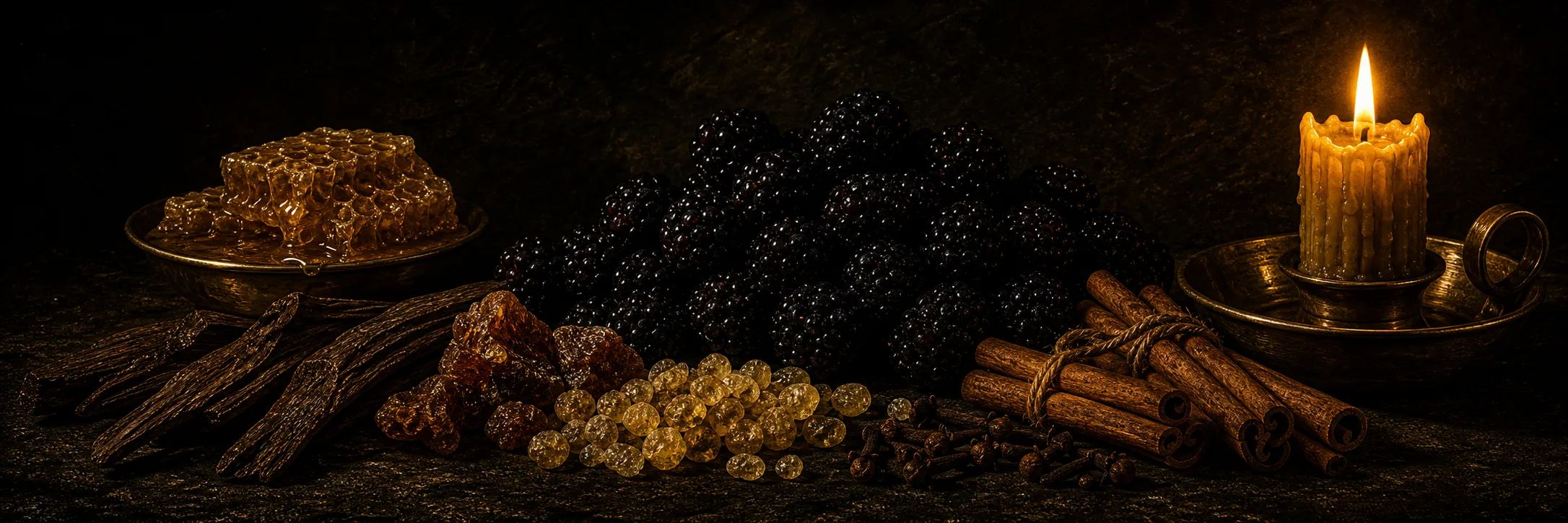
The dense pyramid reads as a kaleidoscopic, tightly orchestrated whole rather than a legible sequence of notes. In the first ten to twenty minutes the standout is a dark, almost boozy blackberry elixir laced with juicy-bitter orange and davana, immediately threaded with gauzy frankincense smoke and a warm honeyed sweetness - blackberry, honey, and incense are the star opening accord. The herbs (coriander, tarragon, bay) and a savory celery-seed facet are present but subtle, lending a green, freshly-sawn edge; up close, those savory notes plus the funkier wood can read slightly harsh, which is why the scent is said to need room to breathe. By the heart, roughly the first one to three hours, the frankincense becomes the protagonist - the Omani Boswellia sacra that one critic memorably said makes other incense smell like sawdust - shifting from damp and dense to smoky, warm, and almost velvety. Around it moves a quiet procession of resins (furry myrrh, sweeter opoponax, sweaty labdanum), warm cinnamon-clove spice, honey, and a dewy abstract rose and orchid that surface later than expected. The drydown, from about three hours on, is woody, dry, and textural: a big dusty guaiac, smoky frankincense residue, patchouli, cedar, a cola-like immortelle nuance, and a soft musk-ambergris base. Jubilation XXV genuinely evolves - fruity-honeyed and bright, then smoky-resinous-floral, then dry-woody - and that journey is much of why it is prized.
Performance
Performance is the single most contested aspect of this fragrance, and a genuine point of polarization. The honest reality is that this is not a beast-mode scent. Projection is light to moderate; it sits relatively close and is famously easy to go anosmic to - one wearer’s line captures it well, that it smells better in a scent trail than under a wrist-sniff, so light in the air that you feel you have to dig in close to find it. Sillage is modest to moderate. Longevity reports vary widely by batch: many find a workable but unspectacular five to six hours on skin, defenders insist it lasts all day as a comfort layer (especially with a generous hand), and a vocal contingent complaining about the most recent batches report it as weak. On clothing it persists notably longer, as resinous incense scents tend to. Longtime fans push back on blaming everything on reformulation, arguing it always had average longevity and low sillage even in the old bottles. The practical playbook: apply generously, let it breathe rather than judging by a close wrist-sniff, and lean on clothing for longevity.
Wearing Context
By overwhelming consensus this is an autumn and winter, evening, special-occasion fragrance - something almost biblical about its profile makes it feel right for cooler nights and greater celebratory moments: weddings, formal events, dressed-up evenings where its regal complexity is the point. Several owners explicitly reserve it for occasions because it feels too opulent for everyday, finding even the smokier Interlude Man more versatile. Where it falls flat is hot, humid weather, where its resinous richness turns heavy and its modest projection suffers further, and casual daytime or office settings, where its incense-heavy character can feel like overkill or read as old to some. It will not satisfy anyone who wants loud, obvious projection; this is an intimate, sophisticated wear rather than a compliment-bait powerhouse. Socially it skews expensive, regal, and mature - admirers say it smells like royalty, detractors just say old. Marketed for men, it is genuinely unisex, and wearers note it can be seductive on a woman, fitting given its kinship with the women’s Jubilation 25.
Comparisons & DNA
Jubilation XXV is the capstone of Bertrand Duchaufour’s celebrated incense arc, and the critic Mark Behnke has laid out the lineage explicitly: it draws together everything Duchaufour developed across Comme des Garcons Avignon and Kyoto (his two foundational incense accords, astringent-cathedral versus clean-meditative), Eau d’Italie (a gauzy incense veil), L’Artisan Timbuktu (a darker, smokier incense), L’Artisan Dzongkha (incense with chai and orris), and Eau d’Italie Paestum Rose (incense with Turkish rose). One writer described Jubilation as Timbuktu with the dirt toned down and the sweaty notes removed, plus something spicy and honeyed, and called it more elegant and more wearable. Other genuine comparators: YSL Opium pour Homme is repeatedly cited as a cheaper relative sharing the spicy-incense-resin idea, with Jubilation as the richer niche version, and Hermes Elixir des Merveilles is named for its boozy-orange-amber opening, so close that Jubilation’s blackberry-amber bear hug feels reminiscent of it. Within Amouage it stands alongside Gold (the classicist benchmark, to which Jubilation is the postmodernist counterpoint), the smokier and louder Interlude Man, and Dia and Reflection. On clones, a budget impression exists but is generally judged half-baked and short-lived - the artistry and the genuine Omani frankincense are hard to replicate cheaply.
Reception
Coverage is strong and the consensus is reverent but debated. Luca Turin praised the Jubilation launches, calling the masculine a lovely incense composition by Bertrand Duchaufour, and the warm verdicts pile up from there: critics have crowned it the ultimate incense and the red carpet, called it one of the finest incense perfumes ever made and a modern masterpiece, and described it as mesmerizing and fabulously evocative while still being wearable. The notable dissenter is Kafkaesque, who admires it but, as someone who already owns Elixir des Merveilles, finds it not quite worth the mass genuflection. Among enthusiasts it is widely hailed as a benchmark resinous incense oriental and fit for a king, with deep appreciation for its complexity, material quality, and the blackberry-honey-frankincense accord. Two criticisms dominate: the performance, with its low sillage and inconsistent longevity, and a minority who find it overrated - arguing people fall for the high concept more than the smell - or who read it as soapy, too feminine, or old. The fault lines are predictable: high-concept artistry versus everyday wearability and value, niche price versus modest projection, and vintage versus current formulation. Blind-buy verdict is to sample first; but for established lovers of incense and resinous orientals, or of Duchaufour’s work, it is frequently called completely worth it.
Versions & Reformulation
Reformulation is a real and documented topic. The 2007 original - often identified by an early white plastic cap - is prized by collectors as bolder and more legible note by note, with a more authentic blackberry and davana opening. Later batches are reported as more muted, more blended, oilier, and closer to the skin: a mellow golden jammy amber aura rather than the original regal, dramatic kaleidoscope, with the distinctive opening fading faster, and some of the most recent batches drawing sharp complaints about diminished longevity. Vintage decants are sought specifically to experience that first formulation. The fragrance is an eau de parfum throughout. Separately, in 2023 Amouage released Jubilation 40 Man, a forty-percent reinterpretation by Duchaufour himself that keeps the essential structure while emphasizing certain facets - blackberry, blackcurrant, rosemary, and a more chypre-leaning moss - and is considered richer, drier, and stronger-performing, effectively a higher-octane sibling rather than a replacement. It should not be confused with Jubilation 25 Woman, a different composition altogether.
Acquisition Notes
This is luxury-niche territory. The standard 100 ml eau de parfum historically retailed around USD 290 to 300, with a less-common 50 ml near USD 245, and current pricing sits higher. Buy authentic stock from Amouage boutiques and the brand site or authorized niche retailers. Given the price and the divisiveness on performance, the decant market is the smart entry point - samples run from just a few dollars, and there is an active split scene for both current and vintage formulations, the latter worth seeking from sellers who can document the early white-cap era.
Notable Facts & Lore
- Jubilation XXV was created for Amouage’s twenty-fifth anniversary in 2007 under artistic director Christopher Chong, and is documented as the first Amouage main-collection fragrance to make frankincense the star (all of them contain it).
- Duchaufour’s framing centered on Omani Boswellia sacra as the heart and on a meeting of cultures - Eastern materials and sensibilities expressed through Western composition - with the perfume positioned as the postmodernist counterpoint to Guy Robert’s classicist Amouage Gold.
- It is often described as the deliberate culmination of Duchaufour’s multi-house, multi-year incense apprenticeship, a landmark in his career.
- The launch was a genuine wearers event: by one account the perfume world went a little crazy in 2007, and amid roughly 1,700 releases that year the Jubilation pair dominated the scent blogosphere.
- The reputation has held - it is routinely called the ultimate incense and a three-wise-men scent, and it functions as the reference point against which other incense orientals are measured.
- There is no celebrity or viral lore here; its fame is connoisseur-driven.
- The richest ongoing argument is simply whether its modest performance undermines its masterpiece status, and the related vintage-versus-current debate that follows it everywhere.