Roja Dove — 51 Pour Femme
Essence
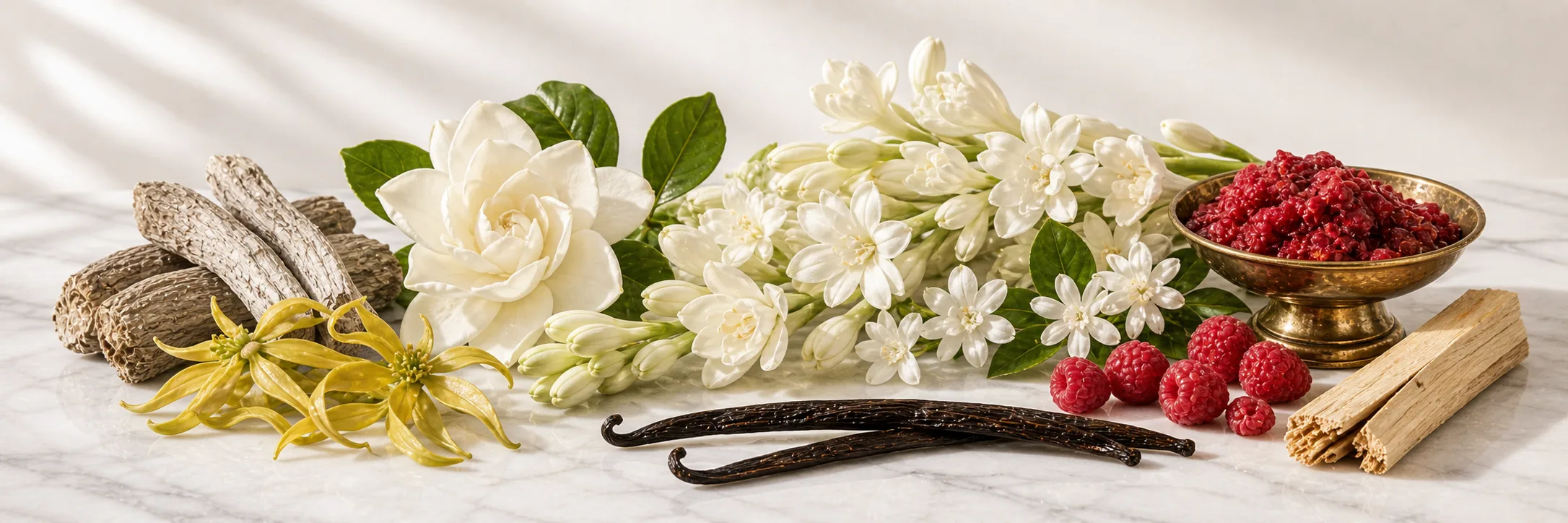
51 Pour Femme is Roja Dove’s house-portrait fragrance for women, named for the brand’s flagship boutique at 51 Burlington Arcade in London’s Mayfair. It is an opulent, slightly retro fruity-floral oriental: a vanilla-and-cashmere bed laid under a wide-petalled white-floral bouquet, with a single rasp of raspberry as its modern signature. Think of it as Roja’s attempt to bottle a luxury jewel-box of a shop - generous, well-mannered, recognisably feminine, and tilted firmly toward sweet creaminess rather than the powerhouse white florals of the 1980s it gestures back toward.
Scent Profile
The first ten minutes are deceptively simple: a soft bergamot lift, immediately overtaken by ylang-ylang’s banana-custard creaminess and a clearly drawn raspberry that reads more as crushed berry than synthetic candy. Tuberose, gardenia and orange blossom enter quickly and merge - there is none of the indolic, mentholated tuberose of Fracas or Carnal Flower here; the white flowers are sanded down, round and milky against the ylang. Rose threads through as a sweetener rather than as a soliflore. By the one-hour mark, 51 settles into its true shape: a vanilla-and-cream floral with a faintly powdered, faintly spiced lining. Anise and cinnamon sit deep in the structure, just enough to suggest warmth without ever pushing into a true gourmand or spice register, and the cloves are essentially submerged. Lily-of-the-valley supplies most of the sparkle as a clean, abstract green muguet. Patchouli and orris are textural rather than narrative - orris a cool dust, patchouli a brown ballast that keeps the raspberry from going soda-pop. From hour three onward the drydown does its most distinctive work. Cashmere wood and sandalwood wrap the florals in a soft, almost suede-like base - the cashmeran doing most of the heavy lifting, the sandalwood reading more as a creamy halo than as dry Mysore character - which benzoin sweetens and orris cools. The raspberry never fully disappears; it pulses faintly under the vanilla until end of day. The arc is gently evolving rather than linear: opening, heart and base are distinguishable, but they share one creamy-sweet-floral DNA throughout. The signature is raspberry-vanilla-ylang over cashmere - a modern, slightly retro boutique perfume, not a powerhouse.
Performance
In the Parfum concentration this is a moderate-to-soft projector, not a powerhouse. Two sprays sit at arm’s length for the first ninety minutes, then pull in toward a personal-space sillage by hour three. On skin, expect seven to nine hours of clear wear and a faint cashmere-vanilla skin scent extending past twelve hours; on clothing - especially wool or cashmere - it can be picked up the next day. It is at its best in cool weather; in heat the vanilla and ylang turn cloying within an hour, and humidity dampens projection further. The smart application is two sprays to fabric rather than to bare warm skin, which is exactly where its boutique-scent quality emerges: a faint trail rather than a cloud. Skip the décolletage in summer.
Wearing Context
This is an autumn-winter daytime fragrance with strong evening-formal applicability - a ladies-who-lunch-in-Mayfair scent that translates surprisingly well to a candlelit dinner, because the cashmere-vanilla base reads quietly luxurious rather than loud. Office settings where heavy perfume is unwelcome are genuinely viable thanks to its restrained projection. It falls flat in summer, in athletic or casual contexts, and anywhere that rewards the unusual - it is too polished, too nice, to register as a statement. Its social signal is unambiguous: this reads as expensive, mature femininity. Women under twenty-five tend to draw comments about smelling older than they are; women over thirty-five tend to draw compliments about smelling expensive. The brand’s own copy invokes “the quintessential uptown girl,” and that framing colours how the fragrance lands. It does not aspire to be a niche oddity, and it isn’t one.
Comparisons & DNA
The closest reference points are mid-1980s vanilla-floral orientals retooled for modern noses. Guerlain’s Samsara shares the sandalwood-jasmine-vanilla architecture, but Samsara’s woody base is far drier and more austere; 51 Pour Femme is rounder and sweeter. Dior’s Hypnotic Poison sits in the almond-vanilla-jasmine zone but is more medicinal and almond-forward; 51 has none of its bitter-cherry edge. Tom Ford’s Velvet Orchid shares the heavy-ylang-vanilla register but is more brutally sweet and less floral-detailed. Within Roja’s own line, 51 Pour Femme is essentially the feminine bookend to Enigma Pour Femme (gentler, fruitier) and a sweeter cousin to Reckless. Roja Dove has described it as a portrait of two sides of the Burlington Arcade - opulent clientele on one face, a cheeky, sexy past on the other - with the raspberry meant to read as the wink. The clone ecosystem is thin compared with Roja’s Aoud lineup: a few oil interpretations circulate under “51 / Roja Inspired” naming, rated close by enthusiasts but with markedly weaker performance than the original Parfum. There is no widely visible budget-house dupe of the kind that shadows Amber Aoud. In lineage terms, 51 doesn’t start a trend so much as translate the heady-feminine of the 1980s and early 1990s into something palatable to 2010s and 2020s tastes - less indole, more vanilla, a fruit accent for lift - descended from the Samsara and Poison-era floral oriental.
Reception
Aggregate consensus skews positive but is clearly bimodal. Enthusiast wearer reports consistently praise the smoothness of the ylang-vanilla-raspberry knit, reaching for words like creamy, snuggly, and expensive-smelling. The sharper split comes over value: critics complain that for a Parfum at this price the projection is modest and the composition derivative, and the harshest reviews land on the later Essence de Parfum flanker, faulting its performance. Among named critics, Ida Meister offered the most influential positive read, calling 51 Pour Femme “blithe, sun-drenched and pure of heart” and noting it “smells expensive straight out of my tester,” with “no corners cut.” She framed it as “an abundantly floral, spicily sweet dance number in triple meter. Resistance is futile.” Luca Turin’s Perfumes: The Guide is famously dismissive of the wider Roja catalogue, which is useful context for the long-running perfumer-versus-critic argument that has followed the brand. Among everyday enthusiasts the verdict tends toward “beautiful but not worth retail - sample first, decant second, blind-buy never.”
Versions & Reformulation
Three concentrations exist: the EDP, the Parfum (the version this profile centres on), and a later Essence de Parfum. In wear, the EDP reads sharper and rosier in the opening with shorter longevity; the Parfum is the creamier, deeper, longer-lasting version and the one reviewers most often cite as the reference. The Essence is the controversial release - positioned by the house as a more transparent, skin-scent interpretation, but criticised by a significant share of wearers as too short-lived for the price. No major reformulation of the Parfum itself has been documented; bottle caps and presentation have been refreshed as part of broader house updates.
Acquisition Notes
This sits in the ultra-luxury tier. The Parfum runs into the several-hundred range at 50ml and roughly double that at 100ml direct from the brand, with a small travel size occasionally available; the EDP is somewhat less. US discounters have historically carried the EDP at a deep discount during sales, which is where many buyers acquire it. Given the price, a decant is the strongly recommended path for first exposure before committing to a full bottle.
Notable Facts & Lore
- The fragrance is explicitly a self-portrait of Roja Dove’s flagship boutique at 51 Burlington Arcade - a covered shopping arcade designed by architect Samuel Ware, opened in 1819 and commissioned by George Cavendish, 1st Earl of Burlington.
- In Dove’s own words, he wanted “51 to have the air of the glamorous women that shop with us, so I blended an opulent bouquet with indulgent Vanilla and Cashmir Wood,” then, thinking of the Arcade’s “cheeky, sexy past,” he “layered in hints of Fruits and Spices.”
- The raspberry, then, is meant to be the cheeky element - the Arcade carried a Victorian reputation for discreet assignations, which Dove encodes as a single fruit accent against the cashmere-vanilla bourgeois backdrop.
- The boutique remains the brand’s flagship and only standalone in central London, and the fragrance functions as a souvenir scent for its clients.
- No viral moment is attached; it has stayed within the niche luxury-aesthete sphere.
- The closest it has come to genuine controversy is the reception of the later Essence de Parfum, where the house publicly defended its “skin scent” intent against complaints of poor performance.