Roja Dove — A Midsummer Dream
Essence
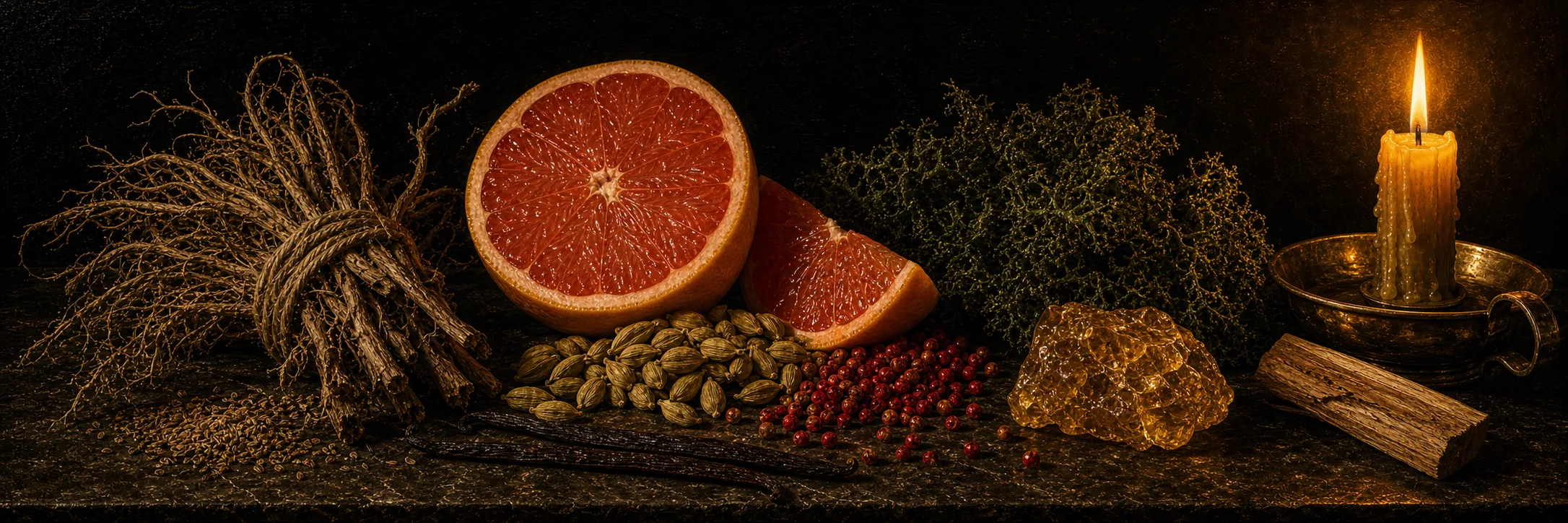
A Midsummer Dream is Roja Dove’s 2016 tribute to Shakespeare, released for the 400th anniversary of his death and conceived as an olfactive reading of A Midsummer Night’s Dream. It is a fresh-aromatic chypre with an amber undertone, built on grapefruit, cardamom, pink pepper and elemi laid over a mossy vetiver-orris forest floor and finished in a powdery carrot-seed haze. Within Roja’s catalogue it is the most overtly green and “barbershop-modern” entry, a daytime unisex perfume that genuinely splits opinion: some critics have called it an evergreen enchantment, others almost wholly uninspiring.
Scent Profile
The opening is a bright citrus burst led by grapefruit, with bergamot, lemon and mandarin in support and a clear thread of elemi’s lemony-piney resin. Pink pepper and cardamom add an immediate spicy lift that pushes the citrus toward an aromatic-fougere register rather than a clean cologne. The first impression for many wearer feedback is “expensive barbershop” - a citrus-spice-resin chord that recalls Cartier Declaration or Hermes Eau d’Orange Verte seen through a more luxurious lens. In the heart, the perfume deliberately avoids behaving like a floral bouquet. Cyclamen, geranium and orange blossom add a faint green-floral haze, and Rose de Mai stays restrained. What dominates instead is the cardamom-pink-pepper-elemi triangle holding firm against an emerging mossy backdrop. Around the ninety-minute mark, carrot seed begins to surface - earthy, slightly sweet and vegetal in a way few mainstream perfumes attempt, and easily the composition’s most distinctive note. The drydown settles into a powdery, slightly rooty base of orris, carrot seed, vetiver, oakmoss and patchouli, sweetened gently by benzoin and vanilla under a discreet musk. The patchouli is clean rather than headshop, and the oakmoss is muted, but together with vetiver they build a credible “forest floor.” Cedar and fir balsam add a dry coniferous edge. The signature accord is grapefruit-cardamom-elemi over orris, carrot seed and moss - a fresh chypre with an amber-resinous undertone that Roja’s own marketing calls a “Chypre-Ambree hybrid.” The fragrance evolves through its first three hours and turns increasingly linear after, holding a single powdery-mossy chord for a long time.
Performance
Performance is moderate by Roja standards. Expect roughly six to eight hours on skin, with projection that is moderate at the open and pulls into a personal bubble after the first ninety minutes. On clothing it does considerably better, lasting twelve hours or more on wool with the powdery carrot-seed-orris base most audible. It shines in moderate temperatures and dry air, struggles in heavy heat where the citrus-resin opening collapses quickly, and reads surprisingly well in the cold, where the mossy base carries better than the bright top would suggest. Humidity tends to flatten it. Because it is built to be diffuse and atmospheric rather than projection-heavy, a generous application - four to six sprays across chest and arms - suits it best. It is a scent that sits near the skin and creates an aura rather than a cloud.
Wearing Context
Spring and autumn are ideal, late-summer evenings work well, and deep winter or high summer are sub-optimal. It leans daytime over evening and casual-elegant over formal - at its best on a long outdoor walk, a garden party or a daytime wedding, the kind of transitional-season wear one critic described as “a forlorn farewell to summer.” It tends to fall flat in dressed-up evening settings, where its restraint can read as undersell, and in nightclubs, where it offers neither sweetness nor projection. There is an interesting social wrinkle: to noses unfamiliar with niche, it reads as “expensive cologne” rather than announcing itself as a luxury perfume, so the people who recognize it are usually other Roja-aware enthusiasts. More than a few wearers treat it as a “secret weapon” or “stealth flex” for exactly that reason.
Comparisons & DNA
The closest structural ancestor is Paloma Picasso Minotaure, whose masculine-leaning, fresh-resinous citrus-orris contour A Midsummer Dream clearly echoes; Minotaure is drier and more austere, while A Midsummer Dream is sweeter and powdier. The cardamom-citrus opening also draws frequent comparison to Cartier Declaration and Declaration d’un Soir, though it is more powdered and less sharp than either. It shares the grapefruit-vetiver-cedar architecture of Hermes Terre d’Hermes, but Terre is far more mineral and woody and far less floral and powdery. Vetiver-orris fans will hear a kinship with Chanel Sycomore, against which A Midsummer Dream is fresher and more spiced, while casual grapefruit cousins such as Maison Margiela Replica Under the Lemon Trees and Atelier Cologne Pomelo Paradis lack its spice-moss complexity. Within Roja’s own line it sits closest to the later green-aromatic Burlington 1819 and functions as the brand’s “fresh” daytime statement, a deliberate counterweight to the heavier Aoud compositions. Its lineage runs from the modern fresh-chypre school of Declaration-era citrus-spice crossed with a niche carrot-seed-orris experiment in the spirit of the Hermessence and Les Exclusifs collections. It never sparked a wider trend - carrot seed has remained a specialist note - but it belongs to a small group of luxury fresh-chypres that keep an “old chypre” structure alive beneath a modern fresh opening.
Reception
Reception has been genuinely polarised, and at a lower volume than Roja’s Aoud line. Admirers praise the blending quality, the cardamom-grapefruit-elemi opening, the distinctive carrot-seed character and a recurring “enchanted forest” impression. Detractors point to performance that feels modest for the price, an opening that reads to a minority as “cheap washing detergent,” and a Shakespearean concept they find more poetic in the copy than in the juice. The most influential positive review came from Robert Herrmann, who wrote that “Roja Dove has turned iambic pentameter into impeccable perfume,” reading the patchouli-oakmoss-vetiver as a forest floor and the cyclamen and geranium as green freshness, and concluding that it is “evergreen enchantment, enduring and should be enjoyed in all seasons.” The sharpest pan came from Neil Chapman of The Black Narcissus, who found it “almost wholly uninspiring,” a “fresh (but very confused) bouquet” that “doesn’t fuse properly or have any discernible theme.” Luca Turin’s 2018 guide was broadly dismissive of the Roja line as a whole. Given how sharply opinion divides, this is not a blind-buy - sampling first is essential.
Versions & Reformulation
There is a single composition, offered only as an eau de parfum. No parfum version exists and no reformulation has been documented. A minor change to the bottle-cap presentation accompanied a relaunch in the early 2020s, and a small number of wearers claim the juice softened at the same time, but this is anecdotal and not confirmed by the house.
Acquisition Notes
A Midsummer Dream sits in Roja’s luxury tier, priced below the Aoud line - around 430 USD for the 100ml eau de parfum, with a 50ml available at a lower price and a 7.5ml travel size surfacing occasionally. It is widely carried by the brand’s boutiques and major luxury retailers. Given the polarising carrot-seed-cardamom signature, a decant is a sensible first step.
Notable Facts & Lore
- The fragrance launched in 2016 to coincide with the 400th anniversary of Shakespeare’s death.
- Roja’s framing is explicit: in honour of that anniversary, the perfumer set out to translate A Midsummer Night’s Dream into the language of scent, evoking the enchanted woodland of Shakespeare’s imagination.
- The composition nods to specific characters - Titania, Queen of the Faeries, “written to have slept on a bed of Musk and Rose” - and Dove deliberately dropped “Night” from the title so the perfume could be worn day or night.
- The unusual carrot-seed note is his gesture toward Titania’s “powdery balsamic” bed.
- There is no celebrity tie-in or viral moment in its history.
- Its most enduring story is simply the split in critical opinion, alongside a recurring enthusiast argument that the Shakespeare concept promises more than the juice delivers.
- Within Roja’s catalogue it stands as the brand’s most overtly conceptual “Art Collection” piece, part of a small series - with Burlington 1819 and the later Serenity Blend - that treats perfume as cultural translation rather than straightforward composition.