Roja Dove — Amber Aoud
Essence
Amber Aoud is the keystone of Roja Dove’s Aoud Collection: a Western rose-saffron-oud built over a salty ambergris-resin base, launched in 2012 as a pure parfum. The idea was to render the vocabulary of Middle Eastern perfumery through a French and British luxury lens, and it sits beside the house’s original Aoud Parfum as the pair that defined Roja’s Aoud identity. Within the Western rose-oud canon it is among the most cited of all, and it has spawned the most extensive clone ecosystem of any Roja release.
Scent Profile
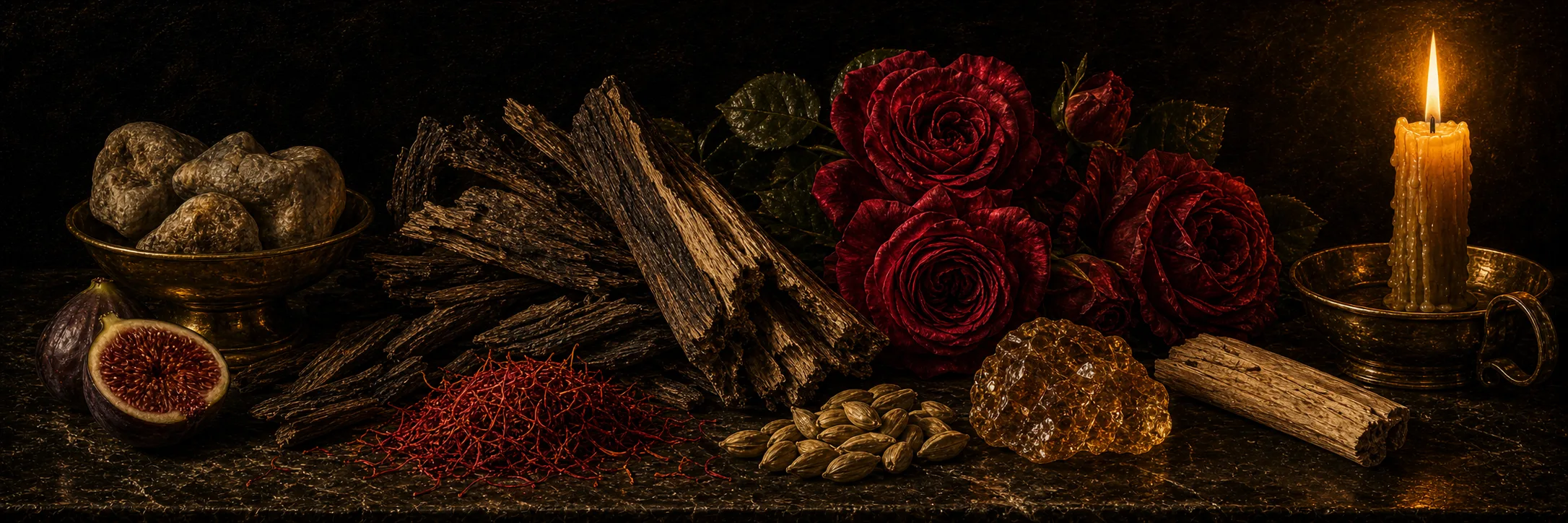
The first ten to twenty minutes give you a brief but clearly drawn citrus introduction of bergamot, lemon and lime. The lime in particular is unusually well realised for a luxury oriental, and it is the part of the opening wearers single out most. The citruses do not linger; they yield to a jammy, slightly Concord-grape-tinged rose that is the perfume’s real identity, with fig appearing almost immediately as a pulpy, milky undertone and saffron lifting from the base into the heart at the same time. Through the first few hours this is essentially a rose-saffron-fig-oud accord, with ylang-ylang and jasmine smoothing rather than featuring. The rose is dense and slightly stewed; cinnamon is restrained and warming; the patchouli is fractioned and sweet, lending a fruitchouli quality that is the most divisive thing about the composition. The drydown is where the craft shows. Ambergris adds a salty-warm radiance that lifts and smooths an otherwise dense base, benzoin and sandalwood bring creamy resin, and a thin smoky birch-tar edge gives the leather facet that sets it apart from the usual rose-oud-saffron formula. Civet stays gentle and clean rather than dirty, and the oud itself is restrained and Western in style: smoky, faintly medicinal, never barnyard. Late in the wear it settles into a warm gingerbread skin scent. The signature is jammy rose, fig, saffron and ambergris over soft oud, with the ambergris doing more work than the oud despite the name.
Performance
This is a long-lasting parfum that projects more modestly than its reputation suggests. Expect a couple of inches of projection at most early on, settling to a personal scent bubble within the first ninety minutes and a true skin scent a few hours in. On skin it runs roughly ten to fourteen hours; on clothing it easily lasts a day or more. Cool weather and moderate temperatures suit it best - in heavy heat the jammy rose can read cloying, while humidity dampens the citrus and amplifies the resinous base. Apply generously on cool skin for cold-weather wear and more sparingly in the warmth.
Wearing Context
Autumn, winter and cool spring evenings, leaning formal rather than casual. This is a black-tie or formal-evening fragrance at heart, though plenty of enthusiasts wear it in the daytime in cooler climates. It is at its best in cold weather and indoor luxury settings - hotel bars, the opera, a gala - and anywhere dense oriental perfumery feels at home, alongside wool, silk or traditional Gulf attire. It falls flat in athletic, casual or warm-weather contexts, and in the office unless applied lightly. There is also a genuine social-perception split: in Western settings it reads as overtly luxurious and a little old-money, while in the Gulf it reads as appropriately formal - Roja has noted that his Middle Eastern clients tell him “this is how we like to smell.” Officially unisex, it skews slightly more masculine in the Gulf and slightly more feminine in the West, with a lot of overlap.
Comparisons & DNA
A few useful reference points. Against By Kilian Rose Oud or Pure Oud it shares the rose-oud register but is sweeter, fuller-bodied and more distinctly figgy. Next to Tom Ford Oud Wood it is denser and far more rose-forward, where Oud Wood is lighter, drier and more sandalwood-cedar. Compared with MFK Oud Satin Mood it swaps that fragrance’s violet for saffron and fig. Amouage Lyric Woman covers similar rose-incense ground but is more austere, while Amber Aoud is sweeter. Set beside Roja’s own original Aoud, the original is drier and more medicinal and Amber Aoud is noticeably sweeter and denser, with powder and amber present from the first spray. Boadicea the Victorious Ardent is a rose-oud cousin, and Initio Oud for Greatness reads more synthetic where Amber Aoud feels more layered and natural. Within Roja’s own line it is the matriarch of the Aoud Collection that now includes Sweetie Aoud, Taif Aoud, Musk Aoud, Enigma Aoud and the Crystal versions. It descends from the Western rose-oud canon initiated by Montale and refined by Kilian, and it is widely credited as the most successful luxury-house entry in the category. It did not start the rose-oud trend, but it is one of its commercially defining luxury-tier examples. The clone ecosystem is broad. The most cited inspired-by versions get somewhere from roughly two-thirds to mid-eighties percent of the way there, generally with weaker projection and less developed bases. Notably, no cheap mass-market dupe has reached the visibility that clones of Tom Ford or Kilian have - likely because the fig-ambergris-rose-saffron-civet construction is harder to replicate inexpensively.
Reception
Reception is best described as cult consensus that turns polarised at the price-and-originality margin. Praise centers on the blending quality, the depth of the ambergris, the rose-saffron-fig accord, the longevity, and the welcome absence of the synthetic barnyard oud that plagues lower-tier rose-ouds. The criticism is just as consistent: the name is misleading, since rose dominates and the oud is restrained; the price strikes many as hard to justify when less expensive niche covers similar ground; the opening can read jammy or grape-like to anyone tired of fruit-rose; and after a decade of rose-oud saturation some longtime enthusiasts now find it familiar. Critical coverage leans favorable. Luckyscent’s editorial famously called it “a Rolls Royce in a sea of Volkswagens,” set on besting every other rose-oud through superior materials and blending, and “almost obscenely rich and opulent at first,” wearing “like the inside of a red velvet cloak lined in ermine.” The Kafkaesque blog framed it as “a luxurious take on a very traditional scent,” granting that the quality stands out and the focus is far more rose than amber, while flagging that divisive jammy fruitedness - and singling out the birch as “really the best part,” the thing that “elevates Amber Aoud beyond the usual rose-oud-saffron trio.” Michelyn Camen at Cafleurebon called it “one of the most complex and sumptuous rose/oud fragrances I have experienced.” Luca Turin’s published assessment of Roja’s line has been notably cooler, a two-star “pedestrian” read that many enthusiasts treat as a grudge given the polish on display. As for blind buying: only after real sample wear, and rarely worth it at full retail given how saturated and taste-divisive this space has become.
Versions & Reformulation
There are three formal versions. The original Parfum (2012) is the reference. Amber Aoud Crystal is a colourless distillation of the same formula, created specifically so the amber juice will not stain white fabric - important for the white-kandura wearers in the Gulf market Roja targets - and is described by the house as sensorially equivalent. Amber Aoud Absolue Precieux (2016) is a stronger, deeper rose-saffron-ambergris flanker, reported by wearers as denser, more orris- and patchouli-forward and considerably more powerful, though now discontinued in some markets. Reformulation of the original Parfum has been speculated about for years, with some long-term collectors sensing that post-2018 batches are slightly less ambergris-rich and a touch more synthetic than the early-2010s ones. Roja has not confirmed any reformulation. The most that can be said is the general observation that something shifted in Roja’s quality levels after 2017 - useful context rather than specific confirmation.
Acquisition Notes
This sits at the ultra-luxury tier. US retail runs roughly $400 for 50ml and $700 for 100ml of the Parfum, with the Crystal versions priced higher; expect comparable pricing at the major luxury department stores and specialty retailers. Aggressive discounters periodically run large sales, and when they do these tend to sell out within days. The decant ecosystem is the broadest of any Roja release - a 1ml sample is the standard entry point, and 5ml and 10ml decants are widely available and well worth trying first given the price.
Notable Facts & Lore
- Roja Dove’s stated aim was a Western-built rose-oud that would genuinely satisfy Gulf wearers.
- In his words: “I spent three years working in the Middle East where I learnt a great deal about Aoud, smelling how much the qualities differ, but more importantly how people wear it and what makes it smell good.
- I spent two years creating it, and am delighted when my Middle Eastern clients say, ‘This is how we like to smell…
- This is our smell.’ It is the most flattering compliment of all.” On the materials, he has said he took the gum resins long used in perfumery, many of them originating in the Middle East, and blended them with oud “to create a scent which is both soft and sensual.”
- Commercially, Amber Aoud sits at the center of the Aoud Collection’s expansion through the 2010s and 2020s.
- The Collection’s anchor, the original Aoud Parfum, became, by the house’s account, the best-selling fragrance in Harrods and established Roja’s reputation; Amber Aoud and the colourless Crystal innovation consolidated it.
- That Crystal technology is unusual in Western perfumery and was instrumental in cementing the brand’s standing with Gulf clients. There is no documented mainstream celebrity wear, though Roja has personally signed bottles - one wearer recounts him inscribing hers “first edition” in Riyadh in 2024. The fragrance has been reviewed across enthusiast YouTube many times over, most often as a “what does luxury smell like” benchmark. No real scandal attaches to the scent itself; the only running controversy is the broader argument over whether Roja’s pricing matches his ingredient quality, a debate Amber Aoud sits squarely in the middle of.