Roja Dove — Elysium Pour Homme Parfum
Essence
Elysium Pour Homme Parfum is the original 2017 highest-concentration version of what became Roja’s most successful and most divisive masculine release. It is a luxury “blue” fragrance - citrus over woods over clean musks - executed with materials of measurably higher quality than its designer-tier comparators, but in a profile critics have repeatedly called “expensive Bleu de Chanel.” Within the catalog, this is the Elysium for buyers who want the original idea at its richest concentration and best longevity, with a more pronounced vetiver and ambergris base than the more popular Parfum Cologne or EDP versions.
Scent Profile
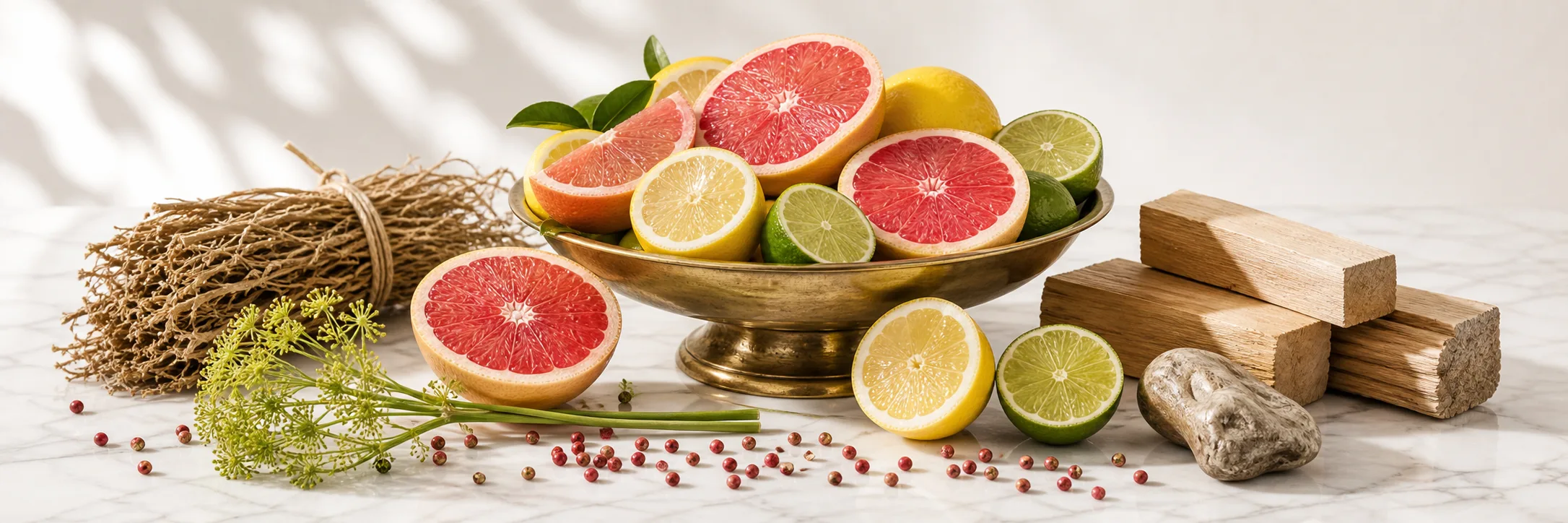
The first ten to twenty minutes are an effervescent citrus burst: grapefruit and lemon dominate, lime and galbanum add a green-vegetal lift, and a faint metallic-aldehydic shimmer rises from the modern musks at the top. The opening reads bright but never sharp, with a soapy-clean roundness that sets it apart from a cologne-style citrus. Lily-of-the-valley peeks through within minutes, apple registers as a textural sweetness rather than a recognizable fruit, and pink pepper provides a dry crackle that keeps the opening from being purely fresh. At the one-hour mark the heart settles into what wearers consistently identify as the signature Elysium accord: pink pepper, woody notes that read as a quality cedar, and a clean musky-floral haze. The listed rose and jasmine are barely identifiable on their own, working instead as background floralcy that smooths edges, while apple persists as a polished sweetness. This is the phase where the scent most resembles Bleu de Chanel Parfum, and where its critics find their ammunition. From three hours onward the Parfum’s superior base reveals itself. Vetiver becomes prominent - dusty, grassy, slightly smoky, with real material weight - while ambergris contributes a salty-warm musk, labdanum adds leathery-amber depth, benzoin softens with resinous sweetness, and vanilla rounds the bottom without becoming dessert-like. Leather is whispered rather than stated. This is where the Parfum justifies its existence over the Cologne: the base is denser, longer-lasting, and more satisfyingly woody. Development is moderate - the structure stays consistent while the proportions shift from citrus-dominant to wood-dominant - and the signature is a citrus-vetiver-ambroxan triangle executed with unusual transparency.
Performance
Performance is where opinions diverge most. Projection is moderate for the first two hours, throwing roughly an arm’s length, then drops to a close-skin scent, and sillage is restrained for a parfum at this price. Longevity runs six to nine hours on skin depending on chemistry and twelve or more on clothing. Compared to the Parfum Cologne, the Parfum genuinely lasts longer and projects more - around seven hours versus three to four for the Cologne - but neither hits the projection benchmarks expected at the ultra-luxury price point. Heat amplifies the citrus and musks dramatically, while cold weather mutes the top and pulls the scent cloud in. Best application is six to eight sprays including a chest or shirt spray, and a common technique is to layer the Cologne over the Parfum to extend the bright top while keeping the deeper base.
Wearing Context
Late spring through early autumn is the natural home. Daytime is ideal - office, business meetings, lunch, daytime weddings - and it works on summer evenings as long as the setting is not formal or dark. It is somewhat wasted in deep winter or in heavy black-tie contexts, where richer Rojas like Diaghilev, Enigma, or Britannia suit better. Its social read is expensive, polished, and conventional: a successful man’s freshie rather than an enthusiast’s quirky pick. Compliments are reported frequently, if not at the explosive volume of Aventus or Sauvage. Where it falls flat is any context where someone catching the cloud will simply say “smells like Bleu de Chanel” - which, today, is most places where mainstream blue fragrances dominate.
Comparisons & DNA
The Bleu de Chanel comparison is unavoidable and has been made by critics and the broader wearers alike. Against Bleu de Chanel Parfum, Elysium Parfum is brighter, more pronounced in citrus, and has a better-quality vetiver base, but the overall shape is similar enough that one prominent forum reviewer called it “the most pointless creation ever to grace the shelves of Harrods, Fortnum & Mason et al.” Another widely cited review describes the base as “an aromachemical kitchen sink of the usual ambrox and norlimbanol, but blended to perfection alongside the more natural essences to hide the seams better than any designer.” Against Creed Aventus, it is not similar in notes - Aventus is pineapple-smoke, Elysium is citrus-vetiver - but they occupy the same luxury-masculine compliment-getter category. Against Dior Sauvage Parfum, Elysium is greener, cleaner, and less amber-woodsy. Against Parfums de Marly Percival, same family but Percival is denser and Elysium more transparent. And against Roja’s own Vetiver, that one is darker and more focused on its title note, where Elysium dresses vetiver in citrus and musk. Its clone landscape is one of the most developed in modern niche perfumery: one widely discussed dupe is frequently called more than 90 percent accurate to the original, with a budget pick and a popular “premium clone” also in circulation, though none specifically replicates the higher Parfum concentration - they target the more popular Parfum Cologne. The lineage descends from a long line of designer-blue archetypes - Acqua di Giò, Bleu de Chanel, Sauvage - and the scent was Roja’s attempt to compete in that space at niche prices. Critics generally treat it as the apex example of the niche-house-goes-mainstream pivot that began in the late 2010s.
Reception
Wearer feedback is genuinely polarized. Aggregate response is positive, but the conversation is a war between fans calling it the best freshie in modern perfumery and critics calling it overhyped, overpriced, and derivative. More measured voices generally agree the quality is high but the price-to-uniqueness ratio is poor, while the harshest takes live in wearer reports, including the “aromachemical kitchen sink” assessment above. A common refrain is “great smell, terrible value, get a clone.” On the positive side, critic Sebastian Jara reviewed it strongly in early 2018 and has consistently included Elysium among his top Roja picks, reviewing the Parfum as one of the line’s defining luxury masculines, and one prominent influencer publicly named the Elysium line among his favorites and helped drive its viral popularity. Blind-buy verdict: no - given the price, sampling is mandatory, and many recommend trying a clone first to confirm you like the profile before committing.
Versions & Reformulation
The Elysium Pour Homme franchise comprises three primary concentrations: the Parfum (2017, this entry - highest concentration, sold in 50ml); the Parfum Cologne (2017, the most popular and accessible tier, lighter but with the same DNA); and an EDP (the most transparent and shortest-lived). Then come the flankers: Eau Intense (2023, a different formula with rhubarb, black pepper, and dry woods) and Elysium Noir (2025, a blackberry-leather riff by a different perfumer, Antoine Cotton), plus an Elysium Pour Femme. The Parfum and Parfum Cologne differ meaningfully in wear - the Parfum has more vetiver-ambergris depth, longer wear, and more weight; the Cologne is brighter and more transparent. No major reformulations of the Parfum itself are documented, though bottle redesigns with different cap engraving and atomizer styles have led some to question authenticity; these appear to be official design updates rather than formula changes.
Acquisition Notes
This sits in the niche-luxury tier. The Parfum is the smaller bottle at 50ml, compared with the Parfum Cologne’s 100ml, so per milliliter the Parfum is significantly more expensive. The decant ecosystem is exceptionally well developed thanks to the price, so sampling before committing is straightforward.
Notable Facts & Lore
- One prominent influencer is widely credited with driving Elysium’s viral popularity around 2018 to 2020, repeatedly naming the line among his all-time favorites, and that endorsement is one of the most-cited reasons for Elysium’s shift from niche curiosity to luxury bestseller.
- The fragrance has been positioned in marketing and influencer content as a kind of modern James Bond in a bottle - the polished, successful, heroic archetype.
- The name Elysium, Greek mythology’s paradise for the heroic dead, fits Roja Dove’s broader habit of naming fragrances after mythological and aspirational concepts.
- Roja’s own description calls it “the kind of fragrance which draws the world to its charm,” exuding “the perfect balance of easy-going brightness with sophisticated strength of character,” with pink pepper resonating throughout and a dominant cedar transforming the whole into a notably fresh, woody-citrus scent.
- The 2017 launch is widely identified as the moment the house pivoted from ultra-luxury old-school perfumery for the CEO set toward a more accessible luxury-for-the-modern-professional positioning, and the clone economy that grew up around Elysium is one of the most active in modern fragrance, visible across social media.
- Commercially, the most successful version is the Parfum Cologne, not the Parfum, because of its lower price.