Roja Dove — Britannia
Essence
Britannia is a 2016 floral-oriental extrait and one of Roja Dove’s most expensive non-bespoke releases - part of his three-piece Imperial Scents collection alongside Diaghilev and Nuwa. Roja conceived it as an olfactory portrait of the British sensibility: “something that feels familiar yet also unexpected, that sense of quality you can’t quite put your finger on, as I believe that is what the British are like.” In practice it layers a vintage-floriental opening - with clear echoes of Guerlain’s L’Heure Bleue and Coty’s L’Origan - over a cocoa-vanilla-orris-ambergris base that pulls the whole thing into modern gourmand-amber territory. It is perhaps the Roja most likely to read vintage at first sniff while smelling distinctly contemporary by the drydown.
Scent Profile
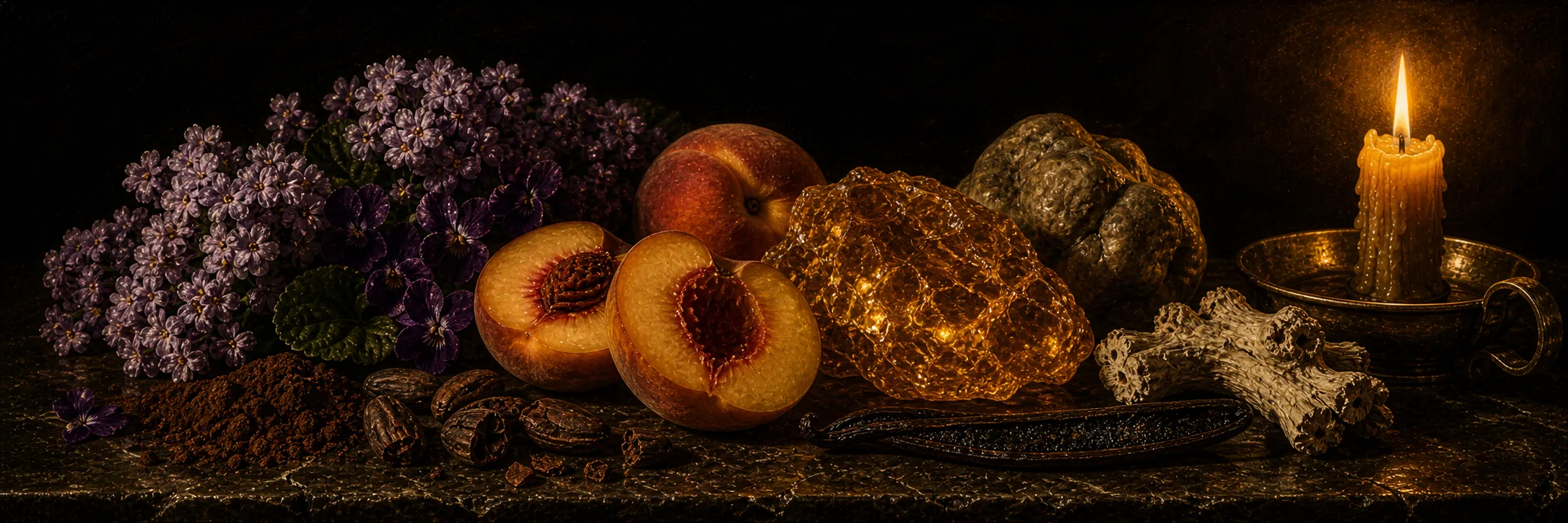
The opening is a citrus medley with a vintage-floral pedigree: cedrat, tangerine, mandarin, and bergamot together, Roja’s signature expensive citric sparkle but slightly more powdered and less aggressive than the brand’s other openings. Within ten to fifteen minutes the citrus thins and the heart blooms. Heliotrope declares itself first - almondy, powdered, almost cherry-pit - followed by champaca with its tropical-magnolia and tea-like dryness, a restrained velvety peach (a Roja house signature), powdery violet, and a floor of rose de Mai and jasmine. A flicker of cassia adds cinnamon-stick warmth. The heart, roughly one to three hours in, is the most Guerlain-adjacent phase, the place where Britannia smells very familiar - echoing, at different moments, everything from vintage L’Origan and L’Heure Bleue to a modern gourmand floral-oriental. Heliotrope and violet dominate, braided into the signature accord, and cocoa enters subtly here: never quite chocolate, more a dry, slightly bitter cocoa-powder facet that gives the bouquet unexpected depth. That powdered heliotrope-violet over cocoa-cinnamon-clove is what sets Britannia apart from its Imperial Scents siblings - Diaghilev being more chypre, Nuwa more aldehydic-floral-spice. The drydown, from about three hours on, is where Britannia becomes a modern gourmand-amber. The vanilla turns to pure creme brulee and becomes one of the two leading elements; a caramel-scented mixed-amber accord of ambergris, labdanum, and benzoin is the other. Vanilla, cocoa, orris, ambergris, sandalwood, patchouli, and musk lock into a long creamy-amber chord that shares territory with Roja’s own Amber Extrait and the Profumi d’Amore line. The transition from vintage-floriental in the first ninety minutes to modern gourmand-amber after two hours is one of the most pronounced in the Roja catalog - Britannia is essentially two compositions in one.
Performance
Projection is moderate; the fragrance is much stronger on longevity than on projection. Sillage runs arms-length to room-filling in the first two to three hours and turns intimate after that. Longevity is strong - eight to twelve hours on skin and fourteen-plus on clothing. It behaves well in cool weather, while high humidity can flatten the floral bouquet into something cloying. Two to three sprays are plenty: the parfum is dense and the gourmand-amber base blooms on its own. Notably, it is one of the lighter-textured Roja parfums - more airy than the house norm, which makes it a relatively forgiving wear for anyone who finds other Rojas overwhelming.
Wearing Context
Britannia is at its best in autumn and winter; the cocoa-vanilla-amber drydown is built for cool weather, and the floral opening tolerates cold far better than heat. It leans afternoon to evening and shines at formal evening events, cool-weather social occasions, and any “smell expensive” context where vintage-leaning elegance is the goal. It falls flat in athletic or casual daywear, in summer humidity, and anywhere high projection is the point. Socially it reads refined, mature, and expensive - though its restraint can register as dullness to some wearers. It is technically unisex but skews feminine in social perception, thanks to the heliotrope-violet-peach heart.
Comparisons & DNA
The most-cited comparison is Guerlain’s Guet-Apens / Attrape-Coeur, which enthusiasts return to repeatedly, sometimes calling it almost identical; the likeness is overstated but points to shared vintage-floriental DNA. The deeper historical antecedents are vintage L’Heure Bleue and L’Origan. Within Roja, the siblings are Diaghilev (more chypre and austere) and Nuwa (a bigger floral-aldehyde-spice statement) from the same Imperial Scents trio, plus Ti Amo and Amore Mio from the Profumi d’Amore line and Amber Extrait, all of which overlap in the gourmand-amber drydown - to the point that one critic suspected the same Robertet nose behind them. Roja Haute Luxe shares thematic territory at higher concentration, and 51 Pour Femme and Enigma Pour Femme are lighter feminine-floral cousins. Some reviewers also reach for vintage masculines like Chanel Pour Monsieur and Givenchy Gentleman for that “lightly scented powder base with strength.” No clone has emerged; the price and exclusivity have kept Britannia out of the clone-able zone. Its lineage is best understood as a deliberate vintage-floriental homage filtered through modern gourmand-amber sensibilities.
Reception
Reception has been admiring but pointed. A 2016 review in Bloomberg gave it a meaningful mainstream endorsement, describing it as “not for the faint of heart, or the light in pocketbook” and quoting Roja’s line, “No one will smell one of my scents and say, ‘It’s quite nice.’ I don’t make anything banal.” The critic Kafkaesque wrote the most thorough analysis, broadly positive with reservations - liking Britannia more than any new Roja release tried in the previous couple of years, while ultimately judging it not worth its four-figure price. Among enthusiasts it has a passionate small fan base that praises the silky, powdery, luxurious texture and the cocoa-amber drydown, while critical voices flag the perceived Guerlain echo as derivative; opinion is polarized chiefly on whether the price is justified. The practical consensus is to sample before committing, given the cost.
Versions & Reformulation
A single composition in parfum (extrait) concentration. The 50ml size appears to have been discontinued, with current availability centered on 100ml; some records list the fragrance as apparently discontinued, though it remains available through Roja’s own channels and major stockists. A separate Britannia Jubilee Limited Edition was released as a Queen’s Jubilee tie-in - the same composition in different presentation. No reformulation of consequence has been publicly announced.
Acquisition Notes
This is an ultra-luxury release. The 100ml parfum runs roughly $1,050 to $1,150 at official channels and authorized retailers; the 50ml, when available, is around $700 to $765. The most cost-efficient way to evaluate it is a decant, with 5 to 9ml samples widely available. Buy from Roja London and authorized luxury retailers such as Harrods, Selfridges, Bergdorf Goodman, Neiman Marcus, and Twisted Lily.
Notable Facts & Lore
- Roja’s stated intent for Britannia was “regal opulent luxury - I wanted to create a very self-assured scent; something that feels familiar yet also unexpected.” It is the third entry in the Imperial Scents collection, his tribute to civilizational icons: Diaghilev for Russia, Nuwa for China, and Britannia for the British Isles.
- The name nods to Britannia herself, the personification of the British nation depicted as a goddess on Roman coins, and the fragrance is positioned as a portrait of British creativity - fitting, given that Roja was appointed Creative Ambassador for the GREAT Britain Campaign in 2013, which he has called one of the proudest moments of his life.
- It should not be confused with Great Britain (2015), an earlier leather-chypre by Roja with a similar name and shared campaign inspiration.
- There has been no viral influencer moment for Britannia; it remains a connoisseur’s pick, consistent with its ultra-luxury price and limited distribution.