Roja Dove — Pierre de Velay No. 56
Essence
Pierre de Velay No. 56 (2017) is a Roja Dove Haute Parfumerie exclusive - a maximalist neo-classical chypre with oud that blends the bones of a 1970s-style grand chypre (think Gucci pour Homme 1976 or Patou Lasso) with modern Middle Eastern oud-saffron-leather. It is one of Roja’s most critically respected creations precisely because it chases no trends; it is the kind of densely blended, materials-forward composition his reputation was built on. Within the Pierre de Velay sub-collection of formulas Roja claims to have recreated from a discovered French perfumer’s notebook, No. 56 is the chypre-leather entry.
Scent Profile
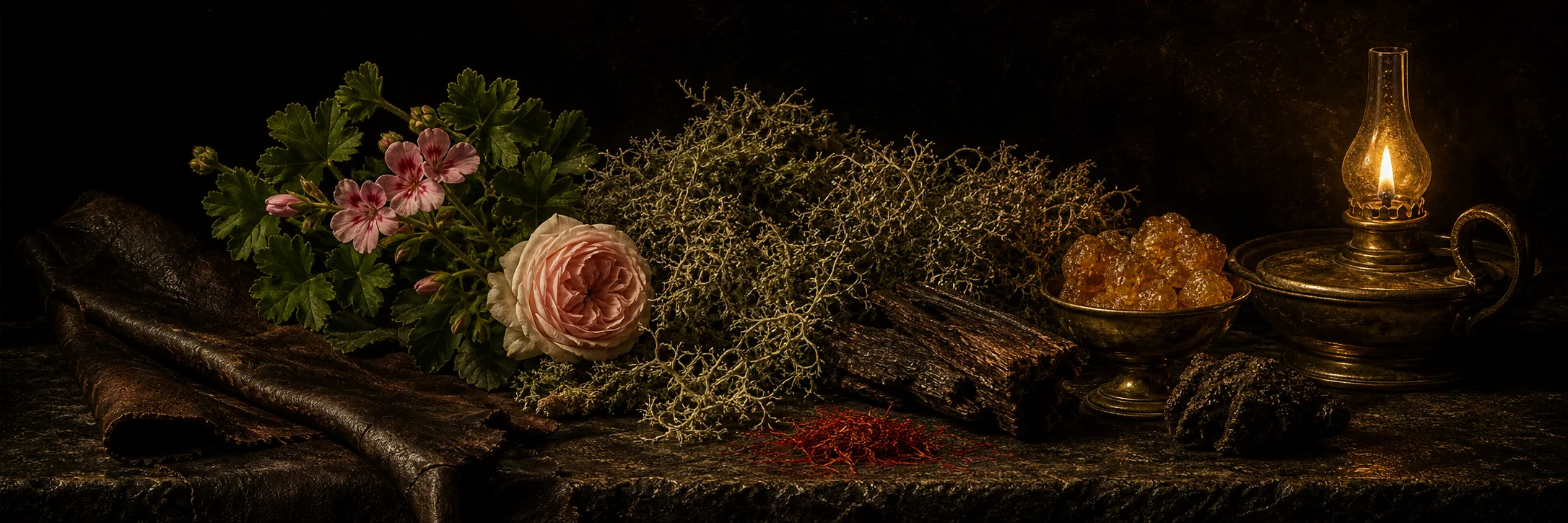
The first ten minutes are an aromatic-citrus burst - bergamot and lemon lifted with a sparkly, lemongrass-like litsea cubeba edge, lavender providing the herbal-clean spine. It reads “barbershop classical,” with a familiar fougere-chypre echo from the lavender-bergamot-spice trifecta, and within minutes peppery spices push forward, black pepper and a faintly cuminic warmth lending an animalic, body-warm quality. By thirty minutes the heart blooms. Geranium is the most identifiable floral - leafy, rosy, slightly minty - and leads the middle stage, with May rose adding depth without sweetness and ylang a creamy floral roundness; violet is barely perceptible but contributes a powdery softness. Cinnamon and nutmeg surface subtly, as warm seasoning rather than a loud spice accord, and saffron begins to appear as a leathery, hay-like, slightly sweaty note whose iodine-leather character is what bridges the floral heart to the base. From three hours on, the chypre-oud base reveals itself fully. The oakmoss is real and present - earthy, slightly bitter, structurally classical, if restrained compared to vintage chypres - over dark, earthy patchouli, with the oud in a sweetened Western style that adds depth rather than any barnyard smear. Leather and labdanum interlock into an ambered, slightly smoky leatheriness, cashmere wood and sandalwood add creaminess, and opoponax, benzoin, and orris weave a resinous-powdery underpinning, with vanilla as the softening agent at the very bottom. The signature is the geranium-saffron-oakmoss-oud crossfade - a chypre-leather-oud composite few contemporary perfumers attempt at this depth - and the composition genuinely evolves across the wear.
Performance
Projection is moderate for the first two hours, about arm’s length, then sits close to the skin from hour three. Sillage is restrained but persistent - this is a fragrance you wear for yourself and those near you rather than as a statement. Longevity is solid for a parfum, eight to ten hours on skin and twelve or more on clothing. Heat amplifies the saffron-leather warmth and can push the cumin-pepper edge more animalic, while cold smooths everything into a powdery-resinous skin scent. Three to five sprays is right; this is a dense composition, and overspraying makes the spices feel suffocating. Pulse points and hair hold it well, and clothing re-emits the woody-leathery facets for days.
Wearing Context
Fall, winter, and cool spring are its natural home. It is an evening or special-occasion fragrance - dinners, formal events, indoor gatherings, cold-weather dates - and although unisex, it leans masculine-classical in execution, reading like a refined gentleman’s chypre with a feminine softening. Daytime works in cool weather and indoor settings, but it falls flat in heat or humidity (where the spices turn cloying) and in casual or sporty contexts. Its price and exclusivity also bias it toward special-occasion wear. The social read is expensive, classical, mature, and connoisseur - very few people will recognize what you are wearing, but those who do will respect it.
Comparisons & DNA
Wearers place No. 56 squarely in the lineage of grand classical chypres like Gucci pour Homme (1976) and Jean Patou Lasso, modernized with a Middle Eastern oud-saffron-leather palette - as one put it, “all of those fully symphonic grand chypres, with oud, saffron and cashmere added to make it his own.” Within Roja’s own catalog, the closest sibling is the more jasmine-forward Pierre de Velay No. 11, with a family resemblance to Diaghilev (though that masterwork is more fruity-peach-mossy). Across other houses, comparators include Amouage Jubilation XXV Man (a similarly dense oud-spice chypre), Frederic Malle Portrait of a Lady (rosier, but a shared rose-patchouli-oud structure), Tom Ford Noir de Noir, and vintage Aramis as the original masculine-chypre archetype. Against pure ouds, No. 56 is far more floral and chypre-structured, with the oud supporting rather than headlining. No notable clone targets it - the exclusivity and the complexity of the formula make it a poor target.
Reception
Wearer feedback is small in volume but uniformly positive: wearers call it underrated, transcendent, and one of Roja’s very best, praising the lavender-spice opening and the smooth, well-balanced drydown. Launch coverage was favorable, with the main friction being the dramatic price jump - the original Pierre de Velay fragrances had been far cheaper before the 2017 relaunch raised the whole collection. Dedicated critical coverage of No. 56 specifically is essentially absent, with discussion confined to wearer reports and a few video reviewers, including Sebastian Jara on parts of the collection. The recurring praise is for the seamless blending, the unusual chypre-oud-saffron-leather structure, and the longevity; the recurring criticism is the price and the limited availability. A blind buy is not advisable - sample first through the Pierre de Velay Discovery set, then commit.
Versions & Reformulation
This is a single composition with no concentration variants, available only as 100ml Parfum. The Pierre de Velay sub-collection comprises many numbered formulas plus a handful of named additions; these are distinct compositions, not flankers of one another, and a small number of earlier “Extrait” versions predate the 2017 relaunch. There is no documented reformulation of No. 56 since launch.
Acquisition Notes
This sits in the ultra-luxury niche tier, around 495 GBP for 100ml Parfum, available exclusively through the Roja Dove Haute Parfumerie and by direct order from Roja’s perfumery, which ships internationally. The decant ecosystem is thin but exists, and the Discovery sets are the lowest-risk way to sample. For a guaranteed authentic bottle, order direct from the Haute Parfumerie.
Notable Facts & Lore
- The collection’s origin, in Roja’s own words: “In a market in the South of France, I discovered a little book of perfume formulae inscribed with the name, Pierre de Velay.
- I used them as the inspiration for a collection that is now coveted amongst fragrance lovers all over the world.”
- The expanded story holds that he could find nothing about the mysterious formulator, translated the text, and discovered that among many simple formulas a few were genuinely complex and elegant.
- The brand narrative positions Pierre de Velay as a forgotten French perfumer who likely worked in the late 1920s or 1930s, since the formulas center on aldehydic styles that emerged after Chanel No.
- 5 in 1921, and “Velay” is a real town in the south of France near Grasse, lending the tale geographical plausibility.
- The historical existence of the perfumer has never been independently verified, and most enthusiasts treat the story as romantic framing rather than provable history - a creative archive of “lost classical styles” as much as a literal recreation.
- The 2017 relaunch more than doubled the collection’s price, drawing some wearer criticism and cementing Pierre de Velay as the Haute Parfumerie’s most exclusive product. No celebrity associations or viral moments attach to No.