Roja Dove — Espresso Aoud
Essence
Espresso Aoud is the March 2026 addition to Roja Dove’s Aoud Collection, a heavily gourmand take on agarwood built around a photorealistic roasted-espresso accord, caramelised nuts, pistachio and a creamy milk-coconut underlay, all anchored by oud, leather, birch and the full Roja amber-woody base. Dove himself is credited as the perfumer, a notable choice given that several recent house releases have been credited to a younger in-house perfumer. The composition is genuinely original within the line, since there has not been a true coffee-oud from Roja before, and it has arrived to one of the most divided receptions of any recent Aoud Collection release.
Scent Profile
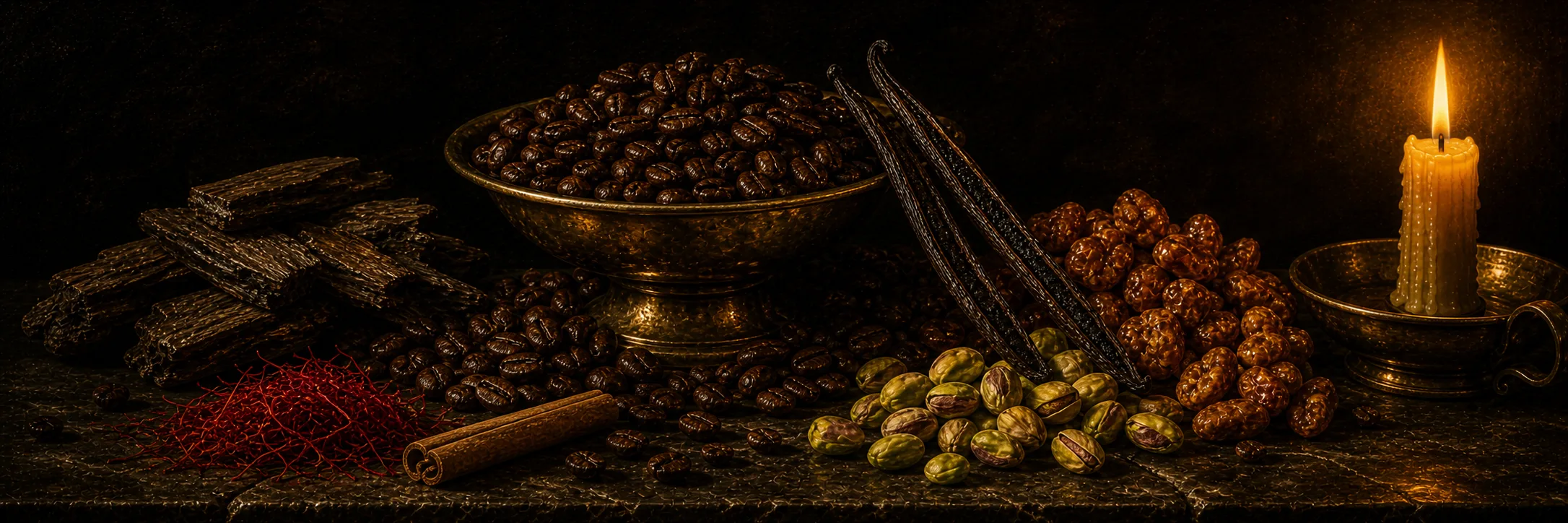
The opening is genuinely shocking on the first spray. One detailed account called it the most eye-poppingly intense thing the reviewer had encountered in years: the espresso accord is about as photorealistic a coffee note as you will find, like fire-roasted Italian beans being ground, but it stays pure only fleetingly before a very heavy leather and an equally heavy, quite raw oud crash in behind it, softened only a little by a soothing musk. Within seconds the orange blossom, rose and violet up top are swallowed into the coffee-leather-oud collision, while saffron and cinnamon add heat that reads as support rather than as distinct spice. Through the first hour the initial caffeine-rush quality settles, as one wearer put it, taking a few minutes to calm down and let your clattering heart rate return to baseline. The heart then brings the caramelised nuts and pistachio forward, with milk and coconut creating the creamy, velvety texture the brand describes, and tonka, vanilla and benzoin adding gourmand sweetness. The dry woods, cypriol, cedar and sandalwood stabilize the base, birch and leather supply a smoky-tarry depth, and cashmeran lends a sweet-spicy radiant fuzz that one critic identifies as the dominant modern, designer-style facet of the composition. The signature accord is bitter-roasted espresso over caramelised pistachio and creamy milk, with oud, leather and burned woods forming the structural floor. It is genuinely two-layered: it smells profoundly different up close than it does in its trail, the close reading heavy with coffee, leather and oud, the sillage softer, sweeter and creamier. By the three-to-four-hour mark the layers homogenize into something very beautiful, the dark-roast bitterness softening into a long, dry, faintly smoky woody-amber drydown where the oud and burned-bean facets linger. This is a fragrance that moves through dramatic phases, from raw espresso-oud opening to creamy nutty heart to smoky woody drydown, while holding a consistent character throughout. It is not for skim-readers, and the opening alienates some wearers who never give it the three hours it needs.
Performance
Projection is strong for the first three hours, well above the average for the Aoud Collection, then drops to moderate for several more before becoming a skin scent. The trail is genuinely powerful in the opening and polite in the drydown. Longevity runs eight to twelve hours on skin and considerably longer on clothing, where the smoky-woody base persists. Heat amplifies the bitter roast and the leather, which makes hot weather a problem, while cool, dry conditions are ideal and a little humidity flatters the creamy heart. One or two sprays is plenty; the opening is already saturated, so more spray only extends the difficult first half hour.
Wearing Context
This is a cold-weather evening composition. The roasted-coffee-leather-oud profile is too heavy for daytime in most settings and entirely wrong for warm weather. It shines at dinner, cocktail evenings, cold-weather socializing, the opera or theatre, or a long flight up front. It falls flat in offices, where it is too aggressive, in summer, where the bitter roast turns acrid, and anywhere you need to read as approachable in the first half hour, since the opening is confrontational. The social read skews mature, and one reviewer flags it outright as not for beginners, the faint of heart, or anyone sensitive to caffeine. It is unisex by composition, though in practice it leans slightly masculine through the leather-oud-burned-wood register, and confident wearers of any gender can carry it.
Comparisons & DNA
The most-cited reference is Creed Oud Zarian for the sheer intensity of the opening, though Espresso Aoud is sweeter and more gourmand. Frederic Malle Promise comes up for the woody-smoky drydown, and Roja’s own Amber Aoud shares the jammy, dark-rose facet that surfaces in the heart. One critic reaches for Caron Aimez-Moi Comme Je Suis for a similar designer feel with a gourmand-hazelnut character, and the same critic frames the base as functionally close to a cluster of amberwoody niche references, a pointed argument that the coffee framing is partly marketing and the underlying composition sits in the broader amberwoody genre. What is conspicuously absent from the comparisons is the existing coffee-oud category itself, names like Mancera Aoud Cafe, By Kilian Black Phantom, Mancera Coffee Tobacco or Montale Intense Cafe. That absence is telling: wearers reach for raw-oud powerhouses and amberwoody niches rather than coffee fragrances, which suggests Espresso Aoud reads more as a Roja amberwoody with a coffee top than as a true entry in the coffee-fragrance genre. It is also too new for any budget clone to have surfaced.
Reception
Reception is sharply divided. Admirers call it among the most accomplished and most expensive displays of Dove’s mastery of blending, praising the photorealistic coffee note, the longevity, and the unusual two-layer effect where the trail and the skin reading diverge. The skeptics, led by one prominent critic, situate it within a perceived decline at the house in recent years, treat it as essentially an amberwoody designer-style base with a gourmand-coffee top, and conclude that neither the notes nor their structure justify the price. Harsher takes range from comparisons to mass-market body sprays to outright dismissal. The praise tends to land on the coffee accord’s realism, the blending, the projection, and the sillage-versus-skin contrast; the criticism on the price, a sense that the house has slipped, the feeling that the coffee framing is marketing, and the difficulty of the opening. Running underneath all of it is a wearer debate about authorship: the house has brought on a younger working perfumer credited on several recent releases, and the choice to credit this flagship to Dove personally is read by some as an effort to anchor a major 2026 release to his own reputation. Whether that reading is accurate or projection is unclear, and no on-record statement settles it. As a blind buy it is high-risk: the opening is confrontational and the price sits at the top of the collection, so it is best to sample first, ideally a small decant that gives you several wearings to evaluate the long drydown. No major critic has published a dedicated review at the time of writing.
Versions & Reformulation
A single composition in a single parfum concentration, offered in 50ml and 100ml from launch. No reformulations are possible yet given the 2026 release date.
Acquisition Notes
This sits at the ultra-luxury end of the Roja line. In the US it runs around $430 for 50ml and $810 for 100ml, in line with the rest of the Aoud Collection. Decants began appearing at launch, which is the sensible way to test something this demanding before committing.
Notable Facts & Lore
- The brand frames Espresso Aoud as a shot of energy within the Aoud Collection, explicitly part of Dove’s long-running mission to position the house as the Western authority on agarwood.
- House copy leans on his recurring line that oud is notoriously difficult to master, and that his greatest compliment is when Middle Eastern clients ask how he knows their smell.
- It is the second gourmand-leaning entry to the collection, after Sweetie Aoud, and the first true coffee composition from the house.
- As of the launch window, no first-person interview with Dove about this fragrance specifically had been published; all statements of intent come from the brand’s press materials, and the most prominent additional coverage was a sponsored advertorial that does not contain a first-person quote about the scent.
- The authorship context is a meaningful part of the fragrance’s story.
- The house recently brought on a young perfumer, trained in Paris and through industry internships, and has credited him on multiple releases while framing his role as expressing the house’s contemporary vision under Dove’s guidance.
- A vocal segment of the wearer response has read this as Dove preparing to step back, and has interpreted the rebrand from “Roja Dove Parfums” to “Roja London” as groundwork for an eventual sale. Against that backdrop, crediting Espresso Aoud to Dove personally and launching it on the collection’s heritage line is read by some as the house re-anchoring a flagship to his name. There is no celebrity tie-in or viral moment for it yet, though a few personalities have shared early impressions on social media.