Roja Dove — NüWa
Essence
NuWa is the most dramatic case of two perfumes under one name in the entire Roja Dove catalogue. The original 2014 release was a blackened, masculine twist on vintage Rochas Femme - a cumin-bomb, leather-and-clove dirty animalic chypre-oriental released in the prestige Imperial Collection alongside Diaghilev. By the end of that same year Roja had reformulated it into something lighter, sweeter and more rose-and-orange-blossom, a fundamentally different perfume kept under the same name. The original is the cult version; the later reformulation, catalogued separately, is the one most current buyers actually encounter. The fragrance is named for NuWa, the Chinese creator goddess of legend.
Scent Profile
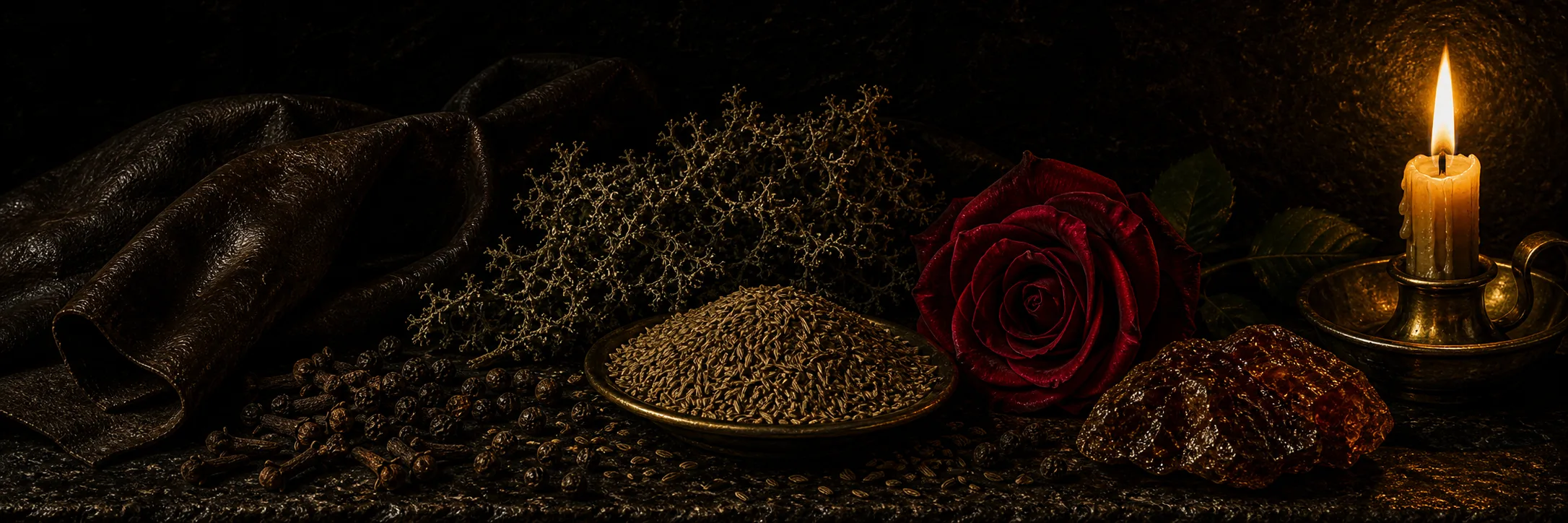
This describes the original 2014 composition. The opening is short - a brief flash of bergamot and lemon swallowed almost immediately by the heart. Within five minutes a floral-spicy potpourri surfaces: rich ylang-ylang, dark rose and restrained jasmine, with osmanthus and immortelle lending a spicy, faintly maple-syrup inflection, blackcurrant buds adding a sharp green-fruity undertone and a quiet oleander whisper in the background. From fifteen minutes to two hours the cumin-and-clove assault begins, and it is genuinely an assault. The critic Kafkaesque described a veritable tsunami of cumin and cloves, never having experienced so much cumin in a fragrance - a dense, brown-black block of masculine, dirty labdanum amber stuffed with the world’s largest dose of cloves and cumin, then rolled through a tar pit and set alight. The cumin is the defining note and heroic in dose; clove and black pepper add further spice density; smoky birch-tar leather lays down an animalic chypre floor, while labdanum, styrax, oakmoss, vetiver and patchouli build a dark, resinous, very vintage-chypre base. From two hours on it softens slightly into a still very dense floriental chypre, the leather and labdanum dominant and the cumin still detectable. The signature accord is cumin and clove over dirty smoked labdanum-leather-oakmoss - an outright Femme-on-steroids structure. Evolution is moderate across three phases, but the cumin character defines the whole wear. Critic Mark Behnke framed it as a chypre in all caps followed by exclamation points, perfumery unafraid to push limits and pay homage to the past while challenging the wearer, identifying a heart where rose holds the middle while pungent blackcurrant bud and maple-syrup immortelle pierce it like twin blades.
Performance
The original 2014 NuWa performed strongly - eight to twelve hours on skin, substantial projection in the first couple of hours, a dense scent bubble. Wearers called it a monster, owing partly to cumin’s persistence and partly to the extrait concentration. It is best in cold weather, where the cumin and clove can stretch out; in summer heat many wearers found it read as sweaty body, even almost unbearable, depending on how cumin interacted with their skin. The application strategy is very conservative - one to two sprays at most. This is a fragrance that rewards restraint.
Wearing Context
Cold weather, evening, very specific occasions. The original NuWa was famously unfit for the office, casual or daytime wear; its cumin-and-leather density read as too much almost everywhere except a dim formal dinner or a self-confident solo wear. Reviewers reached for images like a Hell’s Angel or a fallen angel in Russian leather. Where it shines is a cold winter evening with no audience, or a willing one; its cultural perception is unisex but heavily masculine-coded thanks to the cumin and leather. Where it falls flat is anywhere with social stakes attached to smelling clean.
Comparisons & DNA
The closest comparison for the original 2014 NuWa is vintage Rochas Femme in its post-1989 form, when cumin was added as a civet substitute. Kafkaesque framed NuWa explicitly as a concentrated version of that Femme with its cumin magnified, the whole injected with smoky birch-tar leather and reduced to the densest syrup imaginable. Caron Poivre, Puredistance M, Amouage Jubilation 25 and Guerlain Mitsouko sit in the broader fruity-spicy chypre lineage, while Roja’s own Diaghilev is the sister Imperial Collection release sharing the Femme and Mitsouko DNA but without the cumin and leather. Molyneux Fete is cited as a classic early use of cumin in perfumery and a cheaper alternative, and Etro Messe de Minuit and Serge Lutens Daim Blond approach related territory more sparingly. Within Roja, Diaghilev is the closest sibling, while Amber Aoud and Musk Aoud share the dense blending style in different families. The later reformulation, though it carries the same name, is a fundamentally different fragrance and not a meaningful comparison. For a cheaper substitute, vintage post-1989 Femme, before its own later reformulation, is the closest and is broadly available secondhand at a fraction of the price. NuWa was Roja’s most aggressive deployment of cumin and part of his broader vintage-chypre revival alongside Diaghilev; too divisive to inspire imitators, it nonetheless proved he would release commercially difficult perfumes when his artistic intent demanded it.
Reception
The original 2014 NuWa was deeply divisive. Admirers, including a small subset of cumin-and-leather enthusiasts, called it a masterpiece, while detractors found it suffocating, sweaty and almost unbearable - one representative dismissal likened it to a suffocating stench of sweaty men in a concentration of almonds. The polarisation was severe enough that Roja reformulated it within a year. Behnke’s verdict was that NuWa was everything that makes him love fragrance all over again; Kafkaesque’s was that it was the kind of gorgeous that had her sniffing her own arm every time she wore it - though both acknowledged the cumin would alienate most buyers. The consensus is that the original was more interesting and more polarising than the reformulation, which is broadly liked but considered safer and less distinctive. On the original, the honest verdict is no for a blind buy, and it is increasingly impossible to find anyway; decants trade at a premium among chypre collectors.
Versions & Reformulation
This entry covers the original 2014 NuWa from the Imperial Collection; the later reformulation is catalogued separately. The original was released as a 100ml pure parfum, and later in 50ml. There appears to have been no separate decolorised variant, unlike the Aoud Collection fragrances. By early 2015 the original was, per Kafkaesque, still available by request from Roja but unlikely to be carried by most retailers. The later reformulation is a different fragrance at a different concentration tier, with significantly fewer notes and a completely different character - as enthusiasts put it, the original was not reformulated so much as replaced by a different perfume given the same name. The line has since been extended further with a more recent Eau de Parfum.
Acquisition Notes
For the original 2014, this is ultra-luxury and increasingly unobtainable, effectively discontinued by late 2014 and available only occasionally on the secondary market at a premium. A thin but real decant market exists. One practical caution worth knowing: most bottles labelled simply NuWa on the secondary market are the later reformulation, a completely different fragrance - the original is the deep amber-brown juice in the Imperial Collection presentation.
Notable Facts & Lore
- Roja Dove’s stated intent is on record: inspired by the legend of NuWa, the gentle and kindly Chinese goddess said to have created woman and man, taught her people to be creative and wise, and filled the field flowers with fragrance - a tender liquid narrative to seduce the soul.
- The disconnect between that gentle-goddess inspiration and the actual cumin-leather-tar result became one of the defining ironies of the original release, with Kafkaesque memorably recasting NuWa not as a gentle goddess but as a fallen angel in blackened Russian leather.
- The reformulation itself is genuine lore: Roja is one of very few prestige perfumers to have publicly replaced a fragrance with a different composition under the same name within a year of release.
- Wearer accounts suggest the change was partly market-driven, cumin being famously divisive, and partly because the original was felt to offend some clients given the fragrance’s role representing China in the Imperial Collection.
- Whether that account is fully accurate or a later rationalisation, the reformulation is documented and material.
- NuWa’s place in the catalogue has shifted over time, from the Imperial Collection at launch into the broader collection since, with the original 2014 remaining the cult acquisition, the reformulation the daily wearable, and the recent Eau de Parfum the casual entry point.