Roja Dove — Elysium Pour Homme Parfum Cologne
Essence
Elysium Pour Homme Parfum Cologne is Roja Dove’s 2017 reinterpretation of the modern fresh-fruity-aromatic masculine - a hyper-polished citrus-and-vetiver fougère sitting at the exact crossroads where Creed Aventus, Bleu de Chanel, and a great barbershop after-shave meet. Within the catalog it is the gateway, the bestseller, and the fragrance that carried the house from Harrods-counter connoisseur status into general enthusiast consciousness. What makes it distinctive is not a novel structure but its lacquered finish: very expensive raw materials applied to a deliberately mass-appealing skeleton. “Aventus done in linen and a tan” is the shorthand that stuck.
Scent Profile
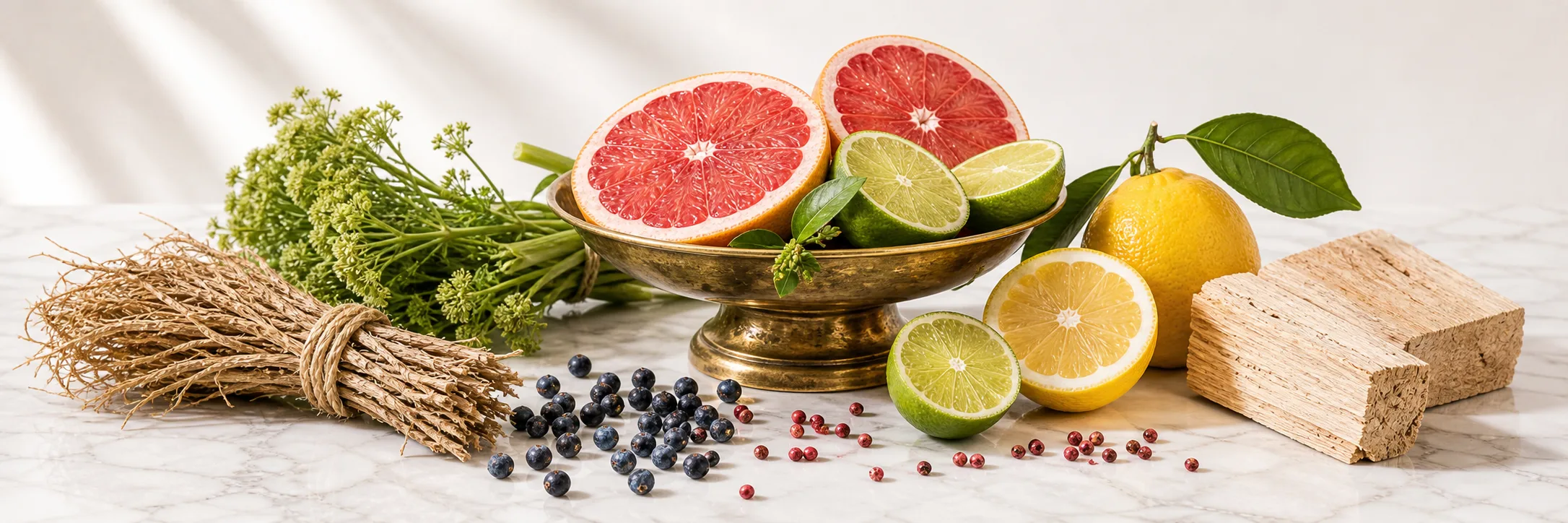
The first ten to twenty minutes are the entire reason this fragrance sells. The opening is an aggressive, almost effervescent citrus chord - grapefruit and lime carry it, lemon and bergamot fill the edges, and galbanum plus artemisia add a green, slightly bitter herbal bite that keeps it from reading as a fruit-juice cologne, with pink pepper sparkling on top. There is a recurring descriptor worth naming: a clean, slightly briny “blue shower-gel” or “fresh dill and cucumber” quality some noses pick up in the first half-hour, from the interplay of galbanum, juniper berry, and aldehydic citrus lift. The blackcurrant-apple pairing is real but submerged, reading as a glistening tartness beneath the citrus rather than as fruit. Crucially, there is no pineapple despite the Aventus comparisons - the “champagne and pineapple” tag refers to the sparkling effervescence, not any literal tropical note. Between roughly one and three hours the fragrance settles into its true center, which is not floral despite the listed lily-of-the-valley, jasmine, and rose. Those florals work as connective tissue, smoothing edges rather than reading as distinct flowers. What is perceptible is vetiver - clean, slightly rooty, very polished - supported by cedar and the dry mineral hum of cypriol, with juniper carrying a faint gin-and-tonic dryness into the heart. The signature crystallizes here: sparkling citrus over clean vetiver and pale woods, with an ambergris-musk gauze keeping it luminous rather than dense. Beyond three hours the drydown is where this version diverges from the original extrait. Leather is whispered rather than spoken; ambergris, benzoin, and labdanum produce a soft, faintly creamy warm-skin effect; vanilla is barely perceptible and never gourmand. Many wearers note a “burnt vetiver” or earthy-hay character in this phase that polarizes opinion. Development is moderate - not strictly linear, but trending citrus to citrus-with-vetiver to vetiver-with-amber-musk, with no dramatic shifts. The luminous citrus, clean vetiver, and ambergris-soft musk are what people pay for and remember.
Performance
Performance is the central controversy. Projection is moderate for the first sixty to ninety minutes - roughly an arm’s length, occasionally a small room in still air - then collapses to a close, intimate radius of two to three feet, and after the fourth hour it is largely a skin scent you have to hunt for. Sillage is short and polite throughout; this is not a fragrance that announces itself to a room. Longevity clusters around six to eight hours on skin with three to four sprays, with a credible range from about four hours on skeptics to ten on dry skin with generous application. On clothing - wool, linen, scarves - it stretches to a full day, with many reporting next-morning detection on fabric. Heat amplifies the citrus opening dramatically and speeds the burn-off; this is its native climate. In cold or dry winter air the top notes feel muted and the dryness of the vetiver-cypriol heart comes forward, while humid summer wear keeps the green-citrus buoyant far longer. The best strategy is to overspray onto clothing rather than skin - four to six sprays, at least two onto a collar or shirt placket - and reapplication around the four-hour mark is common, which is part of the value complaint. The straight Pure Parfum projects noticeably stronger and lasts roughly twice as long; the Parfum Cologne is, by deliberate design, the lighter sibling.
Wearing Context
Spring and summer daytime are the sweet spot - office, brunch, weddings, daytime outdoor events, and resort settings are all native habitat. It performs well in business-formal and smart-casual contexts because the citrus reads as groomed and the drydown is quietly luxurious rather than sexual. As an evening scent it underperforms, lacking the density and warmth to register at dinner-table distance in cool air. It is forgiving across age range, working on a twenty-five-year-old and a sixty-year-old without smelling like either. Mass appeal is its core trait: colleagues and companions alike code it as “expensive clean” rather than “perfume,” which is precisely the effect most buyers want - though skeptics increasingly flag it as a status-signal scent. It falls flat in two specific contexts: cold-weather wear, where it never quite blooms, and any setting where you actually want to be smelled across the room. Wear it when you want the people next to you in a meeting, a car, or a hug to think you smell incredible - not when you want to leave a trail down a hallway.
Comparisons & DNA
The unavoidable comparison is Creed Aventus. Elysium is brighter, drier, and more citrus-forward; Aventus is smokier, with pineapple-birch and a more obvious leather-ash signature, and Elysium has no pineapple. Aventus is denser and louder; Elysium is more refined and considerably more expensive at retail. The “Roja Aventus” shorthand is half-correct - they share fruity-citrus-leathery DNA, but Elysium swaps pineapple and birch for vetiver and galbanum and trades projection for polish. Bleu de Chanel in its EDP and Parfum forms is the second comparison: Elysium is the higher-quality, less synthetic, more citrus-driven cousin, where Bleu de Chanel Parfum is warmer and more incense-amber and Elysium is cooler, greener, and sparkly on top. Parfums de Marly Percival and Sedley sit nearby - Sedley more aquatic-mint, Percival more soapy-aldehydic, Elysium fruitier than either. Maison Francis Kurkdjian Aqua Universalis shares the bright bergamot-citrus-clean-musk skeleton but is simpler, more linear, and lacks the vetiver-leather base - essentially the half-price summer-shirt version. Mancera Aoud Café is the inverse comparison occasionally raised: where Elysium goes citrus-vetiver-clean, Aoud Café goes coffee-oud-dark, though both share a sense of luxurious resinous finish. Dior Sauvage comes up only as shorthand for the genre, Tom Ford Costa Azzurra shares the Mediterranean-herbal mood but is rosemary-and-myrtle-led, drier and saltier, and Creed Green Irish Tweed is the older fougère ancestor, sharing the violet-leaf, vetiver, and clean-masculine bones in a 1985 vocabulary that Elysium translates for 2017 with louder citrus and ambroxan-style musks. Within the Roja line, Scandal Pour Homme is the sweeter, honey-citrus sibling, Enigma Pour Homme is the cognac-and-spice opposite, and Roja’s own Vetiver overlaps the Elysium drydown closely enough that some have reported difficulty telling them apart blind. Elysium is widely considered hard to clone well - enthusiasts openly say there is not a single decent clone. Among the budget cousins, Lattafa Confidential Platinum comes closest on the citrus-musk opening but falls apart in the heart, while the better attempts come from higher-tier inspired-by houses, with one frequently named as the highest-fidelity dupe. None reach the polish of the original; the gap is in the naturalness of the citruses and vetiver, which is exactly what the price pays for.
Reception
Consensus is split along a clean fault line: the scent quality is widely admired, but value and performance are the persistent complaints. Praise tends toward “the most realistic citrus opening on the market,” “smells expensive,” reliable compliments, exceptional blending, and “the archetypal modern blue.” Criticism clusters around poor projection, fleeting longevity for the price, being derivative of Aventus and Bleu de Chanel, and - increasingly in recent years - a backlash against the hype itself. One representative skeptic quipped that if you hid the bottle, they would ask if it was a new mall body-care scent; a representative defender countered that the people who hate it either sniffed it on a paper strip or are reacting to the price, not the smell. The polarization runs along three axes: price versus performance, where even fans concede the cost-per-hour math is brutal; originality, where critics call it a high-grade reinterpretation of existing freshies and defenders argue execution and naturalness are the point; and hype fatigue, with one prominent reviewer crystallizing the backlash as “overhyped, overpriced, basic.” Dedicated critic coverage is thinner than for older Roja launches, though critic Sebastian Jara ran a positive early-2018 feature framing it as the house’s modern compliment-getter, inspired by the Greek myth of the Elysian Fields, the final resting place of heroes the gods made immortal. Blind-buy verdict: no - sample first. Skin-chemistry variance is real, the price is punishing if you land in the two-hour-longevity camp, and the scent is well-mapped enough against competitors that you should know exactly what you are paying the premium for.
Versions & Reformulation
Elysium exists in a deliberate ladder within Roja’s concentration system: Cologne (lightest), then Parfum Cologne, then Pure Parfum, then Extrait. Roja essentially invented the “Parfum Cologne” designation as a category offering EDP-level concentration with the freshness profile of an eau de cologne; the house has not published a precise percentage. In wear, the differences are coherent. The original Pure Parfum - the dark-amber bottle - is denser, richer in the leather-amber base, projects roughly twice as strongly, and lasts ten to twelve hours. The Parfum Cologne covered here, in the dark cobalt-blue bottle, inverts the structure: citrus and vetiver run the show, the base is lighter and creamier, and performance drops to six to eight hours. A 2023 flanker, Eau Intense, adds rhubarb and lavender and pushes the vetiver harder as a distinct composition, while a 2024 Elysium Pour Femme and 2025 Elysium Noir extended the line into floral and darker leather territory respectively - Noir composed by Antoine Cotton rather than Roja Dove personally. No significant reformulations of the Parfum Cologne itself have been documented since launch.
Acquisition Notes
This sits in the ultra-luxury tier. The 100ml Parfum Cologne carries a retail price in the range of roughly $385 to $485, with 50ml running about half, and the Pure Parfum 100ml above $700. Given the polarizing performance, a small decant before committing to a full bottle is the sensible move.
Notable Facts & Lore
- The 2017 launch is significant in modern niche history less for the fragrance itself than for what it enabled: Elysium was the house’s first deliberate move toward a relatively accessible price point - under $400 at launch, against the $600 to $1,000-plus tags on most of the earlier catalog - and the commercial success of this Parfum Cologne format prompted the house to extend the same treatment to Vetiver, Enigma, Sandal, and Danger in 2019.
- The “Parfum Cologne” category is essentially a Roja invention, and Elysium is the test case that validated it.
- Within the line it now functions, commercially and reputationally, as what glory-days Aventus was for Creed.
- The fragrance was branded around the Greek-mythological Elysian Fields, the resting place of heroes, and Roja Dove’s own statements stay in the aspirational register: “a scent created for a man who needs no help in reaching his Elysium, his paradise.” There is no widely documented personal-biographical inspiration for this specific release; the often-retold Roja origin story attaches to the house philosophy generally, not to Elysium.
- The online fragrance wearer feedback is most of the reason it broke into mass-enthusiast awareness, with heavy influencer coverage from 2019 to 2022 and a further reach through short-form video in 2023 and 2024.
- Wearer reports captures the hype-versus-quality tension neatly: in one blind-test collaboration a prominent influencer reportedly did not recognize Elysium and was lukewarm, then revised upward once told the brand - an exchange cited whenever the “is it actually that good, or are we paying for the name” debate flares.
- The bottle itself - a heavy clear flacon with a deep cobalt-blue lacquer panel, gold lettering, and a weighted gold-tone cap - is a status object photographed on countless shelfies, and has done as much for the fragrance’s reputation as the juice. Among collectors, it is the Roja you buy first, often the Roja you regret most, and the Roja you almost never sell.